Peenemünde in Vorpommern-Greifswald, Mecklenburg-Western Pomerania, Germany — Central Europe
Fieseler Fi 103 “Cherry Stone” FZG 76
(full size replica with original parts, 1991)
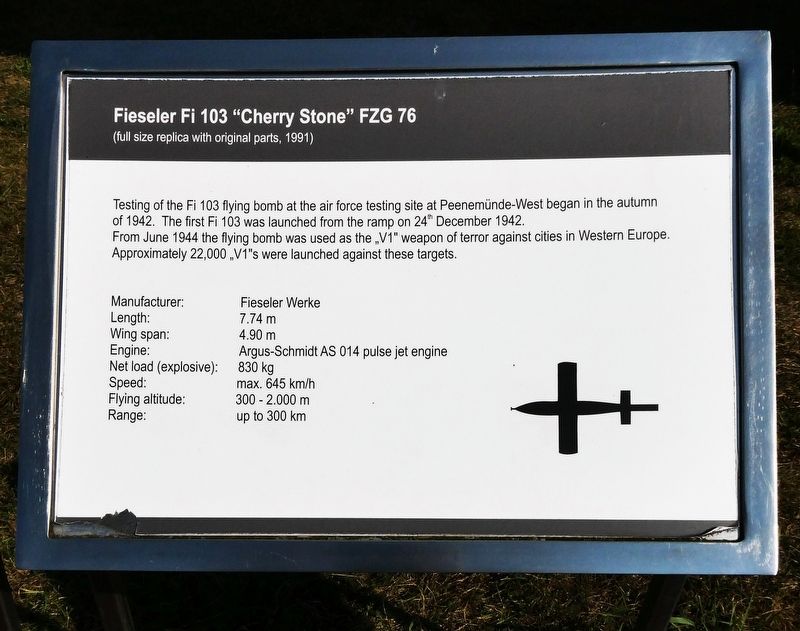
Photographed by Roger W. Sinnott, September 6, 2024
1. Fieseler Fi 103 “Cherry Stone” FZG 76 Marker
Testing of the Fi 103 flying bomb at the air force testing site at Peenemünde-West began in the autumn of 1942. The first Fi 103 was launched from the ramp on 24th December 1942.
From June 1944 the flying bomb was used as the “V1” weapon of terror against cities in Western Europe. Approximately 22,000 “V1”s were launched against these targets.
Manufacturer: Fiesler Werke
Length: 7.74 m
Wing span: 4.90 m
Engine: Argus-Schmidt AS 014 pulse jet engine
Net load (explosive): 830 kg
Speed: max. 645 km/h
Flying altitude: 300 - 2,000 m
Range: up to 300 km
Topics. This historical marker is listed in these topic lists: Air & Space • War, World II. A significant historical month for this entry is June 1944.
Location. 54° 8.332′ N, 13° 46.029′ E. Marker is in Peenemünde, Mecklenburg-Vorpommern (Mecklenburg-Western Pomerania), in Vorpommern-Greifswald. It can be reached from Fährstraße. Marker is part of a permanent outdoor exhibit on the grounds of the Historisch-Technisches Museum Peenemünde. Touch for map. Marker is in this post office area: Peenemünde MV 17449, Germany. Touch for directions.

Regionally, this marker
this page online
Other nearby markers. At least one other marker is within walking distance of this marker: Aggregat 4 (A4) Liquid Fuel Rocket (within shouting distance of this marker).
Regarding Fieseler Fi 103 “Cherry Stone” FZG 76. Almost half of the V1 missiles Germany produced in the Second World War were fired at England from launch sites in northern France, beginning in mid-June 1944 just a week after the Allied landing on D-day. Of these, 2,419 reached London without being shot down or malfunctioning. Londoners nicknamed the V1 the Buzz Bomb for the distinctive sound of its pulse-jet engine. They soon learned that they were safe so long as they heard that sound, but if it went quiet they should immediately seek cover because the V1 would be falling like a rock.
Also see . . . Wikipedia page on the V1 Flying Bomb. (Submitted on September 22, 2024, by Roger W. Sinnott of Norwell, Massachusetts.)
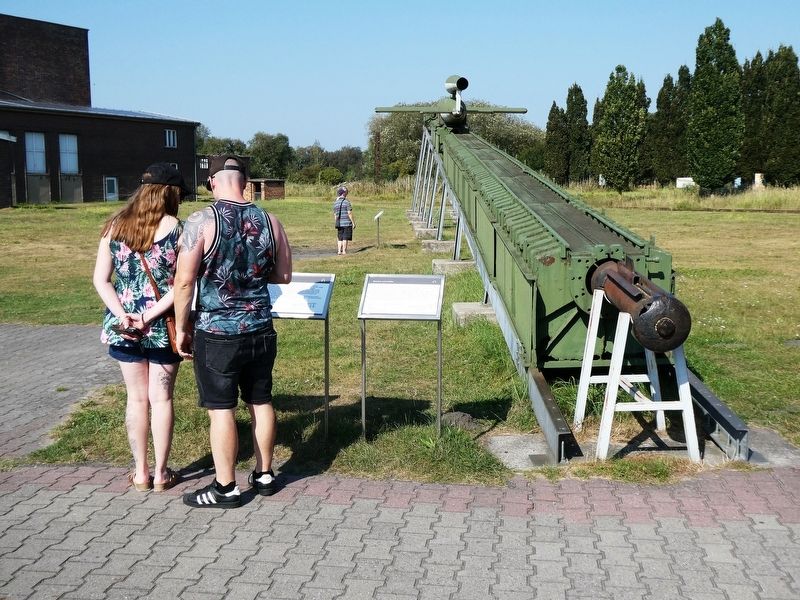
Photographed by Roger W. Sinnott, September 6, 2024
2. Ramp Used To Launch the V1
The catapult system involved a steam-driven piston that pushed the V1 up the entire 48-meter-long ramp, at which point the V1 was traveling 370 km/h and its pulse-jet engine could develop the necessary thrust for it to fly on its own.
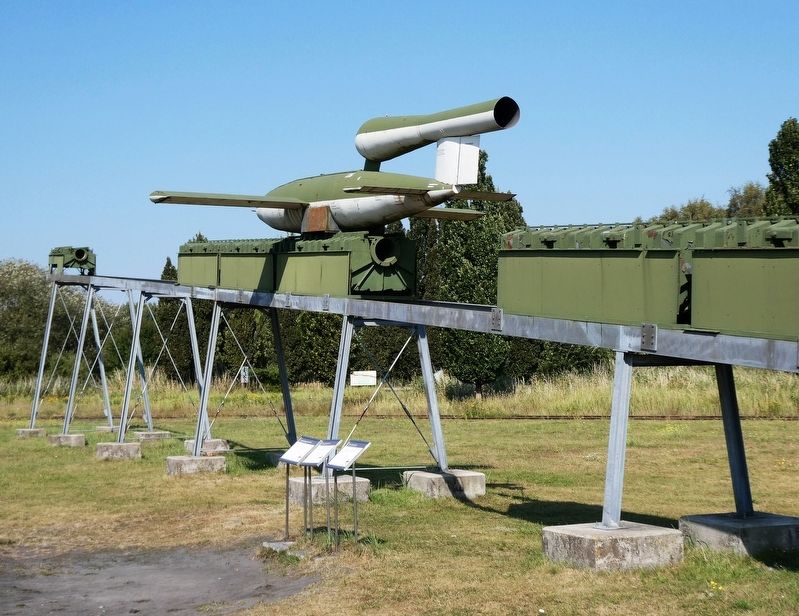
Photographed by Roger W. Sinnott, September 6, 2024
3. Side View of the V1 on the Ramp
Credits. This page was last revised on September 24, 2024. It was originally submitted on September 22, 2024, by Roger W. Sinnott of Norwell, Massachusetts. This page has been viewed 127 times since then and 7 times this year. Last updated on September 24, 2024, by Roger W. Sinnott of Norwell, Massachusetts. Photos: 1, 2, 3. submitted on September 22, 2024, by Roger W. Sinnott of Norwell, Massachusetts. • Devry Becker Jones was the editor who published this page.
