Quadrate in Mannheim, Baden-Württemberg, Germany — Central Europe
Palais Bretzenheim A 2, 1
⎯⎯⎯
Bretzenheim Palace A 2, 1
Photographed by James Hulse, February 20, 2024
1. Palais Bretzenheim A 2, 1 / Bretzenheim Palace A 2, 1 Marker

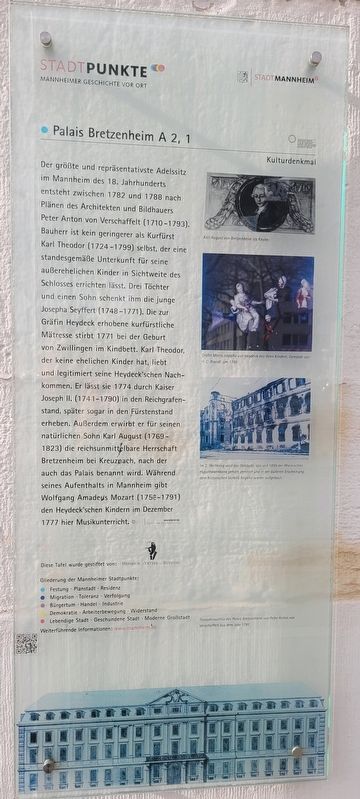
Der größte und repräsentativste Adelssitz im Mannheim des 18. Jahrhunderts entsteht zwischen 1782 und 1788 nach Plänen des Architekten und Bildhauers Peter Anton von Verschaffelt (1710-1793). Bauherr ist kein geringerer als Kurfürst Karl Theodor (1724-1799) selbst, der eine standesgemäße Unterkunft für seine außerehelichen Kinder in Sichtweite des Schlosses errichten lässt. Drei Töchter und einen Sohn schenkt ihm die junge Josepha Seyffert (1748-1771). Die zur Gräfin Heydeck erhobene kurfürstliche Mätresse stirbt 1771 bei der Geburt von Zwillingen im Kindbett. Karl Theodor, der keine ehelichen Kinder hat, liebt und legitimiert seine Heydeck'schen Nachkommen. Er lässt sie 1774 durch Kaiser Joseph II. (1741-1790) in den Reichgrafenstand, später sogar in den Fürstenstand erheben. Außerdem erwirbt er für seinen natürlichen Sohn Karl August (1769- 1823) die reichsunmittelbare Herrschaft Bretzenheim bei Kreuznach, nach der auch das Palais benannt wird. Während seines Aufenthalts in Mannheim gibt Wolfgang Amadeus Mozart (1756-1791) den Heydeck'schen Kindern im Dezember 1777 hier Musikunterricht. © Stadtarchiv Mannheim Institut Für Stadtgeschichte
Diese Tafel wurde gestiftet von: Heinrich-Vetter-Stiftung
Bildunterschriften
(Foto Nr. 1) Karl August von Bretzenheim als Knabe.
(Foto Nr. 2) Gräfin Maria Josepha von Heydeck mit ihren Kindern, Gemälde von H.C. Brandt, um 1785.
(Foto Nr. 3) Im 2. Weltkrieg wird das Gebäude, das seit 1899 der Rheinischen Hypothekenbank gehört, zerstört und in der äußeren Erscheinung dem historischen Vorbild folgend wieder aufgebaut.
(Foto Nr. 4) Fassadenaufriss des Palais Bretzenheim von Peter Anton von Verschoffelt aus dem Jahr 1781.
The largest and most prestigious aristocratic residence in 18th century Mannheim was built between
this page online
This plaque was donated by: Heinrich-Vetter-Stiftung
Captions
(Photo #1) Karl August von Bretzenheim as a boy.
(Photo #2) Countess Maria Josepha von Heydeck with her children, painting by H.C. Brandt, around 1785.
(Photo #3) During World War II, the building, which had belonged to the Rheinische Hypothekenbank since 1899, was destroyed and rebuilt in the same external appearance as the historical model.
(Photo #4) Facade elevation of the Palace Bretzenheim by Peter Anton von Verschoffelt from 1781.
Erected by Stadtpunkte
Photographed by James Hulse, February 20, 2024
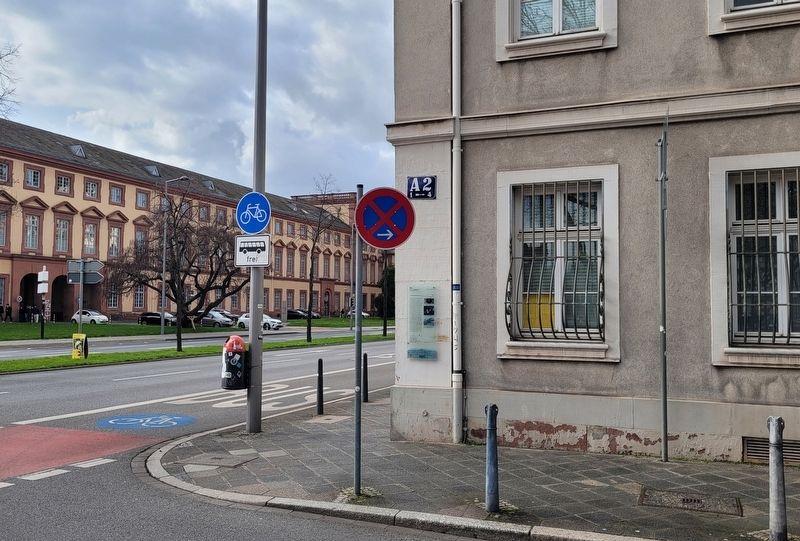
2. The view of the marker along the street
Topics. This historical marker is listed in this topic list: Notable Buildings. A significant historical month for this entry is December 1777.
Location. 49° 29.093′ N, 8° 27.738′ E. Marker is in Mannheim, Baden-Württemberg. It is in Quadrate. It is at the intersection of Bismarckstraße and A2, on the right when traveling west on Bismarckstraße. The marker is located along the corner of the building. Touch for map. Marker is at or near this postal address: A2 1, Mannheim BW 68159, Germany. Touch for directions.

Regionally, this marker is on the German Upper Rhine. Globally, it is in Europe, the European Union, Atlantic Europe, Central Europe, the Schengen Area, Western Europe, and the Western World. Historically, it finds itself in what was once the Roman Empire, the Holy Roman Empire, and the former West Germany.
Other nearby markers. At least 8 other markers are within walking distance of this marker: Wolfgang Amadeus Mozart (within shouting distance of this marker); Christian Mayer (within shouting distance of this marker); Johann Jakob Hemmer (within shouting distance of this marker); Die Mannheimer Schule / The Mannheim School (within shouting distance of this marker); Friedrich Schiller (within shouting distance of this marker); Kurfürst Karl Ludwig Von Der Pfalz (within shouting distance of this marker); Heidelberger Romantik / Heidelberg Romanticism (within shouting distance of this marker); Heidelberger Katechismus / Heidelberg Catechism (within shouting distance of this marker). Touch for a list and map of all markers in Mannheim.
Credits. This page was last revised on September 26, 2024. It was originally submitted on September 24, 2024, by James Hulse of Medina, Texas. This page has been viewed 137 times since then and 19 times this year. Photos: 1, 2. submitted on September 26, 2024, by James Hulse of Medina, Texas.
