Quadrate in Mannheim, Baden-Württemberg, Germany — Central Europe
Nationaltheater B 3
Photographed by James Hulse, February 20, 2024
1. Nationaltheater B 3 Marker

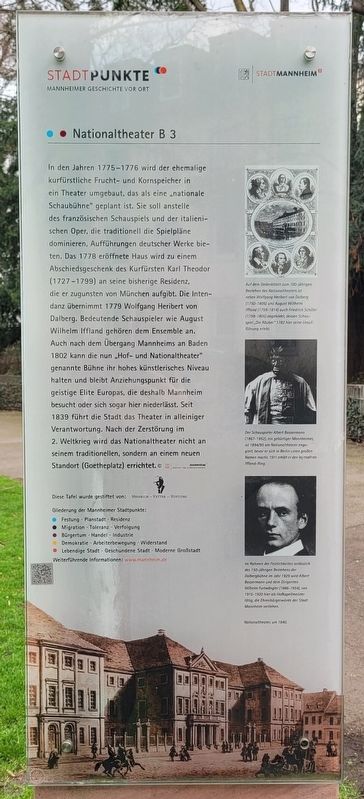
In den Jahren 1775-1776 wird der ehemalige kurfürstliche Frucht- und Kornspeicher in ein Theater umgebaut, das als eine „nationale Schaubühne" geplant ist. Sie soll anstelle des französischen Schauspiels und der italienischen Oper, die traditionell die Spielpläne dominieren, Aufführungen deutscher Werke bieten. Das 1778 eröffnete Haus wird zu einem Abschiedsgeschenk des Kurfürsten Karl Theodor (1727-1799) an seine bisherige Residenz, die er zugunsten von München aufgibt. Die Intendanz übernimmt 1779 Wolfgang Heribert von Dalberg. Bedeutende Schauspieler wie August Wilhelm Iffland gehören dem Ensemble an. Auch nach dem Übergang Mannheims an Baden 1802 kann die nun „Hof- und Nationaltheater" genannte Bühne ihr hohes künstlerisches Niveau halten und bleibt Anziehungspunkt für die geistige Elite Europas, die deshalb Mannheim besucht oder sich sogar hier niederlässt. Seit 1839 führt die Stadt das Theater in alleiniger Verantwortung. Nach der Zerstörung im 2. Weltkrieg wird das Nationaltheater nicht an seinem traditionellen, sondern an einem neuen Standort (Goetheplatz) errichtet. © Stadtarchiv Mannheim Institut Für Stadtgeschichte
Diese Tafel wurde gestiftet von: Heinrich-Vetter-Stiftung
Bildunterschriften
(Foto Nr. 1) Auf dem Gedenkblatt zum 100-jährigen Bestehen des Nationaltheaters ist neben Wolfgang Heribert von Dalberg (1750-1806) und August Willhelm Iffland (1759-1814) auch Friedrich Schiller (1759-1805) abgebildet, dessen Schauspiel „Die Räuber" 1782 hier seine Uraufführung erlebt.
(Foto Nr. 2) Der Schauspieler Albert Bassermann (1867-1952), ein gebürtiger Mannheimer, ist 1894/95 am Nationaltheater engagiert, bevor er sich in Berlin einen großen Namen macht, 1911 erhält er den legendären Iffland-Ring.
(Foto Nr. 3) Rahmen der Festlichkeiten anlässlich des 150-jährigen Bestehens der Dalbergbühne im Jahr 1929 wird Albert Bassermann und dem Dirigenten Wilhelm Furtwängler (1886-1954), von 1915-1920 hier als Hofkapellmeister tätig, die Ehrenbürgerwürde der Stadt Mannheim verliehen.
(Foto Nr. 4) Nationaltheater, um 1840.
In
this page online
This plaque was donated by: Heinrich-Vetter-Stiftung
Captions
(Photo #1) In addition to Wolfgang Heribert von Dalberg (1750-1806) and August Willhelm Iffland (1759-1814), the commemorative sheet for the 100th anniversary of the National Theatre also features Friedrich Schiller (1759-1805), whose play "The Robbers" premiered here in 1782.
(Photo #2) The actor Albert Bassermann (1867-1952), a native of Mannheim, was engaged at the National Theater in 1894/95 before making a big name for himself in Berlin. In 1911 he received the legendary Iffland Ring.
(Photo #3) As part of the festivities marking the 150th anniversary of the Dalbergbühne in 1929, Albert Bassermann and the conductor Wilhelm Furtwängler (1886-1954), who worked here as court conductor from 1915 to 1920, were awarded honorary citizenship of the city of Mannheim.
(Photo #4) National Theater, around 1840.
Erected by Stadtpunkte
Photographed by James Hulse, February 20, 2024
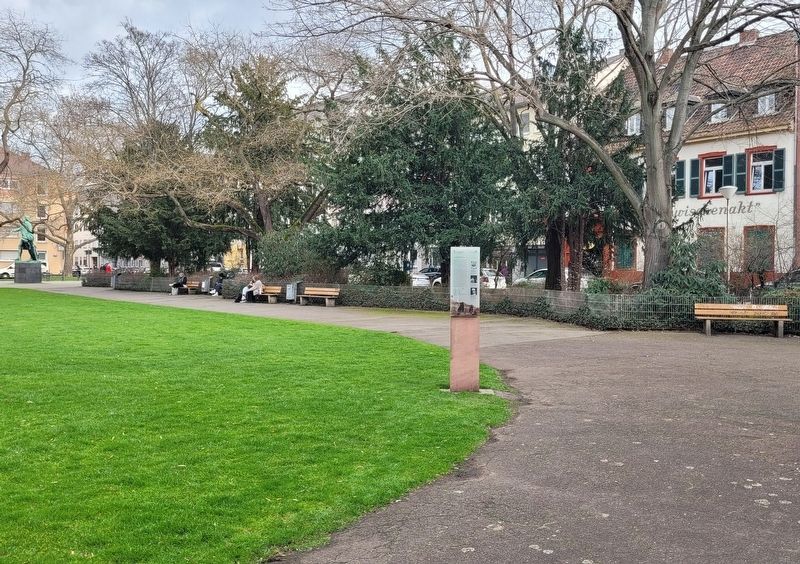
2. The view of the marker is the Schillerplatz
Topics. This historical marker is listed in this topic list: Entertainment. A significant historical year for this entry is 1778.
Location. 49° 29.168′ N, 8° 27.724′ E. Marker is in Mannheim, Baden-Württemberg. It is in Quadrate. It is at the intersection of B3 and A3 on B3. The marker is located in the Schillerplatz (park). Touch for map. Marker is at or near this postal address: B3, Mannheim BW 68159, Germany. Touch for directions.

Regionally, this marker is on the German Upper Rhine. Globally, it is in Europe, the European Union, Atlantic Europe, Central Europe, the Schengen Area, Western Europe, and the Western World. Historically, it finds itself in what was once the Roman Empire, the Holy Roman Empire, and the former West Germany.
Other nearby markers. At least 8 other markers are within walking distance of this marker: Rheinische Creditbank B 4, 2 (here, next to this marker); Jesuitenkirche A 4, 1 / Jesuit Church A 4, 1 (within shouting distance of this marker); Geschäftsstelle der DVP C 3, 21-22 / Office of German People's Party C 3, 21-22 (within shouting distance
Photographed by James Hulse, February 20, 2024
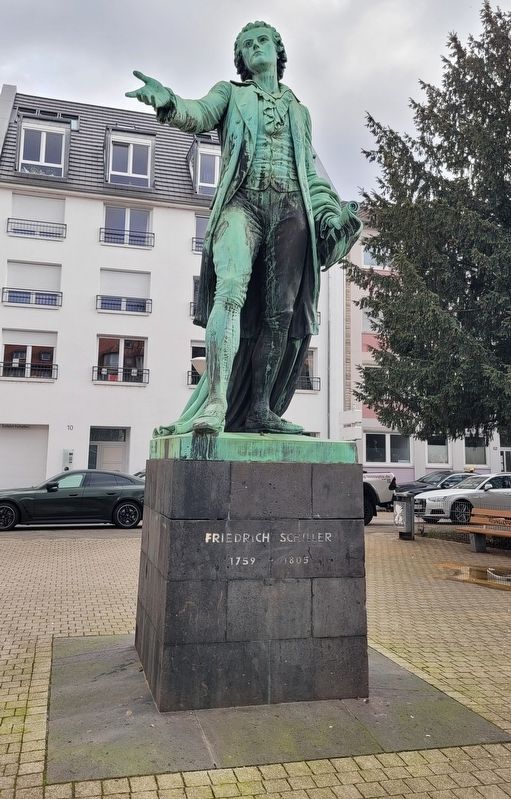
3. The Friedrich Schiller statue in Schillerplatz
More about this marker. There is a non-related marker separately attached on the other side of the post.
Also see . . . Friedrich Schiller. Wikipedia
Johann Christoph Friedrich von Schiller (10 November 1759 – 9 May 1805) was a German playwright, poet, philosopher and historian. Schiller is considered by most Germans to be Germany's most important classical playwright.(Submitted on September 27, 2024, by James Hulse of Medina, Texas.)
Credits. This page was last revised on September 27, 2024. It was originally submitted on September 26, 2024, by James Hulse of Medina, Texas. This page has been viewed 98 times since then and 8 times this year. Photos: 1, 2, 3. submitted on September 27, 2024, by James Hulse of Medina, Texas.
