
Chena Native Village in Chena Ridge in Fairbanks North Star Borough, Alaska — Northwest (North America)
Locked to the End
Photographed by William Fischer, Jr., August 19, 2024
1. Locked to the End Marker
WHY DO MOOSE FIGHT?
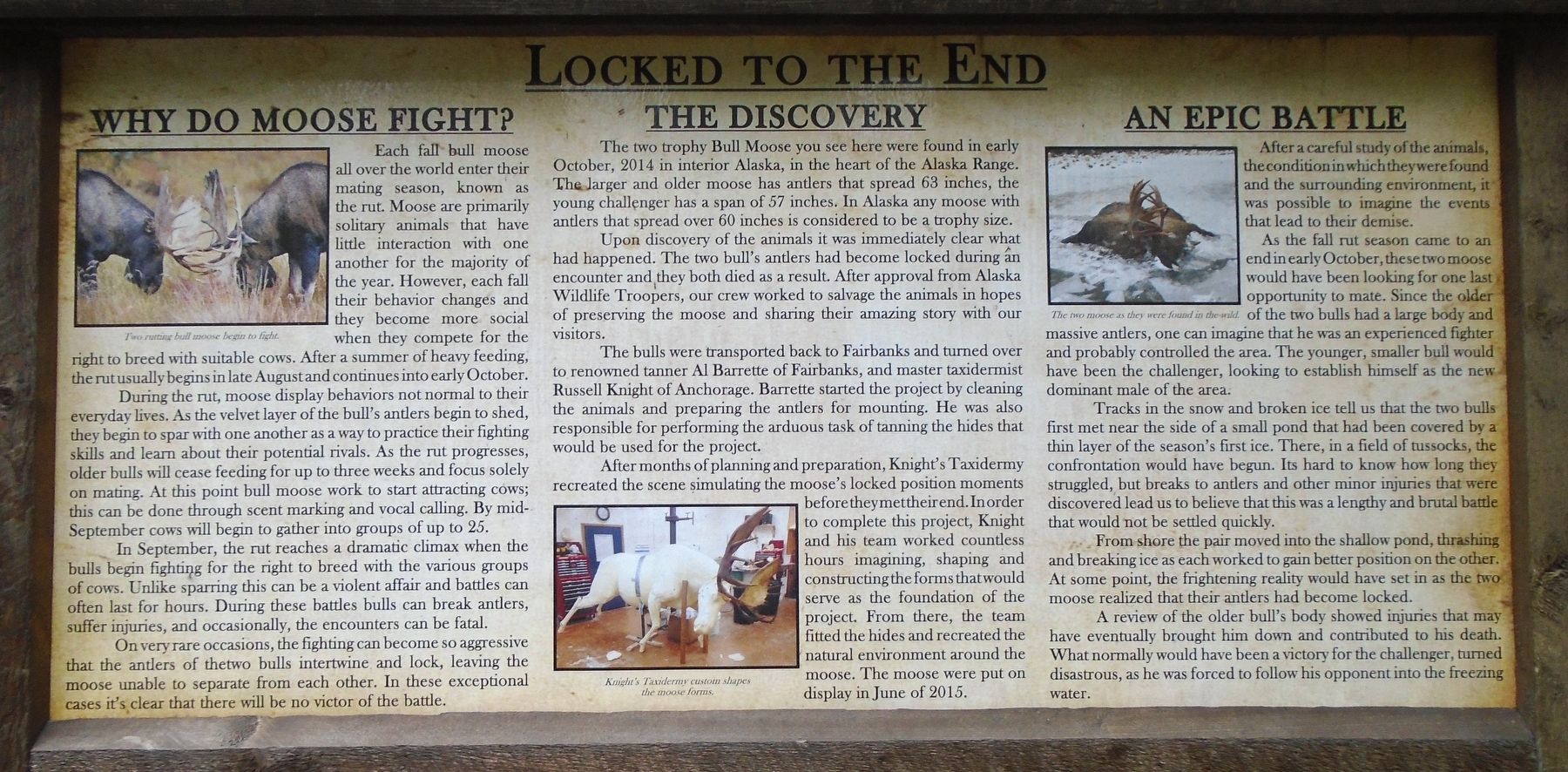
[Photo caption reads] Two rutting bull moose begin to fight.
Each fall bull moose all over the world enter their mating season, known as the rut. Moose are primarily solitary animals that have little interaction with one another for the majority of the year. However, each fall their behavior changes and they become more social when they compete for the right to breed with suitable cows. After a summer of heavy feeding, the rut usually begins in late August and continues into early October.
During the rut, moose display behaviors not normal to their everyday lives. As the velvet layer of the bull's antlers begin to shed, they begin to spar with one another as a way to practice their fighting skills and learn about their potential rivals. As the rut progresses, older bulls will cease feeding for up to three weeks and focus solely on mating. At this point bull moose work to start attracting cows; this can be done through scent marking and vocal calling. By mid-September cows will begin to gather into groups of up to 25.
In September, the rut reaches a dramatic climax when the bulls begin fighting
this page online
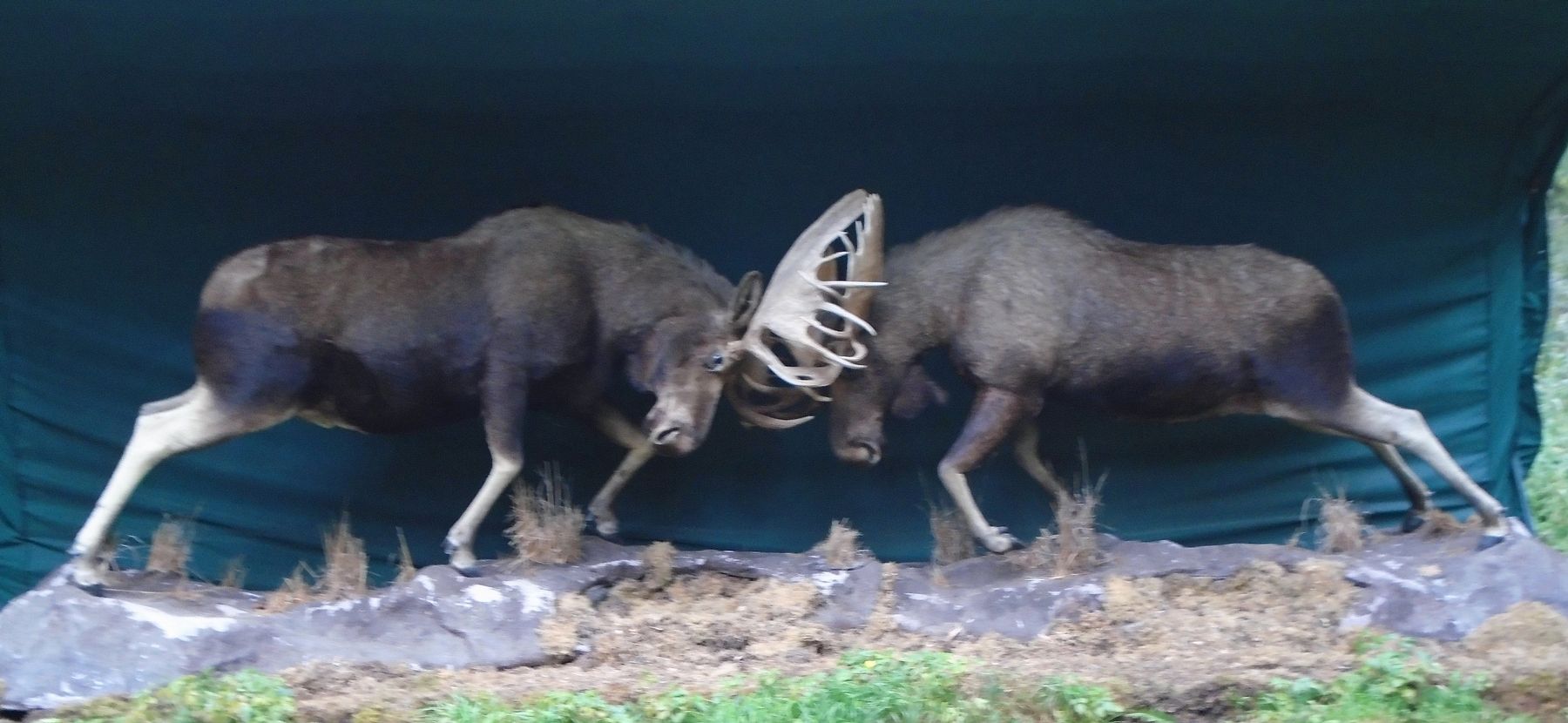
On very rare occasions, the fighting can become so aggressive that the antlers of the two bulls intertwine and lock, leaving the moose unable to separate from each other. In these exceptional cases it's clear that there will be no victor of the battle.
THE DISCOVERY
The two trophy Bull Moose you see here were found in early October, 2014 in interior Alaska, in the heart of the Alaska Range. The larger and older moose has antlers that spread 63 inches, the young challenger has a span of 57 inches. In Alaska any moose with antlers that spread over 60 inches is considered to be a trophy size.
Upon discovery of the animals it was immediately clear what had happened. The two bull's antlers had become locked during an encounter and they both died as a result. After approval from Alaska Wildlife Troopers, our crew worked to salvage the animals in hopes of preserving the moose and sharing their

Photographed by William Fischer, Jr., August 19, 2024
2. Locked to the End Marker
The bulls were transported back to Fairbanks and turned over to renowned tanner Al Barrette of Fairbanks, and master taxidermist Russell Knight of Anchorage. Barrette started the project by cleaning the animals and preparing the antlers for mounting. He was also responsible for performing the arduous task of tanning the hides that would be used for the project.
After months of planning and preparation, Knight's Taxidermy recreated the scene simulating the moose's locked position moments before they met their end. In order to complete this project, Knight and his team worked countless hours imagining, shaping and constructing the forms that would serve as the foundation of the project. From there, the team fitted the hides and recreated the natural environment around the moose. The moose were put on display in June of 2015.
[Photo caption reads] Knight's Taxidermy custom shapes the moose forms.
AN EPIC BATTLE
After a careful study of the animals, the condition in which they were found and the surrounding environment, it was possible to imagine the events that lead to their demise.
As the fall
Photographed by William Fischer, Jr., August 19, 2024
3. Moose Locked to the End
Tracks in the snow and broken ice tell us that the two bulls first met near the side of a small pond that had been covered by a thin layer of the season's first ice. There, in a field of tussocks, the confrontation would have begun. Its hard to know how long they struggled, but breaks to antlers and other minor injuries that were discovered lead us to believe that this was a lengthy and brutal battle that would not be settled quickly.
From shore the pair moved into the shallow pond, thrashing and breaking ice as each worked to gain better position on the other. At some point, the frightening reality would have set in as the two moose realized that their antlers had become locked.
[Photo caption reads] The two moose as they were found in the wild
A review of the older bull's body showed injuries that may have eventually brought him down and contributed to his death. What normally would have been a victory for the challenger, turned disastrous, as he was forced to follow his opponent into the freezing water.
Erected by Riverboat Discovery.
Topics. This historical marker is listed in this topic list: Animals. A significant historical month for this entry is June 2015.
Location. 64° 47.997′ N, 147° 54.918′ W. Marker is in Chena Ridge, Alaska, in Fairbanks North Star Borough. It is in Chena Native Village. It can be reached from Tall Spruce Road. Touch for map. Marker is at or near this postal address: 2633 Tall Spruce Rd, Fairbanks AK 99709, United States of America. Touch for directions.

Regionally, this marker is in the Alaska Railroad Corridor, in the Athabascan Region, and in Interior Alaska. It is also on the American Pacific Coast. Globally, it is in North America, the Pacific Rim, the Western Hemisphere, the Western World, and the Anglosphere. Historically, it finds itself in what was once the Russian Empire.
Other nearby markers. At least 8 other markers are within walking distance of this marker: A different marker also named Locked to the End (here, next to this marker); Trapper's Line Cabin (within shouting distance of this marker); Trapper's Log Cabin (within shouting distance of this marker); Pieper Super Cub (within shouting distance of this marker); Caribou and Reindeer (within shouting distance of this marker); Sod Roof Construction (within shouting distance of this marker); Susan Butcher: A Lifetime of Inspiration (within shouting distance of this marker); Post Office (within shouting distance of this marker). Touch for a list and map of all markers in Chena Ridge.
More about this marker. Although a modern construction, the Chena Native Village is a living history open air museum highlighting historic Athabascan culture, and is reached by Riverboat Discovery tours.
Also see . . . Chena Native Village. (Submitted on September 26, 2024, by William Fischer, Jr. of Reynoldsburg, Ohio.)
Credits. This page was last revised on September 26, 2024. It was originally submitted on September 26, 2024, by William Fischer, Jr. of Reynoldsburg, Ohio. This page has been viewed 300 times since then and 35 times this year. Photos: 1, 2, 3. submitted on September 26, 2024, by William Fischer, Jr. of Reynoldsburg, Ohio.
