Quadrate in Mannheim, Baden-Württemberg, Germany — Central Europe
Kasernen und Zeughaus in C 5 und C 6
⎯⎯⎯
Barracks and Armory in C 5 and C 6
Photographed by James Hulse, February 20, 2024
1. Kasernen und Zeughaus in C 5 und C 6 / Barracks and Armoury in C 5 and C 6 Marker

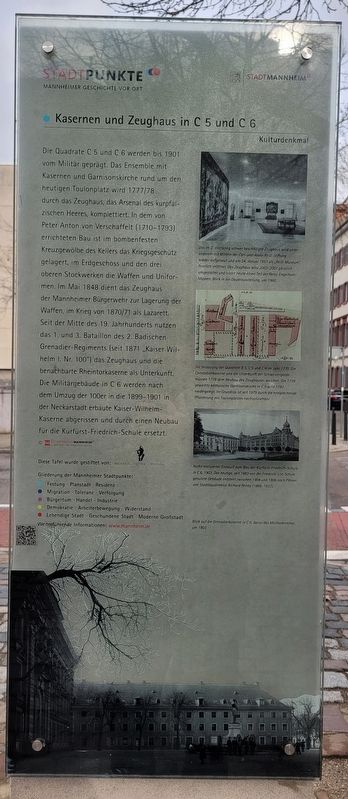
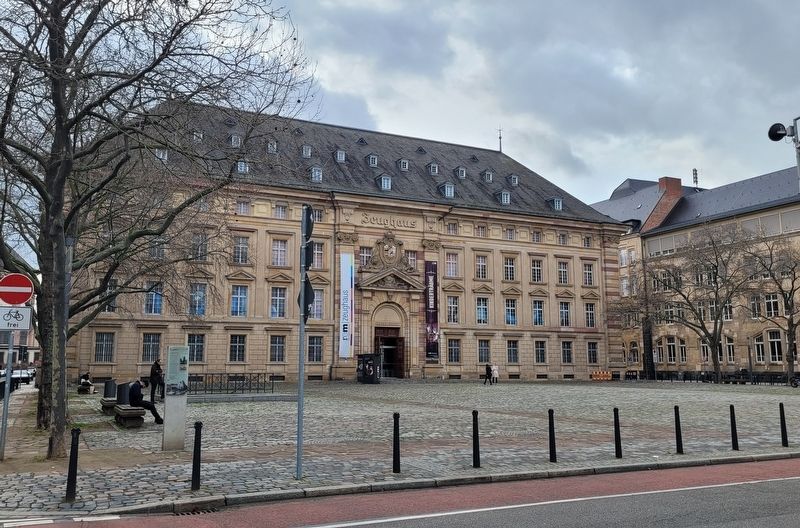
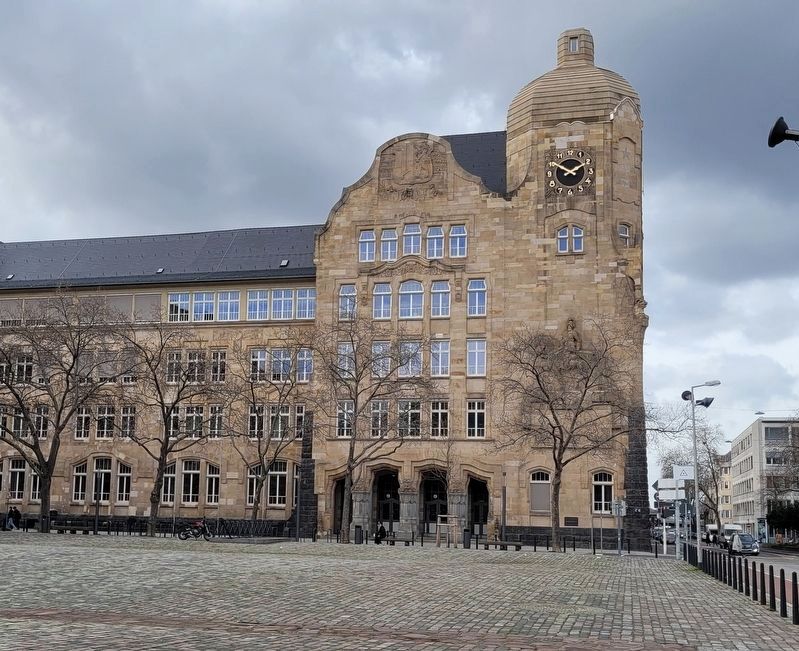
Die Quadrate C 5 und C 6 werden bis 1901 vom Militär geprägt. Das Ensemble mit Kasernen und Garnisonskirche rund um den heutigen Toulonplatz wird 1777/78 durch das Zeughaus, das Arsenal des kurpfälzischen Heeres, komplettiert. In dem von Peter Anton von Verschaffelt (1710-1793) errichteten Bau ist im bombenfesten. Kreuzgewölbe des Kellers das Kriegsgeschütz gelagert, im Erdgeschoss und den drei oberen Stockwerken die Waffen und Uniformen. Im Mai 1848 dient das Zeughaus der Mannheimer Bürgerwehr zur Lagerung der Waffen, im Krieg von 1870/71 als Lazarett. Seit der Mitte des 19. Jahrhunderts nutzen das 1. und 3. Bataillon des 2. Badischen Grenadier-Regiments (seit 1871 „Kaiser Wilhelm I. Nr. 100") das Zeughaus und die benachbarte Rheintorkaserne als Unterkunft. Die Militärgebäude in C 6 werden nach dem Umzug der 100er in die 1899-1901 in der Neckarstadt erbaute Kaiser-Wilhelm-Kaserne abgerissen und durch einen Neubau für die Kurfürst-Friedrich-Schule ersetzt. © Stadtarchiv Mannheim Institut Für Stadtgeschichte
Diese Tafel wurde gestiftet von: Heinrich-Vetter-Stiftung
Bildunterschriften
(Foto Nr. 1) Das im 2. Weltkrieg schwer beschädigte Zeughaus wird unter anderem mit Mittein der Carl-und-Anna-Reiß-Stiftung wieder aufgebaut und am 24 Januar 1957 als „Reiß-Museum" feierlich eröffnet. Das Zeughaus wird 2003-2007 gänzlich umgestaltet und bildet heute einen Teil der Reiss-Engelhorn-Museen. Blick in die Dauerausstellung, um 1960.
(Foto Nr. 2) Die Bebauung der Quadrate B 5, C 5 und C 6 im Jahr 1770. Die Constablerkaserne und die Unterkunft der Schweizergarde müssen 1778 dem Neubau des Zeughauses weichen. Die 1739 geweihte katholische Garnisonskirche in C 5 wird 1782 niedergelegt. Ihr Grundriss ist seit 1979 durch die entsprechende Pflasterung des Toulonplatzes nachvolinenbar.
(Foto Nr. 3) Nicht realisierter Entwurf zum Bau der Kurfurst-Friedrich-Schule in C 6, 1903. Das heutige, seit 1983 von der Friedrich-List-Schule genutzte Gebäude entsteht zwischen 1904 und 1906 nach Plänen von Stadtbaudirektor Richard Perrey (1866-1937).
(Foto Nr. 4) Blick auf die Grenadierkaserne in C 6, davor das Moltkedenkmal, um 1903.
Squares
this page online
This plaque was donated by: Heinrich-Vetter-Stiftung
Captions
(Photo #1) The armory, which was badly damaged in World War II, was rebuilt with funds from the Carl and Anna Reiss Foundation and was officially opened on January 24, 1957 as the "Reiß Museum." The armory was completely redesigned between 2003 and 2007 and is now part of the Reiss-Engelhorn Museums. View of the permanent exhibition, around 1960.
(Photo #2) The construction of squares B 5, C 5 and C 6 in 1770. The constable barracks and the Swiss Guard's quarters had to make way for the new armory in 1778. The Catholic garrison church in C 5, consecrated in 1739, was demolished in 1782. Its floor plan has been able to be rebuilt since 1979 by paving Toulonplatz accordingly.
(Photo #3) Unrealized design for the construction of the Kurfurst-Friedrich School in C 6, 1903. The current building, which has been used by the Friedrich List School since 1983, was built between 1904 and 1906 according to plans by city planning director Richard Perrey (1866-1937).
(Photo #4) View of the Grenadier Barracks in C 6, in front of which is the Moltke Monument, around 1903.
Erected by Stadtpunkte
Photographed by James Hulse, February 20, 2024
2. The Armory building and Barracks to the right side
Topics. This historical marker is listed in these topic lists: Education • Forts and Castles. A significant historical year for this entry is 1901.
Location. 49° 29.295′ N, 8° 27.719′ E. Marker is in Mannheim, Baden-Württemberg. It is in Quadrate. It is at the intersection of D5 and C4, on the right when traveling east on D5. The marker is located on the corner of the intersection in front of the Armory building. Touch for map. Marker is in this post office area: Mannheim BW 68159, Germany. Touch for directions.

Regionally, this marker is on the German Upper Rhine. Globally, it is in Europe, the European Union, Atlantic Europe, Central Europe, the Schengen Area, Western Europe, and the Western World. Historically, it finds itself in what was once the Roman Empire, the Holy Roman Empire, and the former West Germany.
Other nearby markers. At least 8 other markers are within walking distance of this marker: Veteranendenkmal D 5 / Veterans Memorial D 5 (here, next to this marker); Veteranendenkmal / Veterans Memorial (within shouting distance of this marker); Haus des Geheimrats Cunzmann / Privy Councillor Cunzmann’s House
Photographed by James Hulse, February 20, 2024
3. The former Armory Square (Toulon Square) with Friedrich-List-Schule building in the background
More about this marker. There is a non-related marker separately attached on the other side of the post.
Credits. This page was last revised on September 28, 2024. It was originally submitted on September 26, 2024, by James Hulse of Medina, Texas. This page has been viewed 123 times since then and 15 times this year. Photos: 1, 2, 3. submitted on September 28, 2024, by James Hulse of Medina, Texas.
