Quadrate in Mannheim, Baden-Württemberg, Germany — Central Europe
Bankhaus Ladenburg D 3, 14
⎯⎯⎯
Ladenburg Bank D 3, 14
Photographed by James Hulse, February 20, 2024
1. Bankhaus Ladenburg D 3, 14 / Ladenburg Bank D 3, 14 Marker

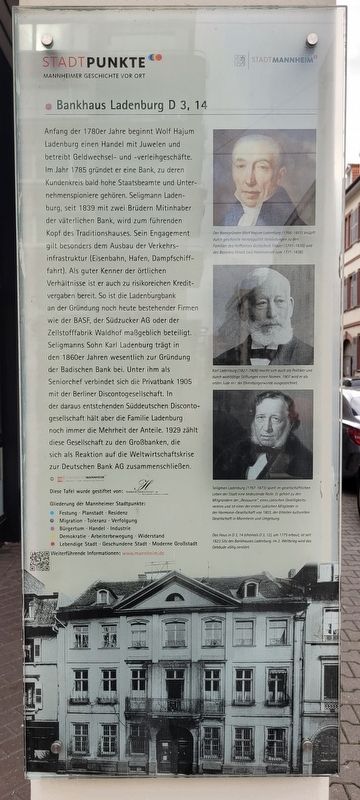
Anfang der 1780er Jahre beginnt Wolf Hajum Ladenburg einen Handel mit Juwelen und betreibt Geldwechsel- und -verleihgeschäfte. Im Jahr 1785 gründet er eine Bank, zu deren Kundenkreis bald hohe Staatsbeamte und Unternehmenspioniere gehören. Seligmann Ladenburg, seit 1839 mit zwei Brüdern Mitinhaber der väterlichen Bank, wird zum führenden Kopf des Traditionshauses. Sein Engagement gilt besonders dem Ausbau der Verkehrsinfrastruktur (Eisenbahn, Hafen, Dampfschifffahrt). Als guter Kenner der örtlichen Verhältnisse ist er auch zu risikoreichen Kreditvergaben bereit. So ist die Ladenburgbank an der Gründung noch heute bestehender Firmen wie der BASF, der Südzucker AG oder der Zellstofffabrik Waldhof maßgeblich beteiligt. Seligmanns Sohn Karl Ladenburg trägt in den 1860er Jahren wesentlich zur Gründung der Badischen Bank bei. Unter ihm als Seniorchef verbindet sich die Privatbank 1905 mit der Berliner Discontogesellschaft. In der daraus entstehenden Süddeutschen Discontogesellschaft hält aber die Familie Ladenburg noch immer die Mehrheit der Anteile. 1929 zählt diese Gesellschaft zu den Großbanken, die sich als Reaktion auf die Weltwirtschaftskrise zur Deutschen Bank AG zusammenschließen. © Stadtarchiv Mannheim Institut Für Stadtgeschichte
Diese Tafel wurde gestiftet von: Harmonie Gesellschaft
Bildunterschriften
(Foto Nr. 1) Der Bankgründer Wolf Hajum Ladenburg (1766-1851) knüpft durch geschickte Heiratspolitik Verbindungen zu den Familien des Hoffaktors Gottschalk Mayer (1761-1835) und des Bankiers Hirsch Levi Hohenemser (um 1771-1838).
(Foto Nr. 2) Karl Ladenburg (1827-1909) macht sich auch als Politiker und durch wohltätige Stiftungen einen Namen. 1907 wird er als erster Jude mit der Ehrenbürgerwürde ausgezeichnet.
(Foto Nr. 3) Seligman Ladenburg (1797-1873) spielt im gesellschaftlichen Leben der Stadt eine bedeutende Rolle. Er gehört zu den Mitgründern der „Ressource" eines judischen Geselligkeitsvereins und ist einer der ersten jüdischen Mitglieder in der Harmonie-Gesellschaft von 1803, der ältesten kulturellen Gesellschaft in Mannheim und Umgebung.
(Foto Nr. 4) Das Haus in D3, 14 (ehemals D 3, 12), um 1775 erbaut, ist seit 1823 Sitz des Bankhauses Ladenburg. Im 2. Weltkrieg wird das Gebäude völlig zerstört.
At
this page online
Photographed by James Hulse
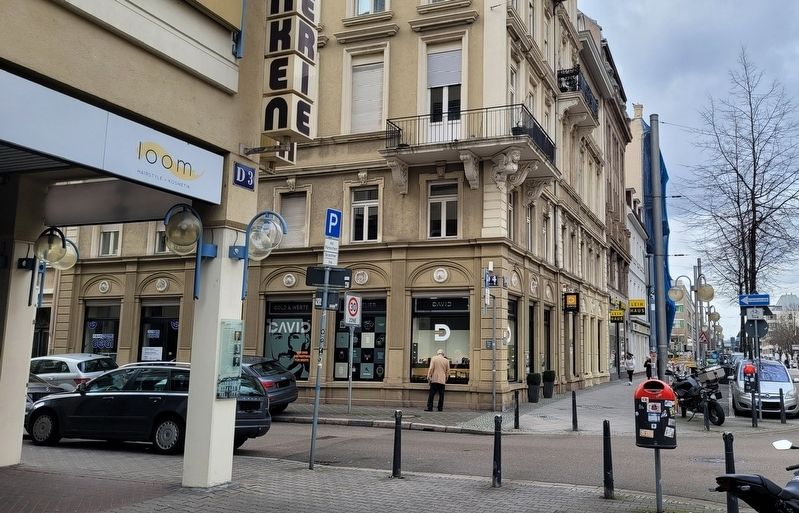
2. The view of the marker from the street
This plaque was donated by: Harmonie Gesellschaft
Captions
(Photo #1) The bank founder Wolf Hajum Ladenburg (1766-1851) established connections with the families of the court factor Gottschalk Mayer (1761-1835) and the banker Hirsch Levi Hohenemser (around 1771-1838) through clever marriage politics.
(Photo #2) Karl Ladenburg (1827-1909) also made a name for himself as a politician and through charitable foundations. In 1907 he was the first Jew to be awarded honorary citizenship.
(Photo #3) Seligman Ladenburg (1797-1873) played an important role in the social life of the city. He is one of the co-founders of the "Ressource", a Jewish social club, and is one of the first Jewish members of the Harmonie Society of 1803, the oldest cultural society in Mannheim and the surrounding area.
(Photo #4) The house at D3, 14 (formerly D 3, 12), built around 1775, has been the headquarters of the Ladenburg bank since 1823. The building was completely destroyed in World War II.
Erected by Stadtpunkte Mannheimer Geschichte Vor Ort and Stadt Mannheim.
Topics. This historical marker is listed in this topic
Photographed by James Hulse
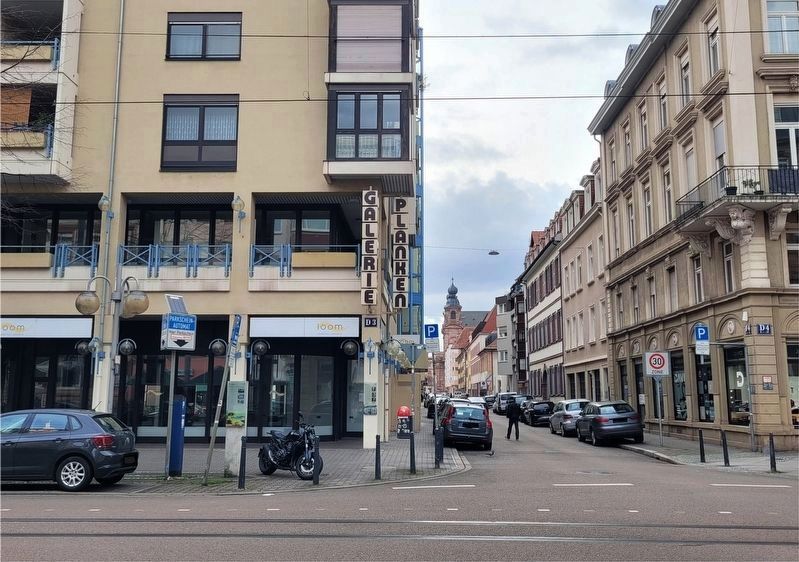
3. The marker is the right side marker of the two markers
Location. 49° 29.317′ N, 8° 27.819′ E. Marker is in Mannheim, Baden-Württemberg. It is in Quadrate. It is at the intersection of Planken and D4, on the right when traveling east on Planken. The marker is located on the wall of the building. Touch for map. Marker is at or near this postal address: D3 1-5, Mannheim BW 68159, Germany. Touch for directions.

Regionally, this marker is on the German Upper Rhine. Globally, it is in Europe, the European Union, Atlantic Europe, Central Europe, the Schengen Area, Western Europe, and the Western World. Historically, it finds itself in what was once the Roman Empire, the Holy Roman Empire, and the former West Germany.
Other nearby markers. At least 8 other markers are within walking distance of this marker: Fachhochschule für Gestaltung E 3, 16 / University of Applied Sciences for Design E 3, 16 (here, next to this marker); Studentenwohnheim des Goethe-Instituts D 4, 4 / Goethe-Institute Student Residence D 4, 4 (here, next to this marker); Städtisches Leihamt D 4, 9-10 / Municipal Loan Office D 4, 9-10 (within shouting distance of this marker); Börse E 4, 14-16 / Stock Exchange E 4, 14-16 (within shouting distance of this marker); Goethe-Zitat über Mannheim / Goethe Quotation About Mannheim (about 90 meters away, measured in a direct line); Haus des Geheimrats Cunzmann / Privy Councillor Cunzmann’s House (about 90 meters away); Achenbach'sches Kaffeehaus D 2, 6 / Achenbach's Coffee House D 2, 6 (about 120 meters away); Veteranendenkmal D 5 / Veterans Memorial D 5 (about 120 meters away). Touch for a list and map of all markers in Mannheim.
Credits. This page was last revised on September 28, 2024. It was originally submitted on September 27, 2024, by James Hulse of Medina, Texas. This page has been viewed 121 times since then and 17 times this year. Photos: 1, 2, 3. submitted on September 28, 2024, by James Hulse of Medina, Texas.
