
Rock Island Snow Plow No. 95580
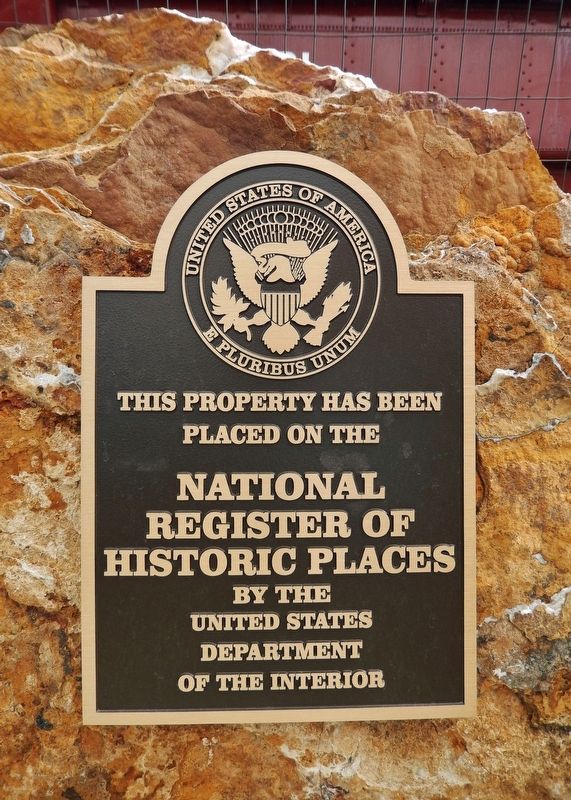
placed on the
National
Register of
Historic Places
by the
United States
Department
of the Interior
Topics and series. This historical marker is listed in this topic list: Railroads & Streetcars. In addition, it is included in the National Register of Historic Places (NRHP) series list. A significant historical year for this entry is 1951.
Location. 39° 15.636′ N, 103° 41.155′ W. Marker is in Limon, Colorado, in Lincoln County. It can be reached from 1st Street near D Avenue, on the right when traveling east. The marker and railroad snowplow are located on the Limon Heritage Museum & Railroad Park grounds. Touch for map. Marker is at or near this postal address: 701 1st Street, Limon CO 80828, United States of America. Touch for directions.

Regionally, this marker is in the Eastern Plains. It is also in the American Mountain West, on the Great Plains, and specifically on the High Plains. Globally, it is in North America, the Western Hemisphere, the Western World, and the Anglosphere. Historically, it finds itself in what was once the Comanchería, the Dust Bowl, and the Louisiana Purchase.
Other nearby markers. At
this page online
Regarding Rock Island Snow Plow No. 95580. National Register of Historic Places № 100002680.
From the National Register Nomination prepared by Mary Andersen and Vivian Lowe, Limon Heritage Society, 9/28/2017:
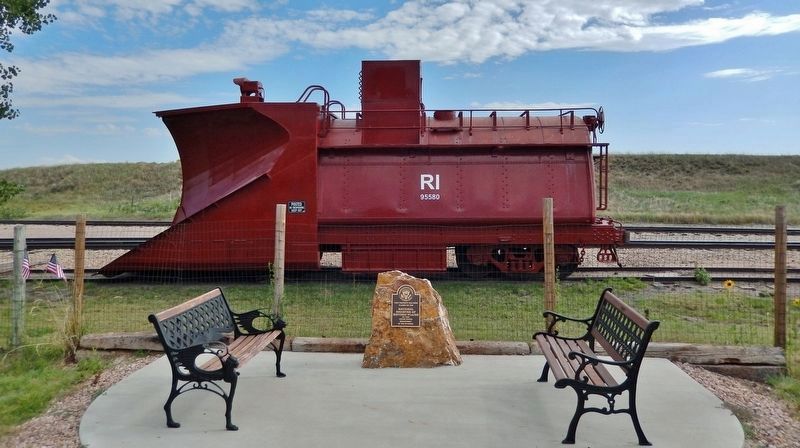
Rock Island Snow Plow No. 95580 sits on rails it originally cleared in the 1950s-’80s. Built as a typical standard gauge wedge plow from a steam locomotive tender by the Chicago, Rock Island & Pacific Railroad (Rock Island) shop in 1951, it was reconditioned, repainted, and used by the Union Pacific Railroad (UP) as No. 900016 beginning in 1981 after the Rock Island ceased operations in 1980. The snow plow was retired to the UP Cheyenne,Wyoming shops in the 1990s and later donated to the Limon Heritage Museum by the UP in 1995. In 2015, the snow plow was restored to its original Rock Island color and format and renumbered to 95580. It has been minimally altered from the historic Rock Island design.Photographed by Cosmos Mariner, September 4, 20242. Rock Island Snow Plow No. 95580 MarkerThe marker is mounted on a large stone, overlooking the north side of the snowplow.Rock Island Snow Plow No. 95580 is significant for its association with the Chicago, Rock Island & Pacific Railroad (Rock Island) and for its crucial role in keeping tracks clear of snow on the plains of Eastern Colorado and Western Kansas, where major storms could easily make tracks impassable.
The aftermath of blizzards allowed no travel on the rails until the snow plows removed the snow banks. These blizzards were not an unusual event on the Western Kansas and Eastern Colorado plains. Massive amounts of snow would blow and drift, forcing the railroad to begin the process of snow removal. The single-track wedge plow provided an efficient means of removing the snow, splitting the snow banks and forcing them to the sides of the rails.
The snow plow is further significant for Engineering as a good example of a wedge-type railroad snow plow converted from a locomotive tender.
Prior to conversion, Snow Plow No. 95580 was a semi-Vanderbilt tender built by Rock Island; the plow still features the distinctive “loaf of bread” shape as developed by Rock Island and is a testament to the repurposing of equipment constantly employed by railroads. The plow was in use by Rock Island until its bankruptcy in 1978 and selling off of equipment in 1980.Photographed by Cosmos Mariner, September 4, 20243. Rock Island Snow Plow No. 95580From the National Register Nomination: At the front, or “A” end, of the snow plow is the single-track wedge plow itself. Measuring 16’-7” from the tip of the plow to the edge of the plow box that attaches to the tender, the plow has an angled horizontal blade that lifts snow upward, which is then forced by the center vertical blade to either side of the track. The plow measures 12’-4” tall from the rail to the top edge, 10’-0” wide at the top, 11’-0” wide at its full width, and 7’-0” wide at the rail. A headlight is mounted at the top of the plow. At the rear, or “B” end, of the snow plow are two sets of steel ladders on either side that facilitate access to catwalks that run along each side of the body. A steel stirrup step hangs from the sill at each corner of the car. A tool box is attached just right of center above the sill. Attached at the top, just to the right of the left ladder, is a brake wheel with a chain leading down to the brake mechanism below. On either side of the snow plow body is a steel catwalk with handrail that leads from the B end to the plow box. Towards the A end, where the plow box meets the body, the catwalks end at another set of steel ladders (on either side) which provide access to the top of the plow box and the headlight. On top of the body of the snow plow, set back from the plow box by a few feet, is a narrow gabled-roof “dog house,” or small cabin, which houses the brakeman. On the right side of the snow plow the catwalk handrail attaches to either side of the dog house to allow access to the steel cabin door. The left side of the dog house has a plated-over window. Both sides of the snow plow feature the lettering “RI/95580” along the middle of the body. The overall dimensions of the snow plow are 15’-4 ½” in height from the rail to the top of the doghouse and 38’-4 ¾” in length from the tip of the plow to the coupler. The total weight is 190,400 lbs.

Also see . . . Rock Island Snow Plow No. 95580 (Wikipedia).
Excerpt: The Rock Island Snow Plow No. 95580 in Limon, Colorado is a railway snowplow which was listed on the National Register of Historic Places in 2018.(Submitted on September 28, 2024, by Cosmos Mariner of Cape Canaveral, Florida.)It is termed a "Single-Track Wedge Plow". It was created as a snowplow by the Chicago, Rock Island and Pacific Railroad in 1951, rebuilding from a retired steam locomotive tender. It was transferred to the Union Pacific Railway in 1981 and assigned to serve from Oakley, Kansas.
Credits. This page was last revised on September 28, 2024. It was originally submitted on September 28, 2024, by Cosmos Mariner of Cape Canaveral, Florida. This page has been viewed 176 times since then and 27 times this year. Photos: 1, 2, 3. submitted on September 28, 2024, by Cosmos Mariner of Cape Canaveral, Florida.
