Quadrate in Mannheim, Baden-Württemberg, Germany — Central Europe
„Pfälzer Hof" D 1, 5-6
Photographed by James Hulse, February 20, 2024
1. „Pfälzer Hof" D 1, 5-6 Marker

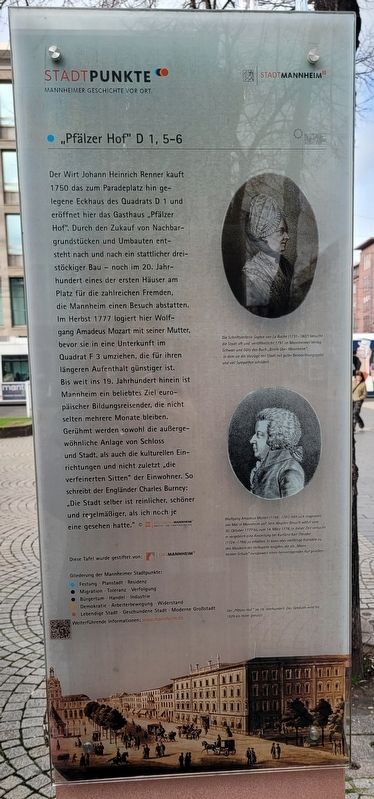
Der Wirt Johann Heinrich Renner kauft 1750 das zum Paradeplatz hin gelegene Eckhaus des Quadrats D 1 und eröffnet hier das Gasthaus „Pfälzer Hof". Durch den Zukauf von Nachbargrundstücken und Umbauten entsteht nach und nach ein stattlicher dreistöckiger Bau - noch im 20. Jahrhundert eines der ersten Häuser am Platz für die zahlreichen Fremden, die Mannheim einen Besuch abstatten. Im Herbst 1777 logiert hier Wolfgang Amadeus Mozart mit seiner Mutter, bevor sie in eine Unterkunft im Quadrat F 3 umziehen, die für ihren längeren Aufenthalt günstiger ist. Bis weit ins 19. Jahrhundert hinein ist Mannheim ein beliebtes Ziel europäischer Bildungsreisender, die nicht selten mehrere Monate bleiben. Gerühmt werden sowohl die außergewöhnliche Anlage von Schloss und Stadt, als auch die kulturellen Einrichtungen und nicht zuletzt „die verfeinerten Sitten" der Einwohner. So schreibt der Engländer Charles Burney: „Die Stadt selber ist reinlicher, schöner und regelmäßiger, als ich noch je eine gesehen hatte". © Stadtarchiv Mannheim Institut Für Stadtgeschichte
Diese Tafel wurde gestiftet von: GBG Mannheim
Bildunterschriften
(Foto Nr. 1) Die Schriftstellerin Sophie von La Roche (1731-1807) besucht die Stadt oft und veröffentlicht 1791 im Mannheimer Verlag Schwan und Götz das Buch „Briefe über Mannheim", in dem sie die Vorzüge der Stadt mit guter Beobachtungsgabe und viel Sympathie schildert.
(Foto Nr. 2) Wolfgang Amadeus Mozart (1756-1791) hält sich insgesamt vier Mal in Mannheim auf. Sein längster Besuch währt vom 30. Oktober 1777 bis zum 14. März 1778. In dieser Zeit versucht er vergeblich eine Anstellung bei Kurfürst Karl Theodor (1724-1799) zu erhalten. Er kann aber vielfältige Kontakte zu den Musikern der Hofkapelle knüpfen, die als „Mannheimer Schule" europaweit einen hervorragenden Ruf gnießen.
(Foto Nr. 3) Der „Pfälzer Hof" im 19. Jahrhundert. Das Gebäude wird bis 1929 als Hotel genutzt.
In
this page online
This plaque was donated by: GBG Mannheim
Captions
(Photo #1) The writer Sophie von La Roche (1731-1807) often visited the city and in 1791 published the book "Letters about Mannheim" with the Mannheim publishing house Schwan and Götz, in which she describes the advantages of the city with good powers of observation and a lot of sympathy.
(Photo #2) Wolfgang Amadeus Mozart (1756-1791) stayed in Mannheim four times. His longest visit lasted from October 30, 1777 to March 14, 1778. During this time he tried in vain to get a job with Elector Karl Theodor (1724-1799). However, he was able to make many contacts with the musicians of the court orchestra, who enjoyed an excellent reputation throughout Europe as the "Mannheim School".
(Photo #3) The "Pfälzer Hof" in the 19th century. The building was used as a hotel until 1929.
Erected by Stadtpunkte
Photographed by James Hulse, February 20, 2024
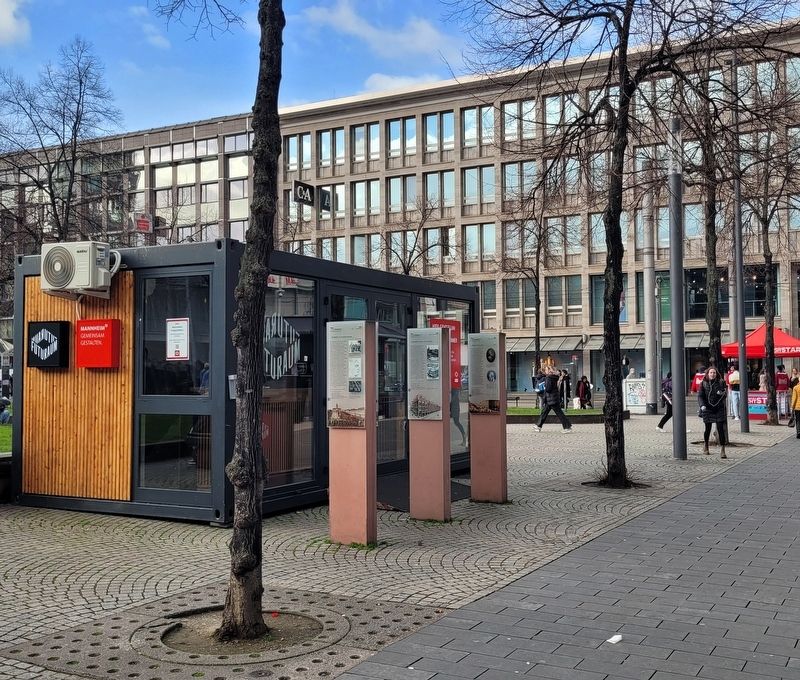
2. The marker is the far right marker of the group
Topics. This historical marker is listed in this topic list: Notable Buildings. A significant historical year for this entry is 1750.
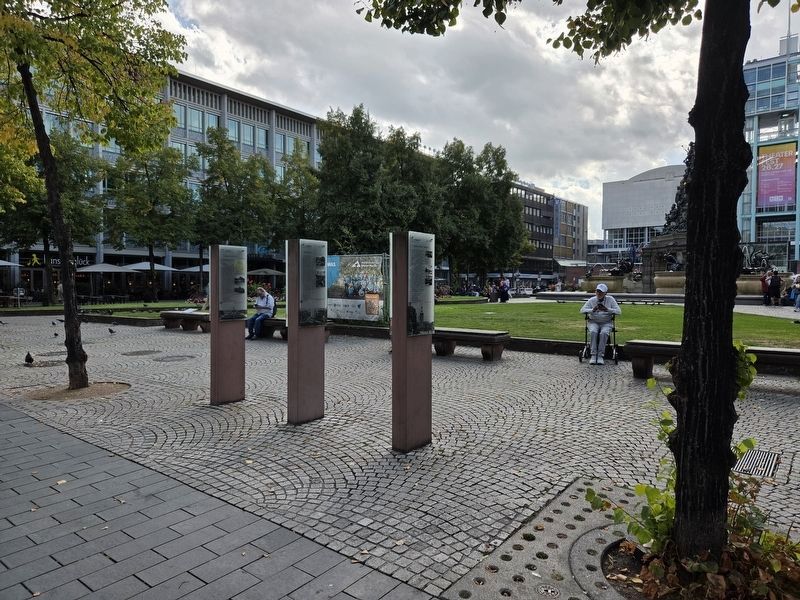
Location. 49° 29.249′ N, 8° 27.988′ E. Marker is in Mannheim, Baden-Württemberg. It is in Quadrate. It is at the intersection of Planken and Kurpfalzstraße, on the right when traveling east on Planken. The marker is located in a group of 6 markers at the north side of the Paradeplatz. Touch for map. Marker is at or near this postal address: O1 1, Mannheim BW 68161, Germany. Touch for directions.

Regionally, this marker is on the German Upper Rhine. Globally, it is in Europe, the European Union, Atlantic Europe, Central Europe, the Schengen Area, Western Europe, and the Western World. Historically, it finds itself in what was once the Roman Empire, the Holy Roman Empire, and the former West Germany.
Other nearby markers. At least 8 other markers are within walking distance of this marker: Kaufhaus - Rathaus - Stadthaus N 1 / Department Store - Town Hall - City Hall N 1 (here, next to this marker); Paradeplatzbunker / Parade Square Bunker (here,
Photographed by James Hulse, September 16, 2026
3. „Pfälzer Hof" D 1, 5-6 Marker
More about this marker. There is a non-related marker separately attached on the other side of the post.
Credits. This page was last revised on September 23, 2026. It was originally submitted on September 29, 2024, by James Hulse of Medina, Texas. This page has been viewed 129 times since then and 15 times this year. Photos: 1, 2. submitted on September 30, 2024, by James Hulse of Medina, Texas. 3. submitted on September 23, 2026, by James Hulse of Medina, Texas.
