Quadrate in Mannheim, Baden-Württemberg, Germany — Central Europe
Palais Hillesheim R 1, 1
⎯⎯⎯
Palace Hillesheim R 1, 1
Photographed by James Hulse, September 23, 2024
1. Palais Hillesheim R 1, 1 / Palace Hillesheim R 1, 1 Marker

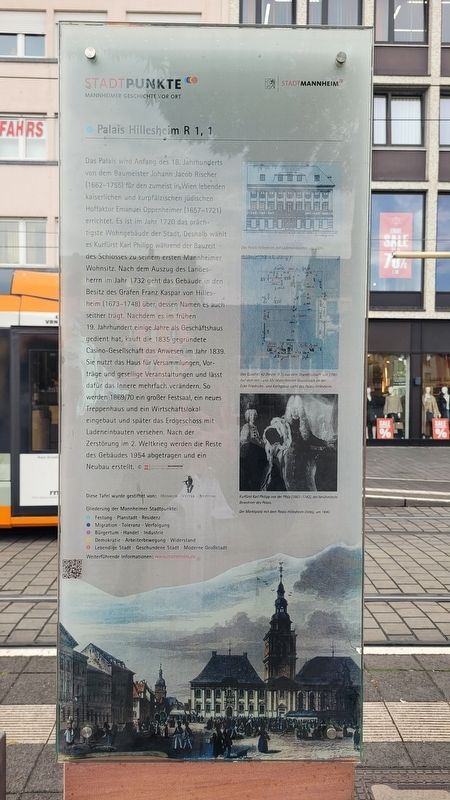
Das Palais wird Anfang des 18. Jahrhunderts von dem Baumeister Johann Jacob Rischer (1662-1755) für den zumeist in Wien lebenden kaiserlichen und kurpfälzischen jüdischen Hoffaktor Emanuel Oppenheimer (1657-1721) errichtet. Es ist im Jahr 1720 das prächtigste Wohngebäude der Stadt. Deshalb wählt es Kurfürst Karl Philipp während der Bauzeit des Schlosses zu seinem ersten Mannheimer Wohnsitz. Nach dem Auszug des Landesherrn im Jahr 1732 geht das Gebäude in den Besitz des Grafen Franz Kaspar von Hillesheim (1673-1748) über, dessen Namen es auch seither trägt. Nachdem es im frühen 19. Jahrhundert einige Jahre als Geschäftshaus gedient hat, kauft die 1835 gegründete Casino-Gesellschaft das Anwesen im Jahr 1839. Sie nutzt das Haus für Versammlungen, Vorträge und gesellige Veranstaltungen und lässt dafür das Innere mehrfach verändern. So werden 1869/70 ein großer Festsaal, ein neues Treppenhaus und ein Wirtschaftslokal eingebaut und später das Erdgeschoss mit Ladeneinbauten versehen. Nach der Zerstörung im 2. Weltkrieg werden die Reste des Gebäudes 1954 abgetragen und ein Neubau erstellt. © Stadtarchiv Mannheim Institut Für Stadtgeschichte
Diese Tafel wurde gestiftet von: Heinrich-Vetter-Stiftung
Bildunterschriften
(Foto Nr. 1) Das Palais Hillesheim mit Ladeneinbauten, um 1900.
(Foto Nr. 2) Das Quadrat 42 (heute. R 1) aus dem Grundrissbuch von 1780. Auf dem mit I und XIV bezeichneten Grundstück an der Ecke Friedrichs- und Karlsgasse steht das Palais Hillesheim.
(Foto Nr. 3) Kurfürst Karl Philipp von der Pfalz (1661-1742), der berühmteste Bewohner des Palais.
(Foto Nr. 4) Der Marktplatz mit dem Palais Hillesheim (links), um 1840.
The palace was built at the beginning of the 18th century by the architect Johann Jacob Rischer (1662-1755) for the imperial and
this page online
This plaque was donated by: Heinrich-Vetter-Stiftung
Captions
(Photo #1) The Hillesheim Palace with shop fittings, around 1900.
(Photo #2) Square 42 (today R 1) from the floor plan book of 1780. The Hillesheim Palace stands on the property marked I and XIV on the corner of Friedrichsgasse and Karlsgasse.
(Photo #3) Elector Karl Philipp of the Palatinate (1661-1742), the palace's most famous resident.
(Photo #4) The market square with the Hillesheim Palace (left), around 1840.
Erected by Stadtpunkte
Photographed by James Hulse, September 23, 2024
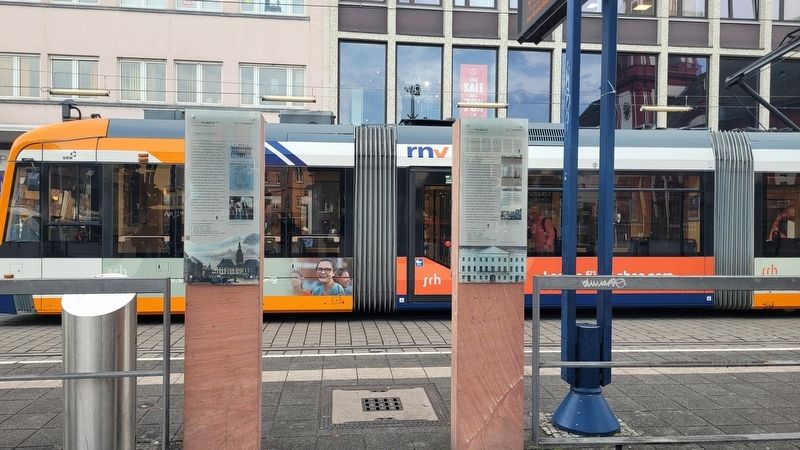
2. The Palace Hillesheim marker is the left marker of the two markers
Topics. This historical marker is listed in this topic list: Notable Buildings. A significant historical year for this entry is 1720.
Location. 49° 29.365′ N, 8° 28.057′ E. Marker is in Mannheim, Baden-Württemberg. It is in Quadrate. It is at the intersection of Kurpfalzstraße and F1 on Kurpfalzstraße. The marker is located in a group of 4 markers at the east side of the Marktplatz by the train platform. Touch for map. Marker is at or near this postal address: R1 1, Mannheim BW 68161, Germany. Touch for directions.

Regionally, this marker is on the German Upper Rhine. Globally, it is in Europe, the European Union, Atlantic Europe, Central Europe, the Schengen Area, Western Europe, and the Western World. Historically, it finds itself in what was once the Roman Empire, the Holy Roman Empire, and the former West Germany.
Other nearby markers. At least 8 other markers are within walking distance of this marker: Marktplatz G 1 / Market Square G 1 (here, next to this marker); Bassermannhaus, R 1, 4-6 / Bassermann House, R 1, 4-6 (here, next to this marker); Altes Rathaus und Untere Pfarrkirche F 1 / Old Town Hall and Lower Parish Church F 1
Photographed by James Hulse, September 23, 2024
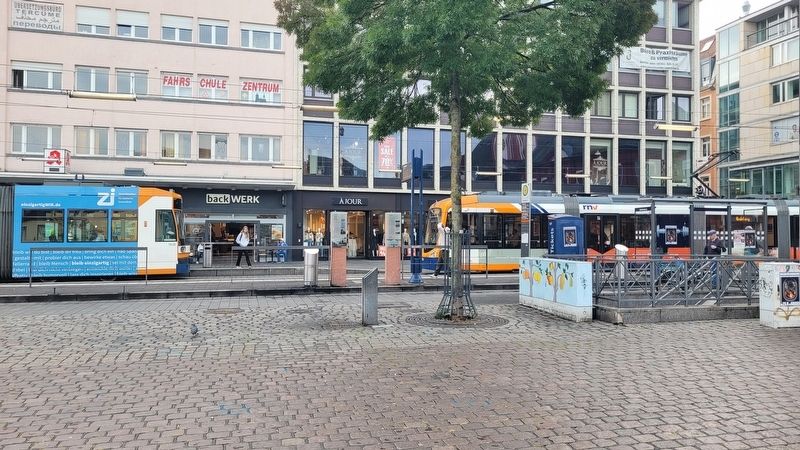
3. The view of the marker along the Marktplatz
More about this marker. There is a non-related marker separately attached on the other side of the post.
Credits. This page was last revised on October 1, 2024. It was originally submitted on October 1, 2024, by James Hulse of Medina, Texas. This page has been viewed 123 times since then and 12 times this year. Photos: 1, 2, 3. submitted on October 1, 2024, by James Hulse of Medina, Texas.
