Quadrate in Mannheim, Baden-Württemberg, Germany — Central Europe
Bassermannhaus, R 1, 4-6
⎯⎯⎯
Bassermann House, R 1, 4-6
Photographed by James Hulse, September 23, 2024
1. Bassermannhaus, R 1, 4-6 / Bassermann House, R 1, 4-6 Marker

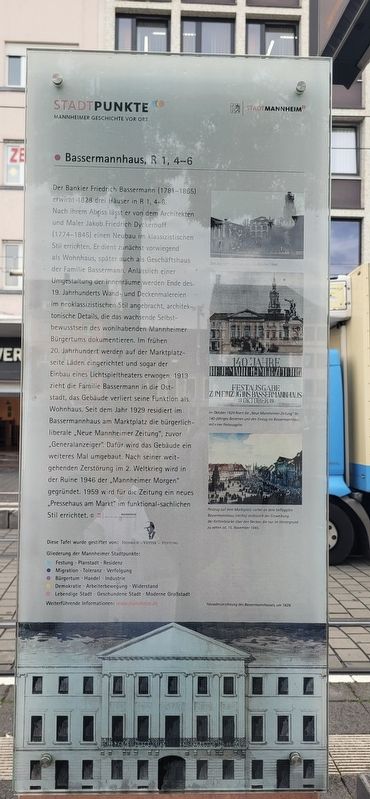
Der Bankier Friedrich Bassermann (1781-1865) erwirbt 1828 drei Häuser in R 1, 4-6. Nach ihrem Abriss lässt er von dem Architekten und Maler Jakob Friedrich Dyckerhoff (1774-1845) einen Neubau im klassizistischen Stil errichten. Er dient zunächst vorwiegend als Wohnhaus, später auch als Geschäftshaus der Familie Bassermann. Anlässlich einer Umgestaltung der Innenräume werden Ende des 19. Jahrhunderts Wand- und Deckenmalereien im neoklassizistischen Stil angebracht, architektonische Details, die das wachsende Selbstbewusstsein des wohlhabenden Mannheimer Bürgertums dokumentieren. Im frühen 20. Jahrhundert werden auf der Marktplatzseite Läden eingerichtet und sogar der Einbau eines Lichtspieltheaters erwogen. 1913 zieht die Familie Bassermann in die Oststadt, das Gebäude verliert seine Funktion als Wohnhaus. Seit dem Jahr 1929 residiert im Bassermannhaus am Marktplatz die bürgerlichliberale „Neue Mannheimer Zeitung", zuvor „Generalanzeiger". Dafür wird das Gebäude ein weiteres Mal umgebaut. Nach seiner weitgehenden Zerstörung im 2. Weltkrieg wird in der Ruine 1946 der „Mannheimer Morgen" gegründet. 1959 wird für die Zeitung ein neues „Pressehaus am Markt" im funktional-sachlichen Stil errichtet. © Stadtarchiv Mannheim Institut Für Stadtgeschichte
Diese Tafel wurde gestiftet von: Heinrich-Vetter-Stiftung
Bildunterschriften
(Foto Nr. 1) Das zerstört Gebäude um 20. Oktober 1944.
(Foto Nr. 2) Im Oktober 1929 feiert die „Neue Mannheimer Zeitung" ihr 140-jähriges Bestehen und den Einzug ins Bassermannhaus mit einer Festousgabe.
(Foto Nr. 3) Festzug auf dem Marktplatz vorbei an dem beflaggten Bassermannhaus (rechts) anlässlich der Einweihung der Kettenbrücke über den Neckar, die nur im Hintergrund zu sehen ist, 15. November 1845.
(Foto Nr. 4) Fassadenzeichnung des Bassermannhauses, um 1829.
In
this page online
Photographed by James Hulse, September 23, 2024
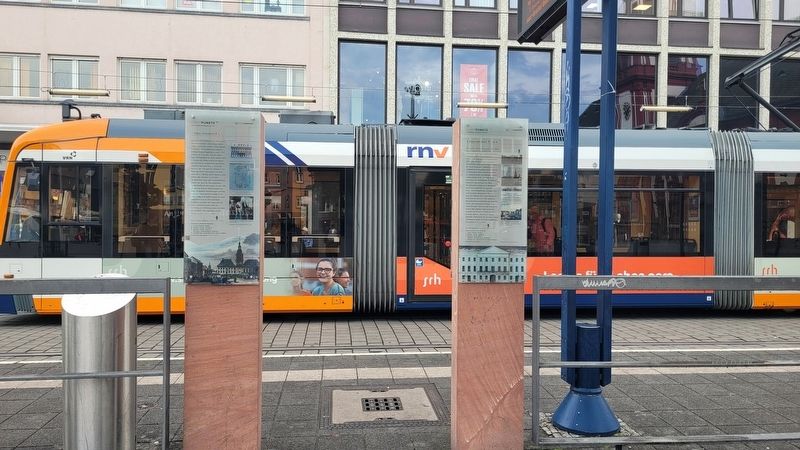
2. The Bassermann House marker is on the right side of the two markers
This plaque was donated by: Heinrich-Vetter-Stiftung
Captions
(Photo #1) The destroyed building around October 20, 1944.
(Photo #2) In October 1929, the "Neue Mannheimer Zeitung" celebrated its 140th anniversary and its move into the Bassermannhaus with a festival edition.
(Photo #3) Festive procession on the market square past the flagged Bassermannhaus (right) on the occasion of the inauguration of the chain bridge over the Neckar, which can only be seen in the background, November 15, 1845.
(Photo #4) Facade drawing of the Bassermannhaus, around 1829.
Erected by Stadtpunkte Mannheimer Geschichte Vor Ort and Stadt Mannheim.
Topics. This historical marker is listed in this topic list: Industry & Commerce. A significant historical year for this entry is 1828.
Location. 49° 29.364′ N, 8° 28.055′ E. Marker is in Mannheim, Baden-Württemberg. It is in Quadrate. It can be reached from the intersection of Kurpfalzstraße and F1, on the right when traveling south. The marker is located in a group of
Photographed by James Hulse, September 23, 2024
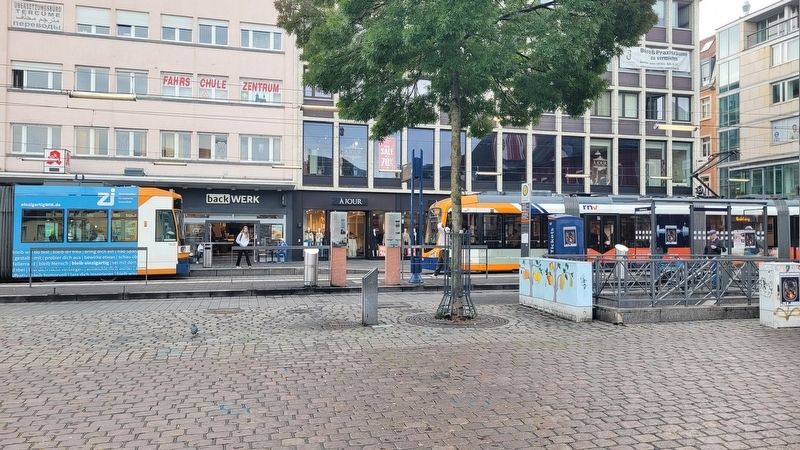
3. The view of the markers from the Marktplatz

Regionally, this marker is on the German Upper Rhine. Globally, it is in Europe, the European Union, Atlantic Europe, Central Europe, the Schengen Area, Western Europe, and the Western World. Historically, it finds itself in what was once the Roman Empire, the Holy Roman Empire, and the former West Germany.
Other nearby markers. At least 8 other markers are within walking distance of this marker: Marktplatz G 1 / Market Square G 1 (here, next to this marker); Altes Rathaus und Untere Pfarrkirche F 1 / Old Town Hall and Lower Parish Church F 1 (here, next to this marker); Palais Hillesheim R 1, 1 / Palace Hillesheim R 1, 1 (here, next to this marker); Altes Rathaus / Old Town Hall (within shouting distance of this marker); Marktplatzbrunnen / Market Square Fountain (within shouting distance of this marker); Die Klaussynagoge / The Klaus Synagogue (about 90 meters away, measured in a direct line); Passage Rös F 1, 3 bzw. 7a (about 90 meters away); Konkordienkirche R 2 / Concordia Church R 2 (about 120 meters away). Touch for a list and map of all markers in Mannheim.
More about this marker. There is a non-related marker separately attached on the other side of the post.
Credits. This page was last revised on October 1, 2024. It was originally submitted on October 1, 2024, by James Hulse of Medina, Texas. This page has been viewed 126 times since then and 25 times this year. Photos: 1, 2, 3. submitted on October 1, 2024, by James Hulse of Medina, Texas.
