Quadrate in Mannheim, Baden-Württemberg, Germany — Central Europe
Marktplatz G 1
⎯⎯⎯
Market Square G 1
Photographed by James Hulse, September 23, 2024
1. Marktplatz G 1 / Market Square G 1 Marker

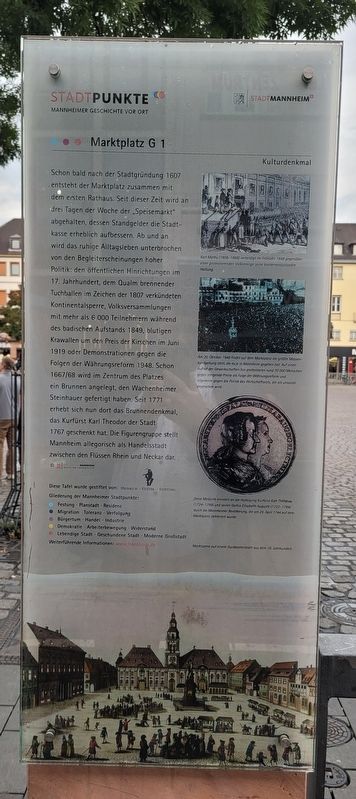
Schon bald nach der Stadtgründung 1607 entsteht der Marktplatz zusammen mit dem ersten Rathaus. Seit dieser Zeit wird an drei Tagen der Woche der „Speisemarkt" abgehalten, dessen Standgelder die Stadtkasse erheblich aufbessern. Ab und an wird das ruhige Alltagsleben unterbrochen von den Begleiterscheinungen hoher Politik: den öffentlichen Hinrichtungen im 17. Jahrhundert, dem Qualm brennender Tuchballen im Zeichen der 1807 verkündeten Kontinentalsperre, Volksversammlungen mit mehr als 6 000 Teilnehmern während des badischen Aufstands 1849, blutigen Krawallen um den Preis der Kirschen im Juni 1919 oder Demonstrationen gegen die Folgen der Währungsreform 1948. Schon 1667/68 wird im Zentrum des Platzes ein Brunnen angelegt, den Wachenheimer Steinhauer gefertigt haben. Seit 1771 erhebt sich nun dort das Brunnendenkmal, das Kurfürst Karl Theodor der Stadt 1767 geschenkt hat. Die Figurengruppe stellt Mannheim allegorisch als Handelsstadt zwischen den Flüssen Rhein und Neckar dar. © Stadtarchiv Mannheim Institut Für Stadtgeschichte
Diese Tafel wurde gestiftet von: Heinrich-Vetter-Stiftung
Bildunterschriften
(Foto Nr. 1) Karl Mathy (1806-1868) verteidigt im Frühjahr 1848 gegenüber einer protestierenden Volksmenge seine konterrevolutionäre Haltung
(Foto Nr. 2) Am 20. Oktober 1948 findet auf dem Marktplatz die größte Mossenkundgebung statt, die es je in Mannheim gegeben hat. Auf einen Aufruf der Gewerkschaften hin protestieren rund 70 000 Menschen gegen steigende Preise als Folge der Währungsreform und allgemein gegen die Politik des Wirtschaftsrats, die als unsozial ongesehen wird
(Foto Nr. 3) Diese Medaille ennnert an die Huldigung Kurfürst Karl Theodors (1724-1799) und seiner Gattin Elisabeth Auguste (1722-1794) durch die Mannheimer Bevölkerung, die am 29. April 1744 auf dem Marktplatz zelebriert wurde.
(Foto Nr. 4) Marktszene auf einem Guckkastenblatt aus dem 18. Jahrhundert.
Soon
this page online
This plaque was donated by: Heinrich-Vetter-Stiftung
Captions
(Photo #1) In the spring of 1848, Karl Mathy (1806-1868) defended his counter-revolutionary stance to a protesting crowd.
(Photo #2) On October 20, 1948, the largest demonstration ever held in Mannheim took place on the market square. In response to a call from the trade unions, around 70,000 people protested against rising prices as a result of the currency reform and generally against the policies of the Economic Council, which were seen as anti-social.
(Photo #3) This medal commemorates the homage to Elector Karl Theodor (1724-1799) and his wife Elisabeth Auguste (1722-1794) by the people of Mannheim, which was celebrated on April 29, 1744 on the market square.
(Photo #4) Market scene on a peep-show sheet from the 18th century.
Erected by Stadtpunkte
Photographed by James Hulse, September 23, 2024
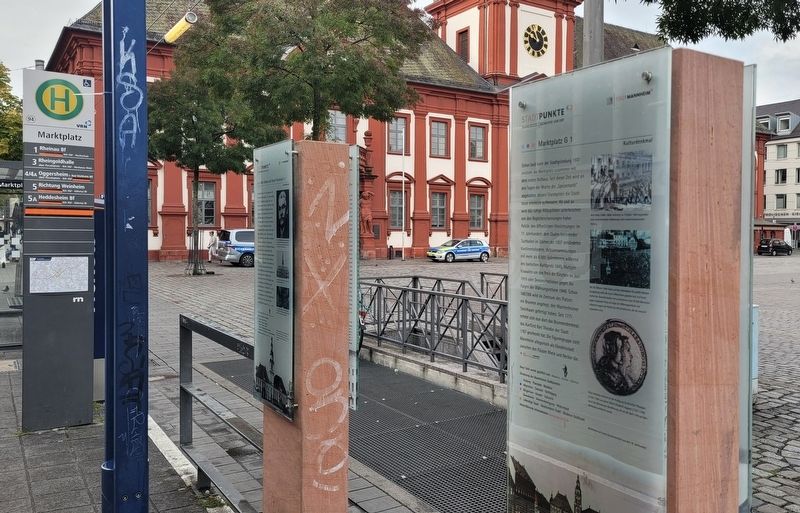
2. The Marktplatz Marker is the right side marker of the two markers
Topics. This historical marker is listed in this topic list: Notable Places. A significant historical year for this entry is 1607.
Location. 49° 29.364′ N, 8° 28.056′ E. Marker is in Mannheim, Baden-Württemberg. It is in Quadrate. It is at the intersection of Kurpfalzstraße and F1 on Kurpfalzstraße. The marker is located in a group of 4 markers at the east side of the Marktplatz by the train platform. Touch for map. Marker is at or near this postal address: G1, Mannheim BW 68161, Germany. Touch for directions.

Regionally, this marker is on the German Upper Rhine. Globally, it is in Europe, the European Union, Atlantic Europe, Central Europe, the Schengen Area, Western Europe, and the Western World. Historically, it finds itself in what was once the Roman Empire, the Holy Roman Empire, and the former West Germany.
Other nearby markers. At least 8 other markers are within walking distance of this marker: Bassermannhaus, R 1, 4-6 / Bassermann House, R 1, 4-6 (here, next to this marker); Palais Hillesheim R 1, 1 / Palace Hillesheim R 1, 1 (here, next to this marker); Altes Rathaus und Untere Pfarrkirche F 1 / Old Town Hall and Lower Parish Church F 1
Photographed by James Hulse, September 23, 2024
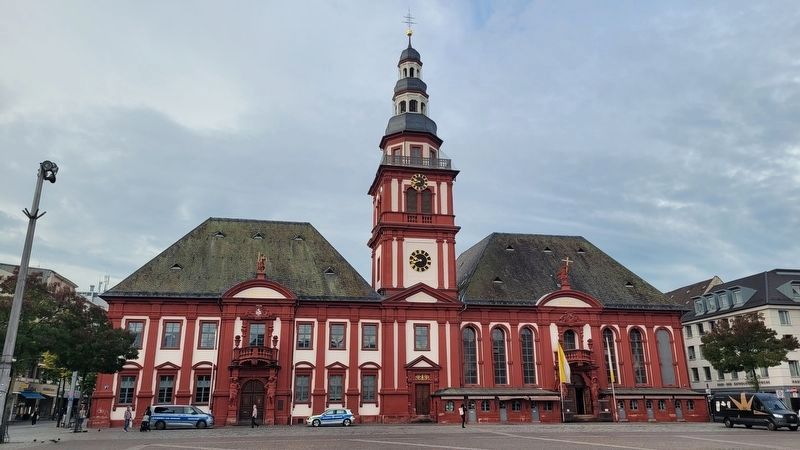
3. The Altes Rathaus building in the Marktplatz
More about this marker. There is a non-related marker separately attached on the other side of the post.
Credits. This page was last revised on October 1, 2024. It was originally submitted on October 1, 2024, by James Hulse of Medina, Texas. This page has been viewed 121 times since then and 15 times this year. Photos: 1, 2, 3. submitted on October 1, 2024, by James Hulse of Medina, Texas.
