Quadrate in Mannheim, Baden-Württemberg, Germany — Central Europe
Altes Rathaus und Untere Pfarrkirche F 1
⎯⎯⎯
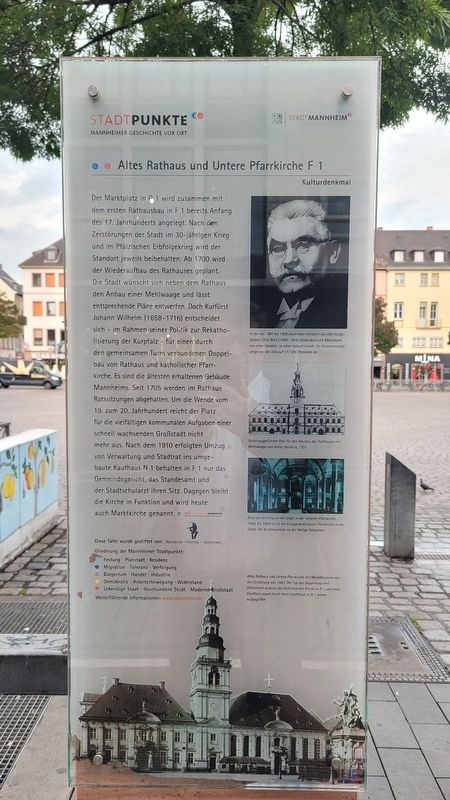
Old Town Hall and Lower Parish Church F 1
Photographed by James Hulse, September 23, 2024
1. Altes Rathaus und Untere Pfarrkirche F 1 / Old Town Hall and Lower Parish Church F 1 Marker

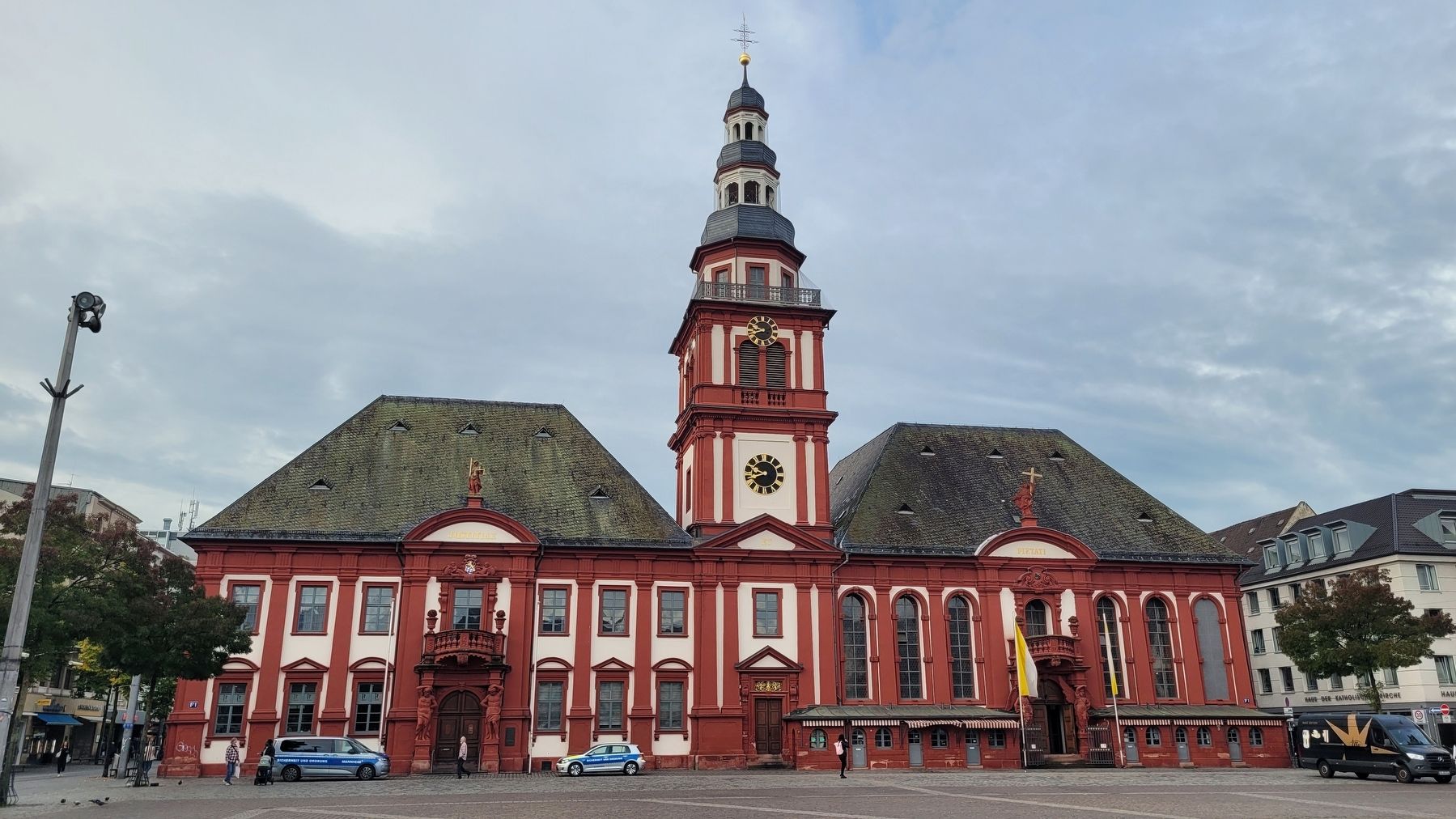
Der Marktplatz in G 1 wird zusammen mit dem ersten Rathausbau in F 1 bereits Anfang des 17. Jahrhunderts angelegt. Nach den Zerstörungen der Stadt im 30-jährigen Krieg und im Pfälzischen Erbfolgekrieg wird der Standort jeweils beibehalten. Ab 1700 wird der Wiederaufbau des Rathauses geplant. Die Stadt wünscht sich neben dem Rathaus den Anbau einer Mehlwaage und lässt entsprechende Pläne entwerfen. Doch Kurfürst Johann Wilhelm (1658-1716) entscheidet sich - im Rahmen seiner Politik zur Rekatholisierung der Kurpfalz - für einen durch den gemeinsamen Turm verbundenen Doppelbau von Rathaus und katholischer Pfarrkirche. Es sind die ältesten erhaltenen Gebäude Mannheims. Seit 1705 werden im Rathaus Ratssitzungen abgehalten. Um die Wende vom 19. zum 20. Jahrhundert reicht der Platz für die vielfältigen kommunalen Aufgaben einer schnell wachsenden Großstadt nicht mehr aus. Nach dem 1910 erfolgten Umzug von Verwaltung und Stadtrat ins umgebaute Kaufhaus N 1 behalten in F 1 nur das Gemeindegericht, das Standesamt und der Stadtschularzt ihren Sitz. Dagegen bleibt die Kirche in Funktion und wird heute auch Marktkirche genannt. © Stadtarchiv Mannheim Institut Für Stadtgeschichte
Diese Tafel wurde gestiftet von: Heinrich-Vetter-Stiftung
Bildunterschriften
(Foto Nr. 1) In der von 1891 bis 1908 douenden Amtszeit von Oberbürgermeister Otto Beck (1846-1908) entwickelt sich Mannheim von einer Handels- zu einer Industriestadt. Die Einwohnerzahl steigt von 80 000 auf 177 000 Personen an.
(Foto Nr. 2) Nicht ausgeführter Plan für den Neubau des Rathauses mit Mehlwaage von Anton Bailleux, 1701.
(Foto Nr. 3) Blick auf die Empore mit Orgel in der Unteren Pfarrkirche, 1934, bis 1804 ist sie die einzige katholische Pfarrkirche in der Stadt. Der Kirchenpatron ist der Heilige Sebastian.
(Foto Nr. 4) Altes Rathaus und Untere Pfarrkirche mit Marktbrunnen vor der Zerstörung von 1943. Der Typ des Doppelbaus mit Mittelturm wird bei der Reformierten Kirche in R 1 und beim Kaufhaus sowie heute beim Stadthaus in N T wieder aufgegriffen.
The
this page online
Photographed by James Hulse, September 23, 2024
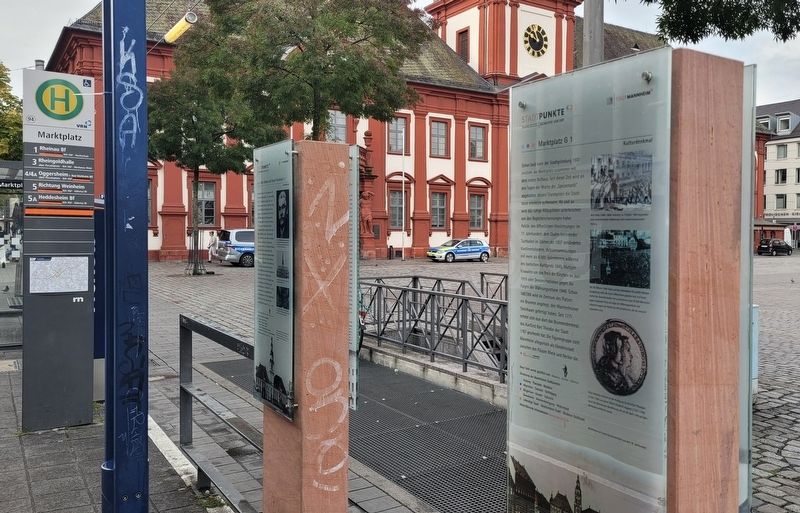
2. The Old Town Hall and Lower Parish Church Marker is the left marker of the two markers
This plaque was donated by: Heinrich-Vetter-Stiftung
Captions
(Photo #1) During the term of office of Mayor Otto Beck (1846-1908), which lasted from 1891 to 1908, Mannheim developed from a commercial to an industrial city. The population increased from 80,000 to 177,000 people.
(Photo #2) Unexecuted plan for the new town hall with Mehlwaage by Anton Bailleux, 1701.
(Photo #3) View of the gallery with organ in the Lower Parish Church, 1934, until 1804 it was the only Catholic parish church in the city. The patron saint is Saint Sebastian.
(Photo #4) Old town hall and Lower Parish Church with market avenues before the destruction in 1943. The type of double building with a central tower was taken up again in the Reformed Church in R 1 and in the department store, as well as today in the town hall in N 1.
Erected by Stadtpunkte Mannheimer Geschichte Vor Ort and Stadt Mannheim.
Topics. This historical marker is listed in this topic list: Notable Buildings. A significant historical year for this entry is 1700.
Location. 49° 29.363′ N, 8° 28.055′ E. Marker is in Mannheim, Baden-Württemberg. It is in
Photographed by James Hulse, September 23, 2024
3. The Altes Rathaus / Old Town Hall

Regionally, this marker is on the German Upper Rhine. Globally, it is in Europe, the European Union, Atlantic Europe, Central Europe, the Schengen Area, Western Europe, and the Western World. Historically, it finds itself in what was once the Roman Empire, the Holy Roman Empire, and the former West Germany.
Other nearby markers. At least 8 other markers are within walking distance of this marker: Bassermannhaus, R 1, 4-6 / Bassermann House, R 1, 4-6 (here, next to this marker); Marktplatz G 1 / Market Square G 1 (here, next to this marker); Palais Hillesheim R 1, 1 / Palace Hillesheim R 1, 1 (here, next to this marker); Altes Rathaus / Old Town Hall (within shouting distance of this marker); Marktplatzbrunnen / Market Square Fountain (within shouting distance of this marker); Die Klaussynagoge / The Klaus Synagogue (about 90 meters away, measured in a direct line); Passage Rös F 1, 3 bzw. 7a (about 90 meters away); Konkordienkirche R 2 / Concordia Church R 2 (about 120 meters away). Touch for a list and map of all markers in Mannheim.
More about this marker. There is a non-related marker separately attached on the other side of the post.
Credits. This page was last revised on October 2, 2024. It was originally submitted on October 1, 2024, by James Hulse of Medina, Texas. This page has been viewed 108 times since then and 16 times this year. Photos: 1, 2, 3. submitted on October 2, 2024, by James Hulse of Medina, Texas.
