Ile de la Cité in Paris in Département de Paris, Île-de-France, France — Western Europe
Héloïse and Abelard
Photographed by Andrew Ruppenstein, September 11, 2024
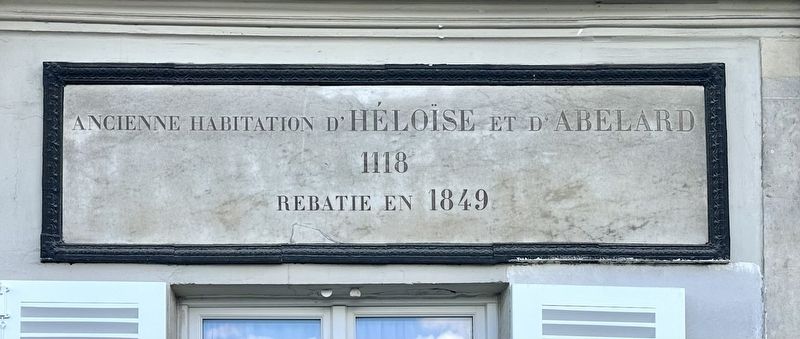
1. Héloïse and Abelard Marker

1118
Rebatie en 1849
Former home of Heloise and Abelard
1118
Rebuilt in 1849
Topics. This historical marker is listed in this topic list: Arts, Letters, Music.
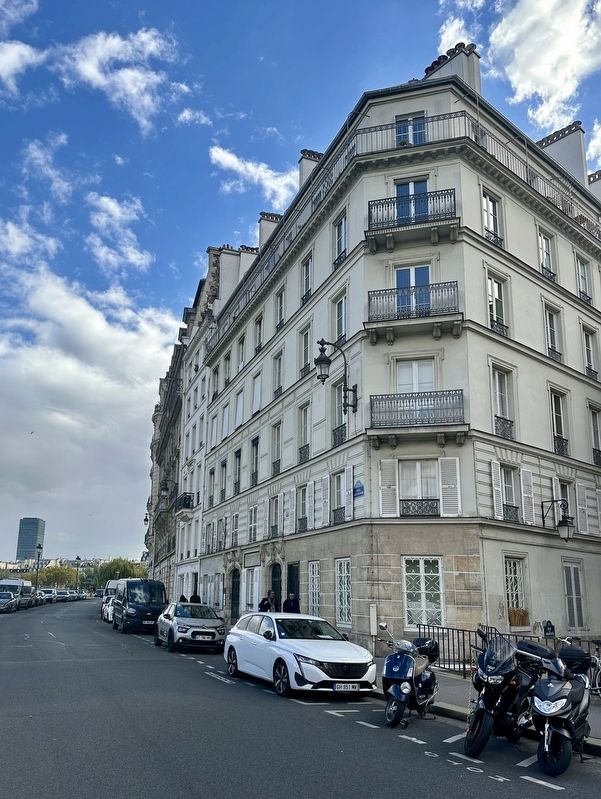
Location. 48° 51.224′ N, 2° 21.109′ E. Marker is in Paris, Île-de-France, in Département de Paris. It is in Ile de la Cité. It is on Quai aux Fleurs, on the left when traveling north. Touch for map. Marker is at or near this postal address: 9 Quai aux Fleurs, Paris, Île-de-France 75004, France. Touch for directions.

Regionally, it is in the North Atlantic Region, Europe, the European Union, Atlantic Europe, the Schengen Area, Western Europe, a coastal Mediterranean country, and the Western World. Historically, it finds itself in what was once a French colony and also the Roman Empire.
Other nearby markers. At least 8 other markers are within walking distance of this marker: Edmond Haraucourt (a few steps from this marker); Rene Coty (a few steps from this marker); Yvonne Netter (within shouting distance of this marker); Joachim du Bellay (within shouting distance of this marker); Marcel Le Vionnois (about 90 meters away, measured in a direct
this page online
Also see . . .
1. Abelard and Heloise – the French Romeo and Juliet (The Good Life France). Overview:
Long before Romeo and Juliet, and the City of Romance itself, another couple set tongues wagging, with their ill-fated romance. Abelard and Heloise’s tale is fascinating, and you can still trace parts of it in Paris today.(Submitted on October 2, 2024.)
The thwarted couple first met on the Ile de la Cite. When Peter Abelard arrived in Paris in 1100 as a student to Guillaume de Champeaux, he soon became a teacher himself. He was asked by the canon of Notre Dame to become tutor to his niece, Heloise. The location of the episcopal school where Abelard taught is now used as garages by the gendarmes.
At Numbers 9 and 11, plaques and a pair of stone medallions commemorate the home of Canon Fulbert. He was Heloise’s uncle, under whose roof Abelard and Heloise began their affair. When Heloise fell pregnant and gave birth to their son, Astrolabe, her uncle forced them into marriage. Heloise argued against it, upset about the effect it could have on Abelard’s career ambitions.
To try andsalvage the situation, Abelard sent Heloise away to a convent for her own protection. But Fulbert wasn’t prepared to let the damage to his reputation go unpunished. He sent a gang of thugs to Abelard’s home to perform, shall we say, the unkindest cut of all.Photographed by Andrew Ruppenstein, September 11, 20242. Héloïse and Abelard Marker - wide view

2. Letters of Abelard and Heloise (Wikipedia). Overview:
The Letters of Abelard and Heloise are a series of passionate and intellectual correspondences written in Latin during the 12th century. The authors, Peter Abelard, a prominent theologian, and his pupil, Heloise, a gifted young woman later renowned as an abbess, exchanged these letters following their ill-fated love affair and subsequent monastic lives.(Submitted on October 2, 2024.)
The letters reveal the personal and intellectual relationship between Abelard and Heloise, and provide an intimate glimpse into the societal context of 12th-century Europe. They've played a significant role in the development of Western epistolary literature, attracting attention from historians, literary scholars, and general readers alike. The Letters of Abelard and Heloise also serve as primary source documents on questions of medieval gender roles, love, and monastic life.
Photographed by Andrew Ruppenstein, September 11, 2024
3. Héloïse and Abelard Marker - wider view
Credits. This page was last revised on October 2, 2024. It was originally submitted on October 2, 2024, by Andrew Ruppenstein of Lamorinda, California. This page has been viewed 457 times since then and 57 times this year. Photos: 1, 2, 3. submitted on October 2, 2024, by Andrew Ruppenstein of Lamorinda, California.
