Stuttgart-Mitte , Baden-Württemberg, Germany — Central Europe
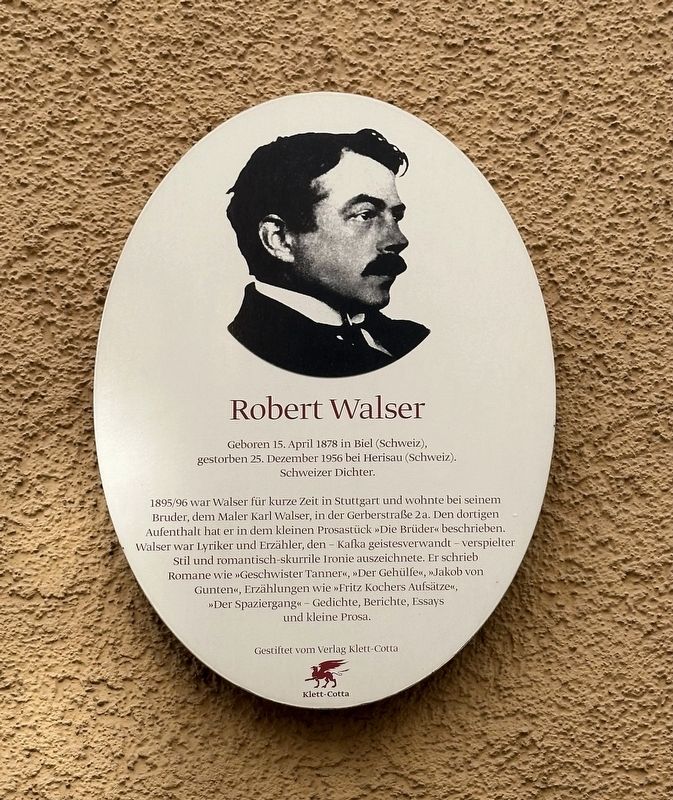
Robert Walser
Photographed by Andrew Ruppenstein, September 13, 2024
1. Robert Walser Marker

gestorben 25. Dezember 1956 bei Herisau (Schweiz).
Schweizer Dichter.
1895/96 war Walser für kurze Zeit in Stuttgart und wohnte bei seinem Bruder, dem Maler Karl Walser, in der Gerberstraße 2a. Den dortigen Aufenthalt hat er in dem kleinen Prosastück »Die Brüder« beschrieben. Walser war Lyriker und Erzähler, den - Kafka geistesverwandt - verspielter Stil und romantisch-skurrile Ironie auszeichnete. Er schrieb Romane wie »Geschwister Tanner«, »Der Gehülfe«, »Jakob von Gunten« , Erzählungen wie »Fritz Kochers Aufsätze« , »Der Spaziergang« - Gedichte, Berichte, Essays und kleine Prosa.
Gestiftet vom Verlag Klett-Cotta
Born April 15, 1878 in Biel (Switzerland), died December 25, 1956 near Herisau (Switzerland). Swiss poet.
In 1895-96, Walser was in Stuttgart for a short time and lived with his brother, the painter Karl Walser, at Gerberstrasse 2a. He described his stay there in the short prose piece "The Brothers". Walser was a poet and storyteller who - a kindred spirit to Kafka - was characterized by a playful style and romantic,
this page online
Donated by the Klett-Cotta publishing house
Topics. This historical marker is listed in this topic list: Arts, Letters, Music. A significant historical date for this entry is April 15, 1878.
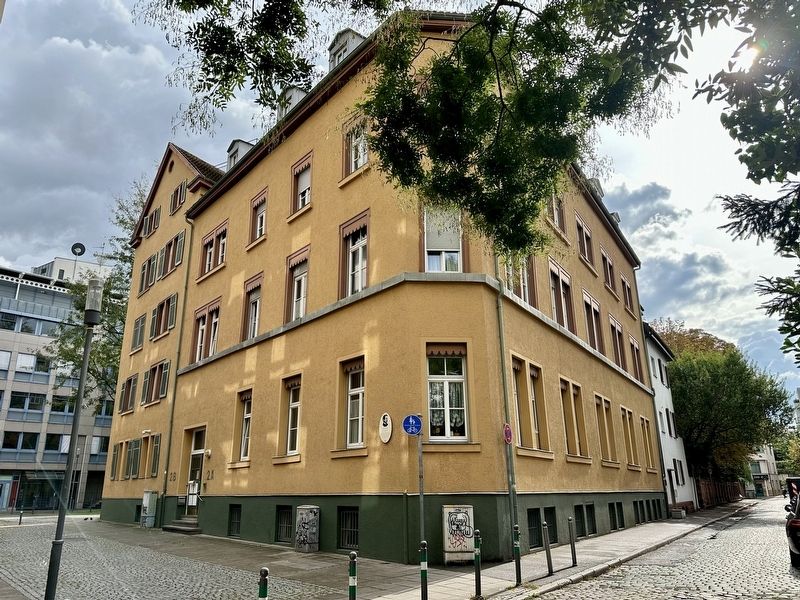
Location. 48° 46.336′ N, 9° 10.621′ E. Marker is in Stuttgart, Baden-Württemberg. It is in Stuttgart-Mitte. It is at the intersection of Gerberstraße and Nesenbachstrasse, on the left when traveling north on Gerberstraße. Touch for map. Marker is at or near this postal address: Gerberstraße 2A, Stuttgart BW 70178, Germany. Touch for directions.

Regionally, this marker is in German Swabia. Globally, it is in Europe, the European Union, Atlantic Europe, Central Europe, the Schengen Area, Western Europe, and the Western World. Historically, it finds itself in what was once the Roman Empire, the Holy Roman Empire, and the former West Germany.
Other nearby markers. At least 8 other markers are within walking distance of this marker: Rest eines Rundturms / Remains of a Round Tower
Photographed by Andrew Ruppenstein, September 13, 2024
2. Robert Walser Marker - wide view
Also see . . . Robert Walser (Wikipedia). Excerpt:
Robert Walser (15 April 1878 – 25 December 1956) was a German language Swiss writer. He additionally worked as a copyist, an inventor's assistant, a butler, and in various other low-paying trades. Despite marginal early success in his literary career, the popularity of his work gradually diminished over the second and third decades of the 20th century, making it increasingly difficult for him to support himself through writing. He eventually had a nervous breakdown and spent the remainder of his life in sanatoriums.(Submitted on October 2, 2024.)
Today, Walser's texts, completely re-edited since the 1970s, are regarded as among the most important writings of literary modernism. In his writing, he made use of elements of Swiss German in a charming and original manner, while very personal observations are interwoven with texts about texts; that is, with contemplations and variations of other literary works, in which Walser often mixes pulp fiction with high literature. Walser has been regarded as the missing link between Heinrich von Kleist and Franz Kafka. As writes Susan Sontag, "at the time [of Walser's writing], it was more likely to be Kafka [who was understood] through the prism of Walser." For example, Robert Musil once referred to Kafka's work as "a peculiar case of the Walser type."
Credits. This page was last revised on October 2, 2024. It was originally submitted on October 2, 2024, by Andrew Ruppenstein of Lamorinda, California. This page has been viewed 124 times since then and 24 times this year. Photos: 1, 2. submitted on October 2, 2024, by Andrew Ruppenstein of Lamorinda, California.
