Quadrate in Mannheim, Baden-Württemberg, Germany — Central Europe
Schlosskirche
⎯⎯⎯
Palace Church
Photographed by James Hulse, September 23, 2024
1. Schlosskirche / Palace Church Marker

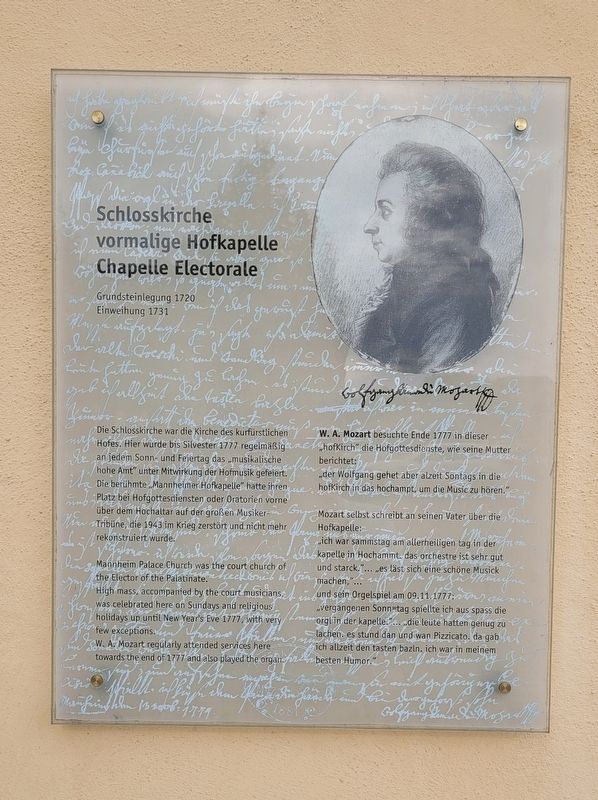
Schlosskirche vormalige Hofkapelle Chapelle Electorale,
Grundsteinlegung 1720, Einweihung 1731
Die Schlosskirche war die Kirche des kurfürstlichen Hofes. Hier wurde bis Silvester 1777 regelmäßiger an jedem Sonn- und Feiertag das „musikalische hohe Amt" unter Mitwirkung der Hofmusik gefeiert. Die berühmte „Mannheimer Hofkapelle" hatte ihren. Platz bei Hofgottesdiensten oder Oratorien vorne über dem Hochaltar auf der großen Musiker-Tribüne, die 1943 im Krieg zerstört und nicht mehr rekonstruiert wurde.
W.A. Mozart besuchte Ende 1777 in dieser „hofKirch" die Hofgottesdienste, wie seine Mutter berichtet: „der Wolfgang gehet aber alzeit Sontags in die hofKirch in das hochampt, um die Music zu hören.” Mozart selbst schreibt an seinen Vater über die Hofkapelle: „ich war sammstag am allerheiligen tag in in der kapelle in Hochammt. das orchestre ist sehr gut und starck."... „es läst sich eine schöne Musick machen,"... und sein Orgelspiel am 09.11.1777: „vergangenen Sonn=tag spiellte ich aus spass die orgl in der kapelle.”... „die leüte hatten genug zu lachen. es stund dan und wan Pizzicato.
this page online
Palace Church, former court chapel Chapelle Electorale,
Foundation stone laid in 1720, inauguration in 1731
Mannheim Palace Church was the court church of the Elector of the Palatinate. High mass, accompanied by the court musicians, was celebrated here on Sundays and religious holidays up until New Year's Eve 1777, with very few exceptions. W.A. Mozart regularly attended services here towards the end of 1777 and also played the organ. The famous "Mannheim Court Orchestra" had its place at court services or oratorios in front above the high altar on the large musicians' platform, which was destroyed in the war in 1943 and not reconstructed.
W.A. Mozart attended court services in this "court church" at the end of 1777, as his mother reports: "Wolfgang always goes to the court church in Hochampt on Sundays to hear the music." Mozart himself wrote to his father about the court orchestra: "I was in the chapel in Hochammt on Saturday, All Saints' Day. The orchestra is very good and strong."... "you can make beautiful music,"... and
Photographed by James Hulse, September 23, 2024
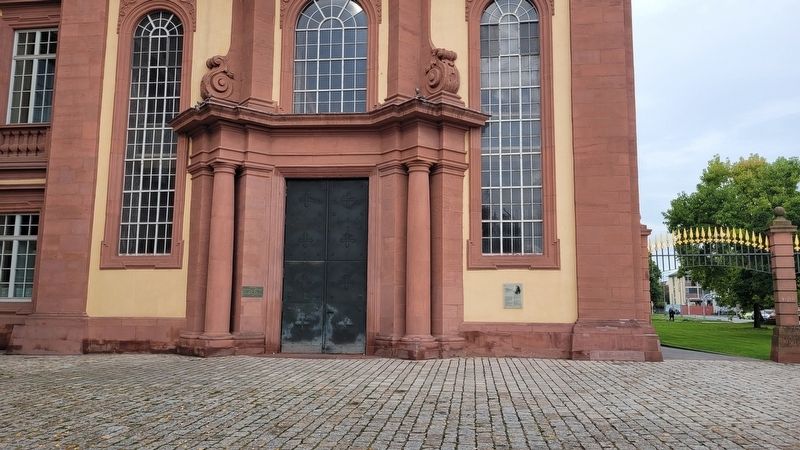
2. The entrance to the Schlosskirche / Palace Church
Topics. This historical marker is listed in these topic lists: Arts, Letters, Music • Forts and Castles • Religion & Religious Structures. A significant historical year for this entry is 1720.
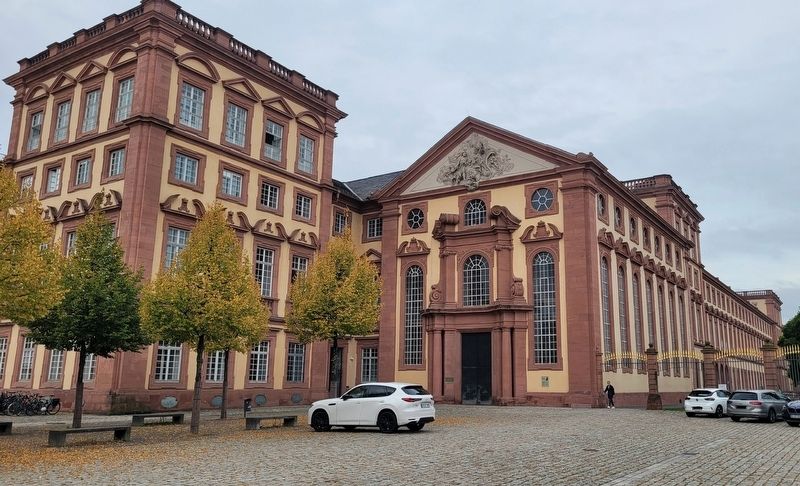
Location. 49° 29.062′ N, 8° 27.717′ E. Marker is in Mannheim, Baden-Württemberg. It is in Quadrate. It is at the intersection of Bismarckstraße and A2, on the right when traveling east on Bismarckstraße. The marker is located on the corner of the church on the campus of the University of Mannheim. Touch for map. Marker is at or near this postal address: Bismarckstraße 14, Mannheim BW 68159, Germany. Touch for directions.

Regionally, this marker is on the German Upper Rhine. Globally, it is in Europe, the European Union, Atlantic Europe, Central Europe, the Schengen Area, Western Europe, and the Western World. Historically, it finds itself in what was once the Roman Empire, the Holy Roman Empire,
Photographed by James Hulse
3. The marker is located at the right side of the entrance
Other nearby markers. At least 8 other markers are within walking distance of this marker: A different marker also named Schlosskirche / Palace Church (a few steps from this marker); Friedrich Schiller (within shouting distance of this marker); Heidelberger Romantik / Heidelberg Romanticism (within shouting distance of this marker); Johann Jakob Hemmer (within shouting distance of this marker); Christian Mayer (within shouting distance of this marker); Karl Friedrich Drais (within shouting distance of this marker); Wege zur Demokratie / Paths to Democracy (within shouting distance of this marker); Wolfgang Amadeus Mozart (within shouting distance of this marker). Touch for a list and map of all markers in Mannheim.
Also see . . . Wolfgang Amadeus Mozart. Wikipedia
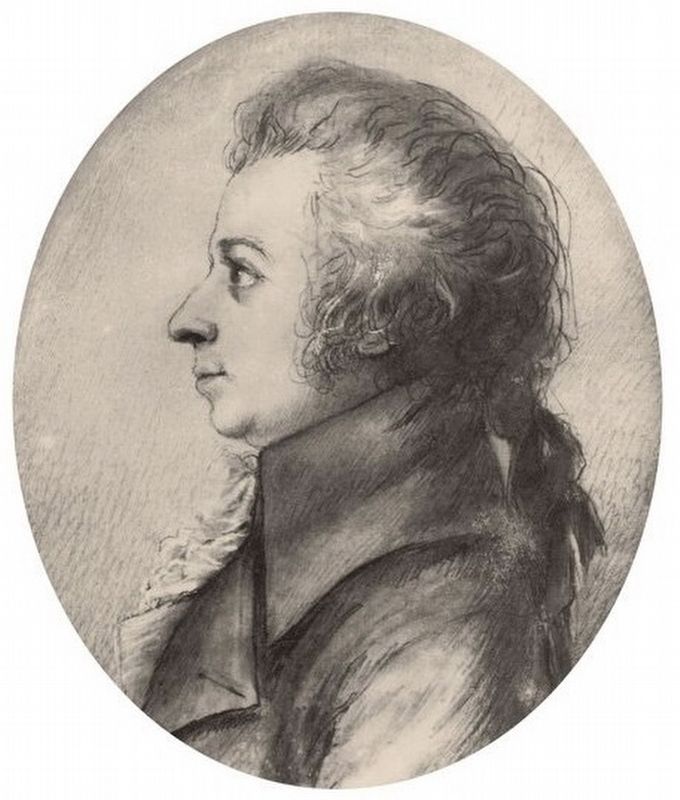
Wolfgang Amadeus Mozart (27 January 1756 – 5 December 1791) was a prolific and influential composer of the Classical period. Despite his short life, his rapid pace of composition resulted in more than 800 works representing virtually every Western classical genre of his time. Many of these compositions are acknowledged as pinnacles(Submitted on October 3, 2024, by James Hulse of Medina, Texas.)of the symphonic, concertante, chamber, operatic, and choral repertoire. Mozart is widely regarded as one of the greatest composers in the history of Western music, with his music admired for its "melodic beauty, its formal elegance and its richness of harmony and texture".Public Domain - Doris Stock, 17894. Portrait of Wolfgang Amadeus MozartThe Silverpoint drawing was made when Mozart visited the city of Dresden in April, 1789.
Credits. This page was last revised on October 3, 2024. It was originally submitted on October 3, 2024, by James Hulse of Medina, Texas. This page has been viewed 215 times since then and 90 times this year. Photos: 1, 2, 3, 4. submitted on October 3, 2024, by James Hulse of Medina, Texas.
