Quadrate in Mannheim, Baden-Württemberg, Germany — Central Europe
Schloss, Universität
⎯⎯⎯
Palace, University
Photographed by James Hulse, September 23, 2024
1. Schloss, Universität / Palace, University Marker

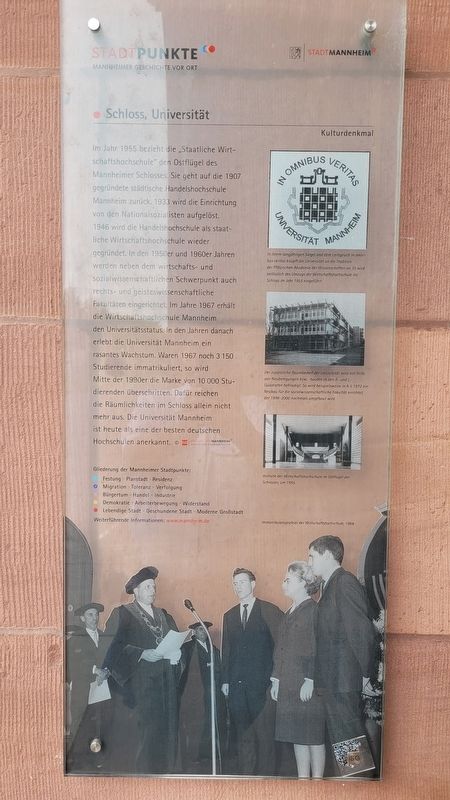
Im Jahr 1955 bezieht die „Staatliche Wirtschaftshochschule" den Ostflügel des Mannheimer Schlosses. Sie geht auf die 1907 gegründete städtische Handelshochschule Mannheim zurück. 1933 wird die Einrichtung von den Nationalsozialisten aufgelöst. 1946 wird die Handelshochschule als staatliche Wirtschaftshochschule wieder gegründet. In den 1950er und 1960er Jahren werden neben dem wirtschafts- und sozialwissenschaftlichen Schwerpunkt auch rechts- und geisteswissenschaftliche Fakultäten eingerichtet. Im Jahre 1967 erhält die Wirtschaftshochschule Mannheim den Universitätsstatus. In den Jahren danach erlebt die Universität Mannheim ein rasantes Wachstum. Waren 1967 noch 3 150 Studierende immatrikuliert, so wird Mitte der 1990er die Marke von 10 000 Studierenden überschritten. Dafür reichen die Räumlichkeiten im Schloss allein nicht mehr aus. Die Universität Mannheim ist heute als eine der besten deutschen Hochschulen anerkannt. © Stadtarchiv Mannheim Institut Für Stadtgeschichte
Bildunterschriften
(Foto Nr. 1) In ihrem langjährigen Siegel und dem Leitspruch in omnibus veritas knüpft die Universität an die Tradition der Pfälzischen Akademie der Wissenschaften on. Es wird anlässlich des Umzugs der Wirtschaftshochschule ins Schloss im Jahr 1955 eingeführt.
(Foto Nr. 2) Der zusätzliche Raumbedart der Universität wird mit Hilfe von Neubelegungen bzw. -bouten in den A- und L- Quadraten befriedigt. So wird beispielsweise in A 5 1972 ein Neubau für die sozialwissenschaftliche Fakultät errichtet, der 1998-2000 nochmals umgebaut wird.
(Foto Nr. 3) Vorhalle der Wirtschaftshochschule im Ostflügel des Schlosses, um 1955.
(Foto Nr. 4) Immatrikulationsfeier der Wirtschaftshochschule, 1964.
In 1955, the State Business School moved into the east wing of Mannheim Palace. It dates
this page online
Captions
(Photo #1) In its long-standing seal and motto in omnibus veritas, the university follows the tradition of the Palatinate Academy of Sciences. It was introduced on the occasion of the move of the business school to the castle in 1955.
(Photo #2) The university's additional space requirements are met with the help of new allocations or blocks in the A and L squares. For example, in 1972 a new building for the social sciences faculty was built in A 5, which was rebuilt again in 1998-2000.
(Photo #3) Venetian hall of the business school in the east wing of the palace, around 1955.
(Photo #4) Matriculation ceremony of the business school, 1964.
Erected by Stadtpunkte
Photographed by James Hulse, September 23, 2024
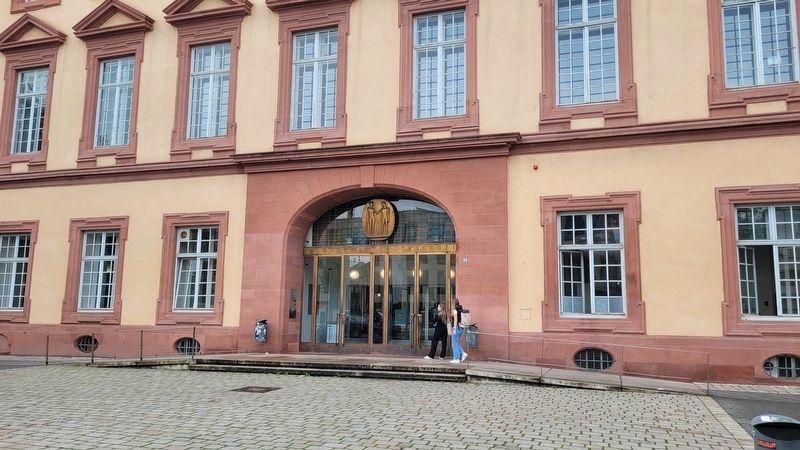
2. The Marker is located under the archway of the east wing entrance on the left side
Topics. This historical marker is listed in this topic list: Education. A significant historical year for this entry is 1955.
Location. 49° 28.997′ N, 8° 27.885′ E. Marker is in Mannheim, Baden-Württemberg. It is in Quadrate. It is at the intersection of Bismarckstraße and L2, on the right when traveling east on Bismarckstraße. The marker is located on the east side of the campus of the University of Mannheim. Touch for map. Marker is at or near this postal address: Bismarckstraße 40, Mannheim BW 68159, Germany. Touch for directions.

Regionally, this marker is on the German Upper Rhine. Globally, it is in Europe, the European Union, Atlantic Europe, Central Europe, the Schengen Area, Western Europe, and the Western World. Historically, it finds itself in what was once the Roman Empire, the Holy Roman Empire, and the former West Germany.
Other nearby markers. At least 8 other markers are within walking distance of this marker: Mannheim-Gen (about 90 meters away, measured in a direct line); SAP (about 90 meters away); Drehstromantrieb / Three-Phase AC Drive (about 90 meters
Photographed by James Hulse, September 23, 2024
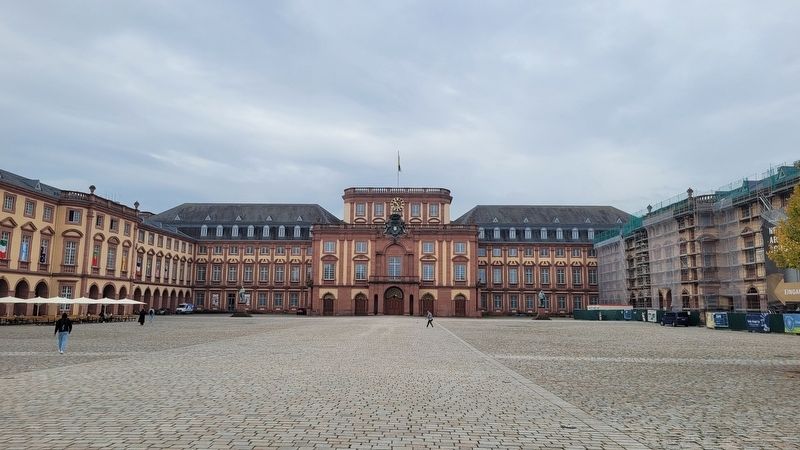
3. The front entrance to the University of Mannheim
Credits. This page was last revised on October 3, 2024. It was originally submitted on October 3, 2024, by James Hulse of Medina, Texas. This page has been viewed 93 times since then and 18 times this year. Photos: 1, 2, 3. submitted on October 3, 2024, by James Hulse of Medina, Texas.
