Clarksville in Austin in Travis County, Texas — The American South (West South Central)
Clarksville
Photographed by Keith Peterson, September 9, 2007
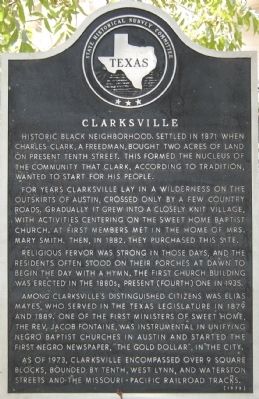
1. Clarksville Marker
Historic black neighborhood. Settled in 1871 when Charles Clark, a freedman, bought two acres of land on present Tenth Street. This formed the nucleus of the community that Clark, according to tradition, wanted to start for his people.
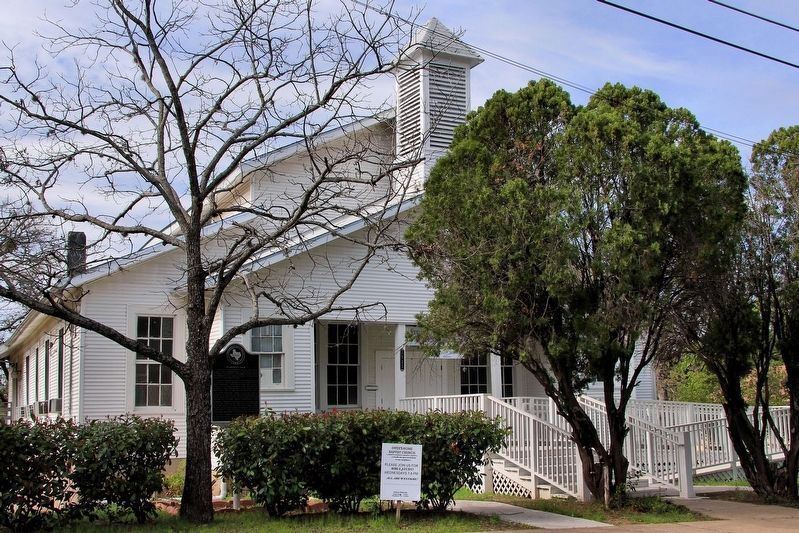
For years Clarksville lay in a wilderness on the outskirts of Austin, crossed only by a few country roads. Gradually it grew into a closely knit village, with activities centering on the Sweet Home Baptist Church. At first members met in the home of Mrs. Mary Smith. Then, in 1882, they purchased this site.
Religious fervor was strong in those days, and the residents often stood on their porches at dawn to begin the day with a hymn. The first church building was erected in the 1880s; present (fourth) one in 1935.
Among Clarksville’s distinguished citizens was Elias Mayes, who served in the Texas Legislature in 1879 and 1889. One of the first ministers of Sweet Home, the Rev. Jacob Fontaine, was instrumental in unifying negro Baptist churches in Austin and started the first negro newspaper, “The Gold Dollar”, in the city.
As of 1973, Clarksville encompassed over 9 square blocks, bounded by Tenth, West Lynn, and Waterston Streets and the Missouri-Pacific Railroad tracks.
Erected 1973 by Texas Historical Commission. (Marker Number 14494.)
Topics. This historical marker is listed in these topic lists: African Americans • Settlements & Settlers. A significant historical year for this entry is 1871.
Location. 30° 16.883′ N, 97° 45.746′ W. Marker is in Austin, Texas, in Travis County. It is in Clarksville. It is on West 11th Street near West 12th Street, on the right when traveling east. Touch for map. Marker is at or near this postal address: 1725 W 11th Street, Austin TX 78703, United States of America. Touch for directions.

Regionally, this marker is in
this page online
Other nearby markers. At least 8 other markers are within walking distance of this marker: Hezikiah Haskell House (about 400 feet away, measured in a direct line); Mathews School (approx. ¼ mile away); Confederate Men's Home (approx. 0.4 miles away); Crusemann-Marsh-Bell House (approx. 0.4 miles away); Family Home of Dr. R. K. Smoot (approx. half a mile away); Davis-Sibley House (approx. half a mile away); Henry H. and Bertha Sterzing Ziller House (approx. half a mile away); Judge Calvin Maples Cureton (approx. 0.6 miles away). Touch for a list and map of all markers in Austin.
Another marker is no longer nearby. King-Von Rosenberg House (was approx. 0.4 miles away but has been confirmed missing).
Photographed by Larry D. Moore, March 19, 2014
2. Clarksville Marker at the Sweet Home Baptist Church
Credits. This page was last revised on February 1, 2023. It was originally submitted on December 24, 2009, by Keith Peterson of Cedar Park, Texas. This page has been viewed 1,893 times since then and 48 times this year. Photos: 1. submitted on December 24, 2009, by Keith Peterson of Cedar Park, Texas. 2. submitted on May 29, 2018, by Larry D. Moore of Del Valle, Texas. • Kevin W. was the editor who published this page.
