
Manjakamiadana in Antananarivo in Antananarivo Renivohitra, Analamanga, Madagascar — Africa (Indian Ocean)
I - Rovan'antananarivo
Photographed by J. Makali Bruton, September 6, 2024
1. I - Rovan'antananarivo Marker

I - Rovan'antananarivo
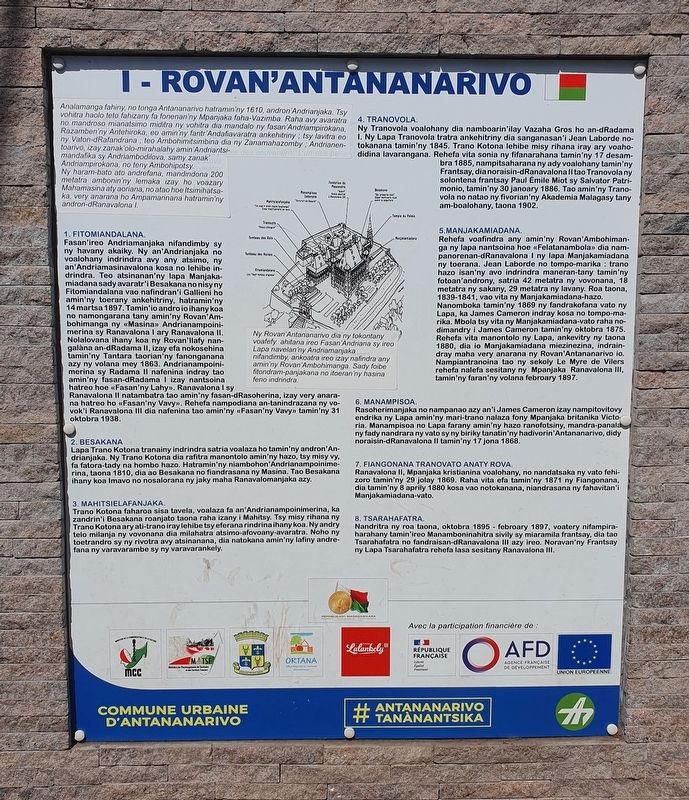
Analamanga fahiny, no tonga Antananarivo hatramin'ny 1610, andron Andrianjaka. Tsy vohitra haolo teto fahizany fa fonenan'ny Mpanjaka faha-Vazimba. Raha avy avaratra no mandroso mianatsimo miditra ny vohitra dia mandalo ny fasan Andriampirokana, Razamben'ny Antehiroka, eo amin'ny fantr Andafavaratra ankehitriny tsy lavitra eo ny Vaton-dRafandrana; teo Ambohimitsimbina dia ny Zanamahazomby: Andrianentoarivo, izay zanak'olo-mirahalahy amin' Andriantsimandafika sy Andriambodilova, samy zanak Andriampirokana, no teny Ambohipotsy. Ny haram-bato ato andrefana, mandindona 200 metatra ambonin'ny lemaka izay ho voazary Mahamasina aty aoriana, no atao hoe ltsimihatsaka, very anarana ho Ampamarinana hatramin'ny andron-dRanavalona I.
1. Fitomiandalana.
Fasan'ireo Andriamanjaka nifandimby sy ny havany akaiky. Ny an'Andrianjaka no voalohany indrindra avy any atsimo, ny an'Andriamasinavalona kosa no lehibe indrindra. Teo atsinanan'ny lapa Manjaka miadana sady avaratri Besakana no nisy ny Fitomiandalana vao nafindran'i Gallieni ho amin'ny toerany ankehitriny, hatramin'ny 14 martsa 1897. Tamin'io andro io ihany koa no namongarana tany amin'ny Rovan'Ambohimanga ny «Masina Andrianampoinimerina sy Ranavalona I ary Ranavalona II. Nolalovana ihany koa ny Rovan'llafy nangalana an-dRadama II, izay efa nokosehina tamin'ny Tantara taorian'ny fanonganana azy ny volana mey 1863. Andrianampoinimerina sy Radama II nafenina indray tao amin'ny fasan-dRadama I izay nantsoina hatreo hoe «Fasan'ny Lahy». Ranavalona I sy Ranavalona II natambatra tao amin'ny fasan Rasoherina, izay very anarana hatreo ho «Fasan'ny Vavy». Rehefa nampodiana an-tanindrazana ny vo vok'i Ranavalona III dia nafenina tao amin'ny «Fasan'ny Vavy tamin'ny 31 oktobra 1938.
2. Besakana
Lapa Trano Kotona tranainy indrindra satria voalaza ho tamin'ny andron'Andrianjaka. Ny Trano Kotona dia rafitra manontolo amin'ny hazo, tsy misy vy. fa fatora-tady na hombo hazo. Hatramin'ny niambohon'Andrianampoinimerina, taona 1810, dia ao Besakana no fiandrasana ny Masina. Tao Besakana ihany koa Imavo no nosalorana ny jaky maha Ranavalomanjaka azy.
3. Mahitsielafanjaka.
Trano Kotona faharoa sisa tavela, voalaza fa an'Andrianampoinimerina, ka zandrin'i Besakana roanjato taona raha izany i Mahitsy. Tsy misy rihana ny Trano Kotona ary ati-trano iray lehibe tsy eferana rindrina ihany koa. Ny andry telo milanja ny vovonana dia milahatra atsimo-afovoany-avaratra. Noho ny toetrandro sy ny rivotra avy atsinanana, dia natokana amin'ny lafiny andrefana ny varavarambe sy ny varavarankely.
4. Tranovola.
Ny Tranovola voalohany dia namboarin'ilay Vazaha Gros ho an-dRadama I. Ny Lapa Tranovola tratra ankehitriny dia sanganasan'i Jean Laborde notokanana tamin'ny 1845. Trano Kotona lehibe misy rihana iray ary voahdidina lavarangana. Rehefa vita sonia ny fifanarahana tamin'ny 17 desambra 1885, nampitsaharana ny ady voalohany tamin'ny Frantsay, dia noraisin-dRanavalona Il tao Tranovola ny solontena frantsay Paul Emile Miot sy Salvator Patrimonio, tamin'ny 30 janoary 1886. Tao amin'ny Tranovola no natao ny fivorian'ny Akademia Malagasy tany am-boalohany, taona 1902.
5.Manjakamiadana.
Rehefa voafindra any amin'ny Rovan'Ambohimanga ny lapa nantsoina hoe «Felatanambola dia nampanorenan-dRanavalona I ny lapa Manjakamiadana ny toerana. Jean Laborde no tompo-marika: trano hazo isan'ny avo indrindra maneran-tany tamin'ny fotoan'androny, satria 42 metatra ny vovor vovonana, 18 matra ny sakany, 29 metatra ny lavany. Roa taona, 1839-1841, vao vita ny Manjakamiadana-hazo. Nanomboka tamin'ny 1869 ny fandrakofana vato ny Lapa, ka James Cameron indray kosa no tompomarika. Mbola tsy vita ny Manjakamiadana-vato raha nodimandry i James Cameron tamin'ny oktobra 1875. Rehefa vita manontolo ny Lapa, ankevitry ny taona 1880, dia lo miezinezina, indraindray Ny Rovan'Antananarivo dia ny tokontany voafely ahitana ireo Fasan Andriana sy ireoLapa navelan'ny Andriamanjaka nifandimby, ankoatra ireo izay nafindra any amin'ny Rovan'Ambohimanga. Sady foibe Stondram-panjakana no itoeran'ny hasina feno indraindray maha very anarana Nampiantranoina tao ny sekoly Le Myre de Vilers rehefa nalefa sesitany ny Mpanjaka Ranavalona III, tamin'ny faran'ny volana febroary 1897.
6. Manampisoa
Rasoherimanjaka no nampanao azy an'i James Cameron izay nampitovitovy endrika ny Lapa amin'ny mari-trano nalaza fony Mpanjaka britanika Victoria. Manampisoa no Lapa farany amin'ny hazo ranofotsiny, mandra-panala my fady nandrara ny vato sy ny biriky tanatin'ny hadivorin'Antananarivo, didy noraisin-dRanavalona II tamin'ny 17 jona 1868.
7. Fiangonana Tranovato Anaty Rova.
Ranavalona II,Mpanjaka kristianina voalohany, no nandatsaka ny vato fehizoro tamin'ny 29 jolay 1869. Raha vita efa tamin'ny 1871 ny Fiangonana, dia tamin'ny 8 aprily 1880 kosa vao notokanana, niandrasana ny fahavitan'i Manjakamiadana-vato.
8. Tsarahafatra.
Nandritra ny roa taona, oktobra 1895-febroary 1897, voatery nifampiraharahany tamin'ireo Manamboninahitra sivily sy miaramila frantsay, dia tao Tsarahafatra no fandraisan-dRanavalona III azy ireo. Noravan'ny Frantsay ny Lapa Tsarahafatra rehefa lasa sesitany Ranavalona III.
Caption
Ny Rovan'Antananarivo dia ny tokontany voafely ahitana ireo Fasan Andriana sy ireo Lapa navelan'ny Andriamanjaka nifandimby, ankoatra ireo izay nafindra any amin'ny Rovan'Ambohimanga. Sady foibe Stondram-panjakana no itoeran'ny hasina feno indrindra.
I. Rova de Madagascar
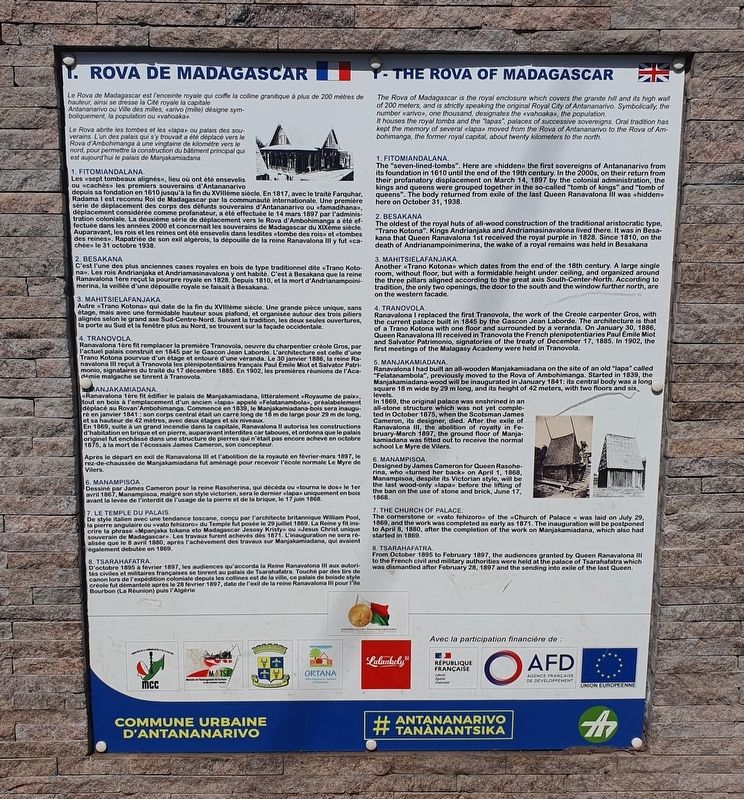
Le Rova de Madagascar est l'enceinte royale qui coiffe la colline granitique à plus de 200 mètres de hauteur, ainsi se dresse la Cité royale la capitale Antananarivo ou Ville des milles, «arivo (mille) désigne symboliquement, la population ou «vahoaka».
Le Rova abrite les tombes et les «lapa» ou palais des souverains. L'un des palais qui s'y trouvait a été déplacé vers le Rova d'Ambohimanga à une vingtaine de kilomètre vers le nord, pour permettre la construction du bâtiment principal qui est aujourd'hui le palais de Manjakamiadana.
1. Fitomiandalana.
Les «sept tombeaux alignés», lieu où ont été ensevelis ou «cachés les premiers souverains d'Antananarivo depuis sa fondation en 1610 jusqu'à la fin du XVIIIème siècle. En 1817, avec le traité Farquhar, Radama I est reconnu Roi de Madagascar par la communauté internationale. Une première série de déplacement des corps des défunts souverains d'Antananarivo ou «famadihana», déplacement considérée comme profanateur, a été effectuée le 14 mars 1897 par l'administration coloniale. La deuxième série de déplacement vers le Rova d'Ambohimanga a été effectuée dans les années 2000 et concernait les souverains de Madagascar du XIXème siècle. Auparavant, les rois et les reines ont été ensevelis dans lesdites «tombe des rois» et «tombes des reines». Rapatriée de son exil algérois, la dépouille de la reine Ranavalona III y fut "cachée le 31 octobre 1938.
2. Besakana
C'est l'une des plus anciennes cases royales en bois de type traditionnel dite «Trano Kotona». Les rois Andrianjaka et Andriamasinavalona y ont habité. C'est à Besakana que la reine Ranavalona 1ère reçut la pourpre royale en 1828. Depuis 1810, et la mort d'Andrianampoinimerina, la veillée d'une dépouille royale se faisait à Besakana.
3. Mahitsielafanjaka.
Autre «Trano Kotona» qui date de la fin du XVIIIème siècle. Une grande pièce unique, sans étage, mais avec une formidable hauteur sous plafond, et organisée autour des trois piliers alignés selon le grand axe Sud-Centre-Nord. Suivant la tradition, les deux seules ouvertures, la porte au Sud et la fenêtre plus au Nord, se trouvent sur la façade occidentale.
4. Tranovola.
Ranavalona 1ère fit remplacer la première Tranovola, oeuvre du charpentier créole Gros, par l'actuel palais construit en 1845 par le Gascon Jean Laborde. L'architecture est celle d'une Trano Kotona pourvue d'un étage et entouré d'une véranda. Le 30 janvier 1886, la reine Ranavalona III reçut à Tranovola les plénipotentiaires français Paul Emile Miot et Salvator Patrimonio, signataires du traité du 17 décembre 1885. En 1902, les premières réunions de l'Académie malgache se tinrent à Tranovola.
5. Manjakamiadana.
«Ranavalona 1ère fit édifier le palais de Manjakamiadana, littéralement «Royaume de paix, tout en bois à l'emplacement d'un ancien «lapa» appelé «Felatanambola», préalabelement déplacé au Rovan'Ambohimanga. Commencé en 1839, le Manjakamiadana-bois sera inauguré en janvier 1841: son corps central était un carré long de 18 m de large pour 29 m de long. et sa hauteur de 42 mètres, avec deux étages et six niveaux.
En 1869, suite à un grand incendie dans la capitale, Ranavalona II autorisa les constructions d'habitation en brique et en pierre, auparavant interdites car taboues, et ordonna que le palais originel fut enchassé dans une structure de pierres qui n'était pas encore achevé en octobre 1875, à la mort de l'écossais James Cameron, son concepteur.
Après le départ en exil de Ranavalona III et l'abolition de la royauté en février-mars 1897, le rez-de-chaussée de Manjakamiadana fut aménagé pour recevoir l'école normale Le Myre de Vilers.
6. Manampisoa.
Dessiné par James Cameron pour la reine Rasoherina, qui décéda ou «tourna le dos le 1er avril 1867, Manampisoa, malgré son style victorien, sera le dernier «lapas uniquement en bois avant la levée de l'interdit de l'usage de la pierre et de la brique, le 17 juin 1868.
7. Le Temple du Palais.
De style italien avec une tendance toscane, conçu par l'architecte britannique William Pool, la pierre angulaire ou «vato fehizoro» du Temple fut posée le 29 juillet 1869. La Reine y fit inscrire la phrase «Mpanjaka tokana eto Madagascar Jesosy Kristy» ou «Jesus Christ unique souverain de Madagascar». Les travaux furent achevés dés 1871. L'inauguration ne sera réalisée que le 8 avril 1880, après l'achèvement des travaux sur Manjakamiadana, qui avaient également debutée en 1869.
8. Tsarahafatra.
D'octobre 1895 à février 1897, les audiences qu'accorda la Reine Ranavalona III aux autorités civiles et militaires françaises se tinrent au palais de Tsarahafatra. Touché par des tirs de canon lors de l'expédition coloniale depuis les collines est de la ville, ce palais de boisde style créole fut démantelé après le 28 février 1897, date de l'exil de la reine Ranavalona III pour l'ile Bourbon (La Réunion) puis l'Algérie
I - The Rova of Madagascar
The Rova of Madagascar is the royal enclosure which covers the granite hill and its high wall of 200 meters, and is strictly speaking the original Royal City of Antananarivo. Symbolically, the number «arivo»>, one thousand, designates the «vahoaka», the population. It houses the royal tombs and the "lapas", palaces of successive sovereigns. Oral tradition has kept the memory of several «lapa»> moved from the Rova of Antananarivo to the Rova of Ambohimanga, the former royal capital, about twenty kilometers to the north.
1. Fitomiandalana.
The "seven-lined-tombs". Here are «hidden» the first sovereigns of Antananarivo from its foundation in 1610 until the end of the 19th century. In the 2000s, on their return from their profanatory displacement on March 14, 1897 by the colonial administration, the kings and queens were grouped together in the so-called "tomb of kings" and "tomb of queens". The body returned from exile of the last Queen Ranavalona III was <
2. Besakana
The oldest of the royal huts of all-wood construction of the traditional aristocratic type, "Trano Kotona". Kings Andrianjaka and Andriamasinavalona lived there. It was in Besa- kana that Queen Ranavalona 1st received the royal purple in 1828. Since 1810, on the death of Andrianampoinimerina, the wake of a royal remains was held in Besakana.
3. Mahitsielafanjaka.
Another «Trano Kotona» which dates from the end of the 18th century. A large single room, without floor, but with a formidable height under ceiling, and organized around the three pillars aligned according to the great axis South-Center-North. According to tradition, the only two openings, the door to the south and the window further north, are on the western facade. 4. Tranovola.
Ranavalona I replaced the first Tranovola, the work of the Creole carpenter Gros, with the current palace built in 1845 by the Gascon Jean Laborde. The architecture is that of a Trano Kotona with one floor and surrounded by a veranda. On January 30, 1886, Queen Ranavalona III received in Tranovola the French plenipotentiaries Paul Émile Miot and Salvator Patrimonio, signatories of the treaty of December 17, 1885. In 1902, the first meetings of the Malagasy Academy were held in Tranovola.
5. Manjakamiadana.
Ranavalona I had built an all-wooden Manjakamiadana on the site of an old "lapa" called "Felatanambola", previously moved to the Rova of Ambohimanga. Started in 1839, the Manjakamiadana-wood will be inaugurated in January 1841: its central body was a long square 18 m wide by 29 m long, and its height of 42 meters, with two floors and six levels.
In 1869, the original palace was enshrined in an all-stone structure which was not yet completed in October 1875, when the Scotsman James Cameron, its designer, died. After the exile of Ranavalona III, the abolition of royalty in February-March 1897, the ground floor of Manjakamiadana was fitted out to receive the normal school Le Myre de Vilers.
6. Manampisoa.
Designed by James Cameron for Queen Rasoherina, who turned her back» on April 1, 1868, Manampisoa, despite its Victorian style, will be the last wood-only «lapa» before the lifting of the ban on the use of stone and brick, June 17, 1868.
7. The Church of Palace.
The cornerstone or «vato fehizoro» of the «Church of Palace « was laid on July 29, 1869, and the work was completed as early as 1871. The inauguration will be postponed to April 8, 1880, after the completion of the work on Manjakamiadana, which also had started in 1869.
8. Tsarahafatra.
From October 1895 to February 1897, the audiences granted by Queen Ranavalona III to the French civil and military authorities were held at the palace of Tsarahafatra which was dismantled after February 28, 1897 and the sending into exile of the last Queen.
Topics.
this page online
Location. 18° 55.361′ S, 47° 31.945′ E. Marker is in Antananarivo, Analamanga, in Antananarivo Renivohitra. It is in Manjakamiadana. It is on Lalana Ramboatiana, on the right. Touch for map. Marker is at or near this postal address: Lalana Ramboatiana 101, Antananarivo, Analamanga, Madagascar. Touch for directions.

Regionally, it is in Africa, specifically in Sub-Saharan Africa, in the Indian Ocean, at one of the Indian Ocean Islands and on the Swahili Coast. Historically, it finds itself in what was once a French colony.
Other nearby markers. At least 6 other markers are within walking distance of this marker: Rova of Antananarivo (within shouting distance of this marker); Lapa Mahitsielafanjaka (about 120 meters away, measured in a direct line); Translation of the Bible to Malagasy (about 150 meters away); Fiangonana (about 180 meters away); Ny Lemak'i Betsimitatatra / Ny Farihin'anosy / Ny Toerana Misy Ireo Minisitera (about 240 meters away); Malagasy Soldiers Memorial (approx. 1.4 kilometers away).
Photographed by J. Makali Bruton, September 6, 2024
2. I - Rovan'antananarivo Marker in French and English
Photographed by J. Makali Bruton, September 6, 2024
3. I - Rovan'antananarivo Marker
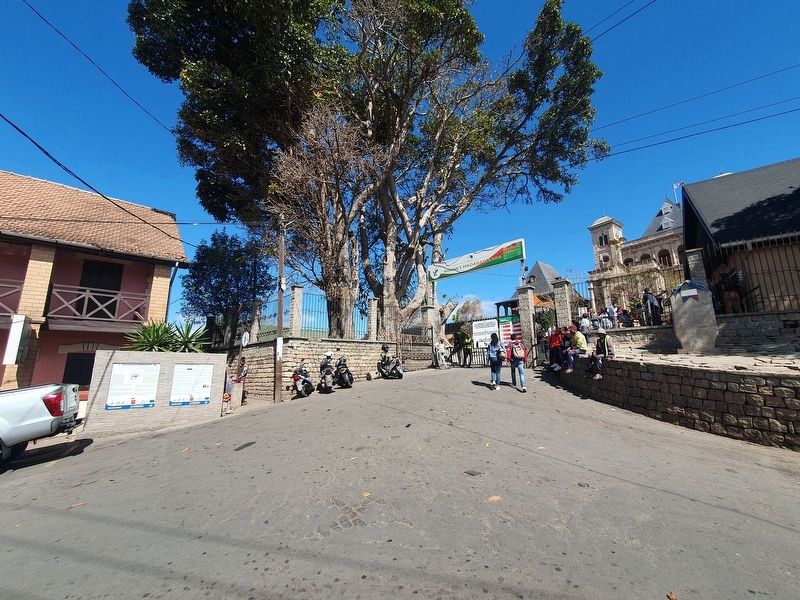
The two-paneled marker is outside of the gates to the Queen's Palace.

Photographed by Couadou, phot., Toulon-sur-Mer, circa 1910
4. View of the “Rova” and of the palace of the ex-Queen Ranavalo
Credits. This page was last revised on October 8, 2024. It was originally submitted on October 6, 2024, by J. Makali Bruton of Washington, District of Columbia. This page has been viewed 189 times since then and 34 times this year. Photos: 1, 2, 3. submitted on October 6, 2024, by J. Makali Bruton of Washington, District of Columbia. 4. submitted on October 8, 2024.
