Guilford Township near Chambersburg in Franklin County, Pennsylvania — The American Northeast (Mid-Atlantic)
The Gass House
Birthplace of Patrick Gass

Photographed by Duane and Tracy Marsteller, September 26, 2024
1. The Gass House Marker
Patrick's father, Benjamin, and uncle William immigrated from Ireland and built the farmhouse on their plantation named “Union”. Continuing their occupation as fullers of cloth, they built a fulling mill nearby on the Falling Spring Creek. Franklin County, chartered in 1784, purchased the Gass house and 165 acres in 1808 for $8,203.75. The purchase provided for an almshouse which was constructed in 1811.
The circa 1760 and 1811 buildings are an open air museum of early American architecture contrasting
this page online
Architectural Highlights of the Almshouse
The almshouse was constructed to higher standards for public use. The features include shaped limestone blocks with flat bearing surfaces which make the building structurally stable.
Almshouse features:
• Uniform courses of limestone blocks provide increased stability and load-bearing capacity.
• Increased stability allowed for a larger footprint, 30 by 54½ feet, greater height and a larger, heavier roof.
• The footprint of the almshouse is 4½ times larger than the Gass House.
• Flat arches with a center keystone above windows and doors allowed for larger openings.
• Larger interior bays provided for larger rooms than the Gass house.
• Stonework and cornerstones in the center of the east wall suggest construction in two phases.
Architectural Highlights of the Gass House
Built during the French and Indian War, 1755-63, on the frontier between the French and British new world empires, the 2½ story farmhouse is constructed
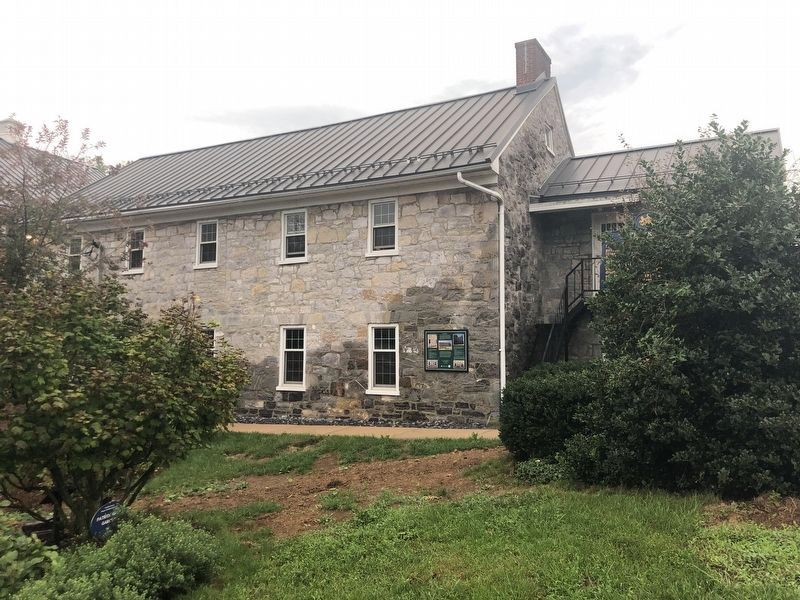
Photographed by Duane and Tracy Marsteller, September 26, 2024
2. The Gass House Marker
Featured marker is affixed to the c. 1811 almshouse. The c. 1760 Gass House is behind the tree on the right.
Gass House features:
• A large number of stones are not reworked into blocks with flat surfaces.
• Stones of irregular sizes and shapes, except for the well formed cornerstones, were randomly layered.
• Simple lintels of one to three flat stones were placed above windows.
• Structurally unstable walls resulted in a smaller 19 foot square footprint and smaller openings for windows.
• Method of wall construction limited height and ability to support a larger, heavier roof.
• The rooms in the Gass House are small, even for that era. The interior footprint is only 290 square feet.
The Gass farmhouse is a landmark from the early years of European settlement in the Cumberland Valley. The Conococheague settlement was established in 1734, the date taken from the ‘Founding of Chambersburg’. Fort Benjamin Chambers was constructed in 1756, the year following British General Edward Braddock's defeat at Fort Duquesne marking the onset of the French and Indian War. All these
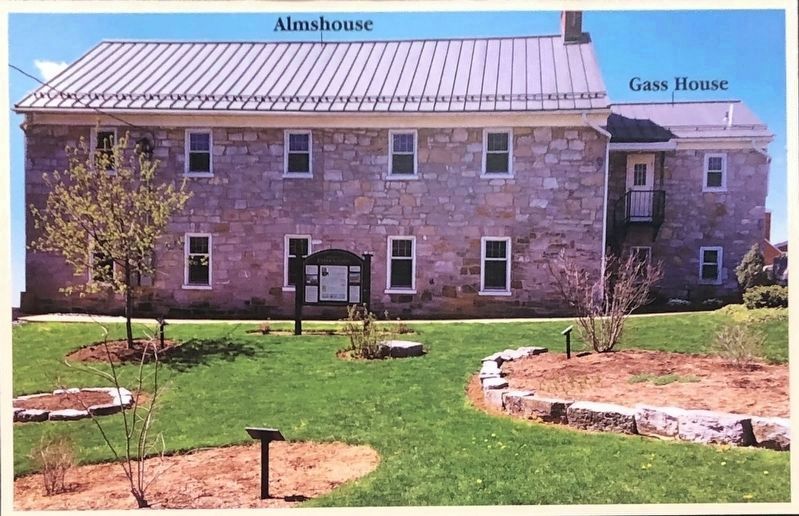
Photographed by Duane and Tracy Marsteller, September 26, 2024
3. The Gass House Marker (detail)
A different marker is shown in the photograph.
Erected by Franklin County Master Gardener • Franklin County Government • Penn State Extension.
Topics and series. This historical marker is listed in this topic list: Architecture. In addition, it is included in the National Register of Historic Places (NRHP) series list. A significant historical year for this entry is 1760.
Location. 39° 55.789′ N, 77° 37.78′ W. Marker is near Chambersburg, Pennsylvania, in Franklin County. It is in Guilford Township. It can be reached from Franklin Farms Lane 0.1 miles north of Lincoln Highway (U.S. 30), on the left when traveling north. Touch for map. Marker is at or near this postal address: 181 Franklin Farms Ln, Chambersburg PA 17202, United States of America. Touch for directions.

Regionally, this marker is in South-Central Pennsylvania. It is also in the American Northeast, in the Mid-Atlantic, in Appalachia, and specifically in Northern Appalachia. Globally, it is in North America, the Western Hemisphere, the Western World, and the Anglosphere. Historically, it finds itself in what was once the Haudenosaunee (Iroquois) Confederacy
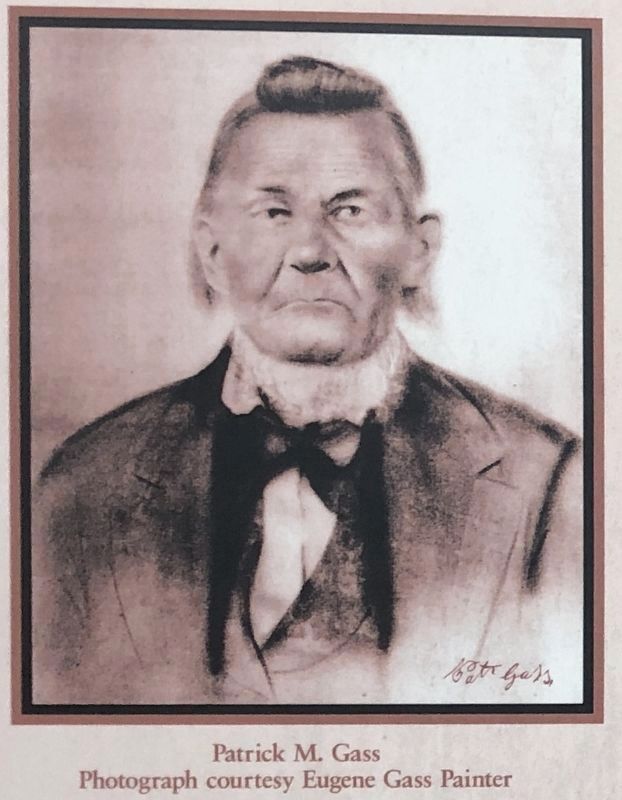
Photographed by Duane and Tracy Marsteller, September 26, 2024
4. Patrick M. Gass (1771-1870)
He is best known for participating in Lewis and Clark's Corps of Discovery, as well as for military service in the War of 1812 and against Native Americans.
Other nearby markers. At least 8 other markers are within 2 miles of this marker, measured as the crow flies: Sergeant Patrick Gass / The Journey of the Corps of Discovery (here, next to this marker); Patrick Gass (a few steps from this marker); Gettysburg Campaign (approx. ¼ mile away); Chambersburg (approx. 0.4 miles away); Timothy G. McCarthy (approx. 0.8 miles away); Messersmith's Woods (approx. 0.8 miles away); S. Sergt Glenn O. Elliott (approx. 0.8 miles away); Franklin County World War I Memorial (approx. 1.2 miles away). Touch for a list and map of all markers in Chambersburg.
Credits. This page was last revised on October 8, 2024. It was originally submitted on October 7, 2024, by Duane and Tracy Marsteller of Murfreesboro, Tennessee. This page has been viewed 533 times since then and 93 times this year. Photos: 1. submitted on October 7, 2024, by Duane and Tracy Marsteller of Murfreesboro, Tennessee. 2, 3, 4. submitted on October 8, 2024, by Duane and Tracy Marsteller of Murfreesboro, Tennessee.
