
Downtown in Ketchikan in Ketchikan Gateway Borough, Alaska — Northwest (North America)
Pioneer Hall
1900
| — | Ketchikan's First (and only) Igloo | — |
Photographed by William Fischer, Jr., August 26, 2024
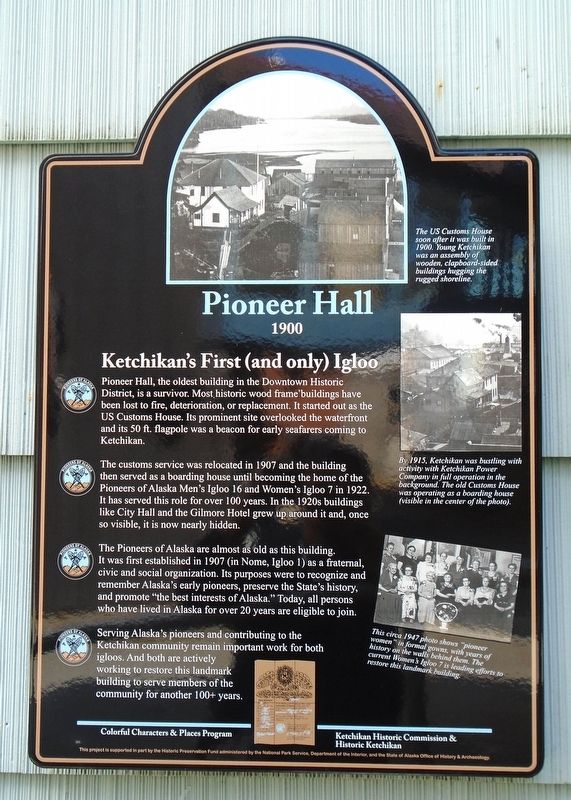
1. Pioneer Hall Marker
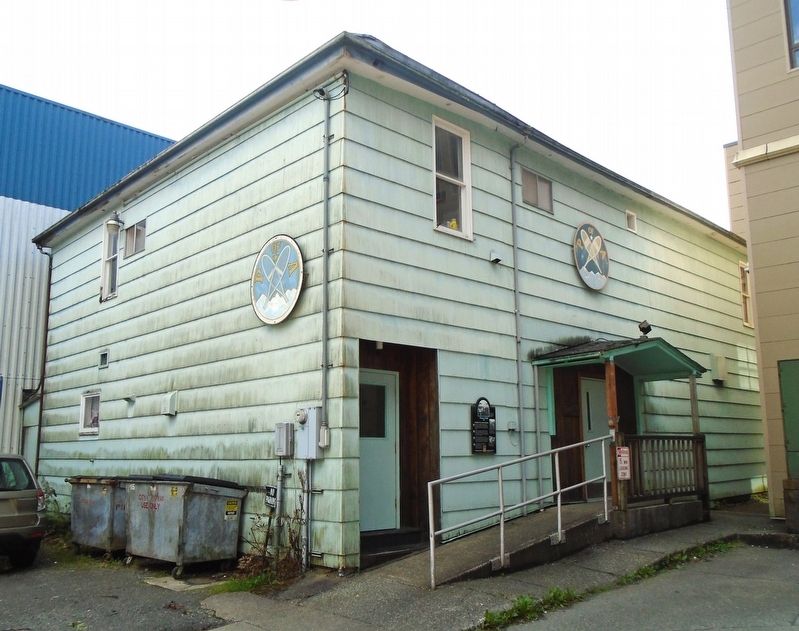
Pioneer Hall, the oldest building in the Downtown Historic District, is a survivor. Most historic wood frame buildings have been lost to fire, deterioration, or replacement. It started out as the US Customs House. Its prominent site overlooked the waterfront and its 50 ft. flagpole was a beacon for early seafarers coming to Ketchikan.
The customs service was relocated in 1907 and the building then served as a boarding house until becoming the home of the Pioneers of Alaska Men's Igloo 16 and Women's Igloo 7 in 1922. It has served this role for over 100 years. In the 1920s buildings like City Hall and the Gilmore Hotel grew up around it and, once so visible, it is now nearly hidden.
The Pioneers of Alaska are almost as old as this building. It was first established in 1907 (in Nome, Igloo 1) as a fraternal, civic and social organization. Its purposes were to recognize and remember Alaska's early pioneers, preserve the State's history, and promote "the best interests of Alaska." Today, all persons who have lived in Alaska for over 20 years are eligible to join.
Serving Alaska's pioneers and contributing to the Ketchikan
this page online
[Photo captions, top to bottom, read]
• The US Customs House soon after it was built in 1900. Young Ketchikan was an assembly of wooden, clapboard-sided buildings hugging the rugged shoreline.
• By 1915, Ketchikan was bustling with activity with Ketchikan Power Company in full operation in the background. The old Customs House was operating as a boarding house (visible in the center of the photo).
• This circa 1947 photo shows "pioneer women in formal gowns, with years of history on the walls behind them. The current Women Igloo 7 is leading efforts to restore this landmark building.
Erected by Colorful Characters & Places Program of the Ketchikan Historic Commission & Historic Ketchikan, NPS & State of Alaska.
Topics. This historical marker is listed in these topic lists: Fraternal or Sororal Organizations • Settlements & Settlers. A significant historical year for this entry is 1907.
Location. 55° 20.554′ N, 131° 38.857′ W. Marker is in Ketchikan,
Photographed by William Fischer, Jr., August 26, 2024
2. Pioneer Hall and Marker

Regionally, this marker is in Southeast Alaska, in Tlingit and Haida & Tsimshian Region. It is also on the American Pacific Coast. Globally, it is in North America, the Inside Passage, the Pacific Rim, the Western Hemisphere, the Western World, and the Anglosphere. Historically, it finds itself in what was once the Russian Empire.
Other nearby markers. At least 8 other markers are within walking distance of this marker: The Gilmore Hotel (within shouting distance of this marker); From Planks to Pavement (within shouting distance of this marker); Upon 'Thundering Wings' (within shouting distance of this marker); Keeping the Catch! (within shouting distance of this marker); First National Bank (within shouting distance of this marker); The Easter Totem Pole (within shouting distance of this marker); J.R. Heckman Buildings (about 300 feet away, measured in a direct line); Tongass Trading Company (about 300 feet away). Touch for a list and map of all markers in Ketchikan.
Also see . . . Ketchikan Pioneers of Alaska. (Submitted on October 7, 2024, by William Fischer, Jr. of Reynoldsburg, Ohio.)
Credits. This page was last revised on October 7, 2024. It was originally submitted on October 7, 2024, by William Fischer, Jr. of Reynoldsburg, Ohio. This page has been viewed 371 times since then and 65 times this year. Photos: 1, 2. submitted on October 7, 2024, by William Fischer, Jr. of Reynoldsburg, Ohio.
