Downtown Los Angeles in Los Angeles County, California — The American West (Pacific Coastal)
Federal Reserve Bank
of San Francisco, Los Angeles Branch
| — | The Reserve | — |
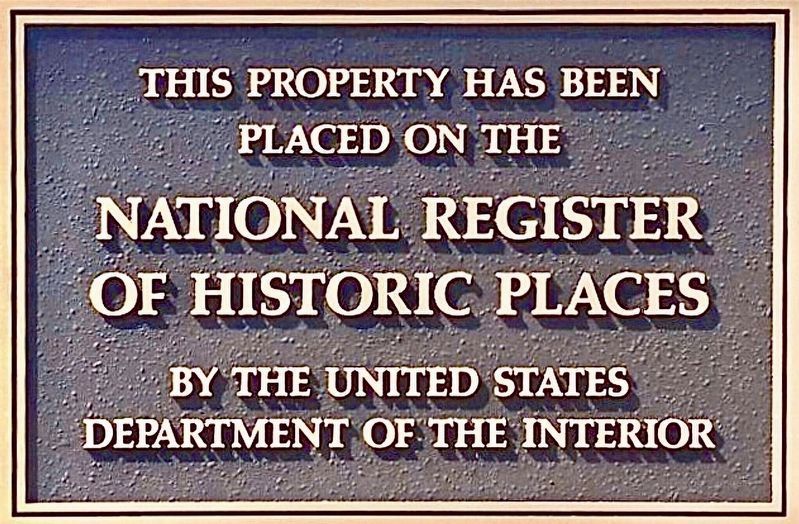
1. National Register of Historic Places
This property has been placed on the National Register of Historic Places by the United States Department of the Interior.
Erected 1984.
Topics and series. This historical marker is listed in these topic lists: Architecture • Industry & Commerce. In addition, it is included in the National Register of Historic Places (NRHP) series list. A significant historical year for this entry is 1930.
Location. 34° 2.561′ N, 118° 15.591′ W. Marker is in Los Angeles, California, in Los Angeles County. It is in Downtown Los Angeles. It is at the intersection of Olympic Boulevard and Olive Street, on the right when traveling west on Olympic Boulevard. Touch for map. Marker is at or near this postal address: 409 W Olympic Blvd, Los Angeles CA 90015, United States of America. Touch for directions.

Regionally, this marker is in California’s Transverse Ranges. It is also on the American Pacific Coast. Globally, it is in North America, on the Ring of Fire, on the Pacific Rim, in the Western Hemisphere, in the Western World, and in the Anglosphere. Historically, it finds itself in what was once
this page online
Other nearby markers. At least 8 other markers are within walking distance of this marker: Garfield Building (approx. ¼ mile away); Variety Arts Center (approx. ¼ mile away); a different marker also named Variety Arts Center (approx. 0.3 miles away); The Original Pantry Cafe (approx. 0.3 miles away); Chapman Building (approx. 0.3 miles away); Staples Center (approx. 0.3 miles away); Kareem Abdul-Jabbar (approx. 0.3 miles away); Earvin "Magic" Johnson (approx. 0.4 miles away). Touch for a list and map of all markers in Los Angeles.
Regarding Federal Reserve Bank. The Federal Reserve Bank of San Francisco, Los Angeles Branch, is significant for its design by the prominent Los Angeles architectural firm of Parkinson and Parkinson, its association with a major financial institution of the city, the quality of its design and workmanship, the appropriateness of its solid, dignified design to its tenant, and its position as one of the earliest Classical Moderne structures in Los Angeles. An anchor to the soutwestern edge of downtown Los Angeles' commercial and financial

Photographed by Craig Baker, August 13, 2023
2. Federal Reserve Bank Building
The father-and-son team Parkinson and Parkinson produced some of Los Angeles' finest Beaux Arts and, in particular, Moderne structures. Among the Los Angeles landmarks designed by the Parkinsons are Los Angeles City Hall, Bullock's Wilshire, Los Angeles Memorial Coliseum, and Los Angles Union Passenger Terminal.
The Federal Reserve Bank of San Francisco, Los Angeles Branch, is a five-story, steel frame, granite clad bank building. Its use, in 1930, of heavy, geometric massing, recessed spandrels, ornate grillwork, stark relief sculpture and virtually flush piers mark it as one of the earliest examples of the Classical Moderne style in Los Angeles, as well as one of the finest and most refined. Unaltered but for

Photographed by Craig Baker, August 13, 2023
3. Federal Reserve Bank Building
The two main, articulated facades of the original structure -
those facing Olympic Boulevard to the south and Olive Street to the east - were each strictly symmetrical and five bays across. The 1953 addition addeed two identical, five-story bays to the left side of the Olympic elevation and a one-story, three bay addition to the Olive elevation. The materials and decorative elements of the addition, which wraps around the two secondary facades in an L-shape, are identical to those of the original structure.
-from NRHP Nomination Form.
A new Federal Reserve building next door was completed in 1987.
The original 1930 building has since been converted to private residential use, and today it’s known as The Reserve Lofts.
Credits. This page was last revised on April 27, 2025. It was originally submitted on October 10, 2024, by Craig Baker of Sylmar, California. This page has been viewed 392 times since then and 62 times this year. Photos: 1, 2, 3. submitted on October 10, 2024, by Craig Baker of Sylmar, California.
