
Summit - University in Saint Paul in Ramsey County, Minnesota — The American Midwest (Upper Plains)
Rondo 1970–1982
⎯⎯⎯
Words from the Founders

Photographed by McGhiever, July 13, 2021
1. Rondo 1970–1982 / Words from the Founders Marker
The impact of the construction of I-94 was destructive and far-reaching. As the 1970's began, the community was still reeling from the homes taken or demolished, the businesses that closed down, the residents who had been forcibly removed, and the devastation that came in the name of "progress." But the Rondo community is nothing if not resilient and they began to rebuild despite the tragedy.
Following the lead of other cities, citizens demanded enforcement of civil, economic, and human rights. Spurred on by the efforts of the St. Paul Urban League, St. Paul NAACP, the North Central Voters League, other organizations, and a long line of courageous individuals, the community of Rondo began to rebuild—but not without effort.
Ramsey County Sheriff's Department, 1970s
Battled were waged against discrimination–in government and private industry—to secure housing, public accommodations, employment, expanded educational opportunities, and basic human rights so that the residents of Rondo could enjoy the same civil liberties like other St. Paul citizens. Between 1972 and 1980, as the result of lawsuits,
this page online
As the community strove to restore Rondo's spirit, pockets of growth began to spring up in the Selby-Dale area and the number of black-owned businesses increased. For a moment, it seemed like once again Rondo was on the rise. But these efforts were hindered by dissipating resources, redlining, and backlash. Promises and commitments from local government and other funding sources were not honored and the community continued to struggle to revive Rondo against significant odds.
Top: Lafayette Fields, the first African-American pharmacist in Minnesota and the owner of Majestic Drugs on the corner of Dale and Rondo in Saint Paul.
Middle: Dr. Robert Johnson, pioneer veterinarian, and later elected to the Minnesota Senate.
Bottom: NAACP members picketing for integrated lunch counters outside Woolworth's in St. Paul on April 2, 1960.
Marvin Roger Anderson
Floyd G. Smaller, Jr.
Marvin Roger Anderson and Floyd G. Smaller, Jr. have worked tirelessly and creatively to keep
Photographed by McGhiever, July 13, 2021
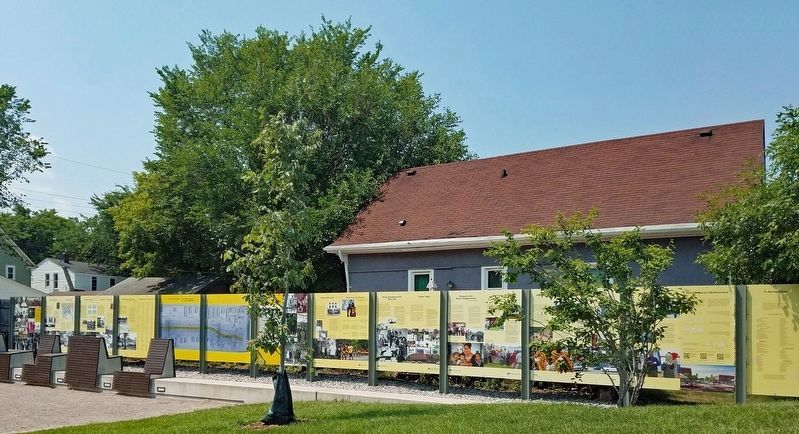
2. Rondo 1970–1982 / Words from the Founders Marker (center) at the Rondo Commemorative Plaza
Marvin Anderson and Floyd G. Smaller, Jr., 1983 and 2013
MRA: I met Floyd in front of the Ober Boys Club in 1953. I was thirteen, Floyd was fifteen.
FGS: We've been friends for 65 years.
MRA: We bonded in the Elks Drum & Bugle Corps. I played bugle and Floyd played the bass drum. We both left the state for college, and then I-94 destroyed the heart of Rondo.
FGM: After returning, I started looking around. Concordia ran where Rondo used to be. The houses, buildings and familiar landmarks were gone. Most importantly, there was a loneliness and sadness in people's body language. They'd ask, "What about old Rondo?" They'd want to tell stories.
MRA: One day, I went to Floyd and said "Let's plan a celebration for Rondo with a parade, music and food giving the opportunity for people to come together." Once we made up our minds, we were going to do it even if it was just us two and our families.
FGS: We slowly got a small army together to get out the message. It was pulling the bow back and letting the arrow fly.
MRA: In 1982, every Saturday, committees would meet to plan for the first festival.
FGS: We looked around after the success of the first Rondo Days and realized that we had to keep this festival alive to support the spirit of Rondo. And now we're looking at our 35th anniversary of Rondo Days. It gives a sense of pride to the community.
MRA: Our next effort is to turn Concordia back to Rondo so that when people come here will never be able to deny what this community was, and what we fought for and believed in.
Flawless Drill Team, Rondo Days Grand Parade, 2010
Topics. This historical marker is listed in this topic list: Civil Rights. A significant historical year for this entry is 1970.
Location. 44° 57.062′ N, 93° 8.107′ W. Marker is in Saint Paul, Minnesota, in Ramsey County. It is in Summit - University. It is at the intersection of N. Fisk Street and Rondo Avenue, on the right when traveling south on N. Fisk Street. The marker is at the Rondo Commemorative Plaza. Touch for map. Marker is at or near this postal address: 820 Rondo Avenue, Saint Paul MN 55104, United States of America. Touch for directions.

Regionally, this marker is in the Twin Cities Metropolitan Area. It is also in the American Midwest, in the Corn Belt, and in the Great River Road Region. Globally, it is in North America, the Western Hemisphere, the Western World, and the Anglosphere. Historically, it finds itself in what was once Rupert’s Land, the territory of the Mississippian Culture, and the Louisiana Purchase.
Other nearby markers. At least 8 other markers are within walking distance of this marker: Rondo Commemorative Plaza Site / Rondo Today (here, next to this marker); Hmong in the Rondo Neighborhood / The Oromo of Rondo (here, next to this marker); Serial Racial Displacement / Rondo Properties Lost to I-94 (here, next to this marker); Karen People in Rondo / Somalis in Rondo (here, next to this marker); Rondo Landmarks / The Story of 755 Rondo (here, next to this marker); History of Rondo / Redlining Rondo (a few steps from this marker); Pilgrim Baptist Church (approx. ¼ mile away); From Service to Solidarity (approx. 0.3 miles away). Touch for a list and map of all markers in Saint Paul.
Credits. This page was last revised on August 11, 2026. It was originally submitted on October 10, 2024, by McGhiever of Minneapolis, Minnesota. This page has been viewed 154 times since then and 22 times this year. Photos: 1. submitted on October 10, 2024, by McGhiever of Minneapolis, Minnesota. 2. submitted on May 20, 2024, by McGhiever of Minneapolis, Minnesota.
