Colonial Village in Arlington in Arlington County, Virginia — The American South (Mid-Atlantic)
Colonial Village
A National Model for Innovative Affordable Housing
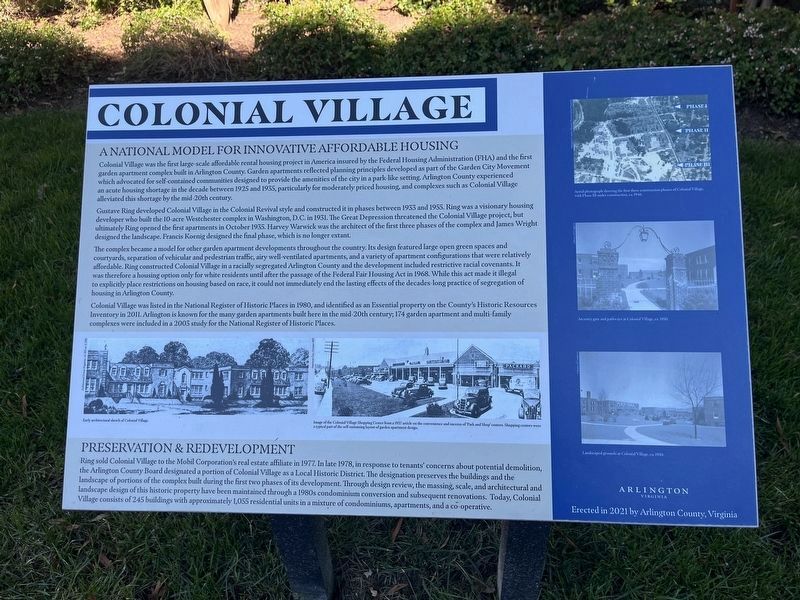
Colonial Village was the first large-scale affordable rental housing project in America insured by the Federal Housing Administration (FHA) and the first garden apartment complex built in Arlington County. Garden apartments reflected planning principles developed as part of the Garden City Movement which advocated for self-contained communities designed to provide the amenities of the city in a park-like setting. Arlington County experienced an acute housing shortage in the decade between 1925 and 1935, particularly for moderately priced housing, and complexes such as Colonial Village alleviated this shortage by the mid-20th century.
Gustave Ring developed Colonial Village in the Colonial Revival style and constructed it in phases between 1933 and 1955. Ring was a visionary housing developer who built the 10-acre Westchester complex in Washington, D.C. in 1931. The Great Depression threatened the Colonial Village project, but ultimately Ring opened the first apartments in October 1935. Harvey Warwick was the architect of the first three phases of the complex and James
this page online
The complex became a model for other garden apartment developments throughout the country. Its design featured large open green spaces and courtyards, separation of vehicular and pedestrian traffic, airy well-ventilated apartments, and a variety of apartment configurations that were relatively affordable. Ring constructed Colonial Village in a racially segregated Arlington County and the development included restrictive racial covenants. It was therefore a housing option only for white residents until after the passage of the Federal Fair Housing Act in 1968. While this act made it illegal to explicitly place restrictions on housing based on race, it could not immediately end the lasting effects of the decades-long practice of segregation of housing in Arlington County.
Colonial Village was listed in the National Register of Historic Places in 1980, and identified as an Essential property on the County's Historic Resources Inventory in 2011. Arlington is known for the many garden apartments built here in the mid-20th century; 174

Preservation & Redevelopment
Ring sold Colonial Village to the Mobil Corporation's real estate affiliate in 1977. In late 1978, in response to tenants' concerns about potential demolition, the Arlington County Baord designated a portion of the Colonial Village as a Local Historic District. The designation preserves the buildings and the landscape of portions of the complex built during the first two phases of its development. Through design review, the massing, scale, and architectural and landscape design of this historic property have been maintained through a 1980s condominium conversion and subsequent renovations. Today, Colonial Village consists of 245 buildings with approximately 1,055 residential units in a mixture of condominiums, apartments, and a co-operative.
[Captions:]
Early architectural sketch of Colonial Village.
Image of the Colonial Village Shopping Center from a 1937 article on the convenience and success of 'Park and Shop' centers. Shopping centers were a typical part of the self-sustaining layout of garden apartment design.
Aerial photograph showing the first three construction phases of Colonial Village, with Phase III under construction, ca. 1946.
An entry gate and pathways at Colonial Village, ca. 1950.
Landscaped grounds at Colonial Village, ca. 1950.
Erected 2021

Photographed by Devry Becker Jones (CC0), October 11, 2024
3. Virginia Historic Landmark plaque for Colonial Village
Topics. This historical marker is listed in these topic lists: Architecture • Settlements & Settlers. A significant historical month for this entry is October 1935.
Location. 38° 53.617′ N, 77° 4.783′ W. Marker is in Arlington, Virginia, in Arlington County. It is in Colonial Village. It is on Wilson Boulevard east of North Rhodes Street, on the right when traveling west. Touch for map. Marker is at or near this postal address: 1720 Queens Ln, Arlington VA 22201, United States of America. Touch for directions.

Regionally, this marker is in the Washington Metropolitan Area and in Northern Virginia. It is also in the American South, specifically in the Upper South, in the Mid-Atlantic, and on the Eastern Seaboard. Globally, it is in the North Atlantic Region, North America, the Western Hemisphere, the Western World, and the Anglosphere. Historically, it finds itself in what was once the territory of the Mississippian Culture, one of the original Thirteen Colonies, one of the Confederate States of America, and the Antebellum South.
Other nearby markers. At least 8 other markers are within walking distance of this marker: The Arlington Line (approx. ¼ mile away); Fort Corcoran (approx. 0.3 miles away); The Investment Building (approx. 0.3 miles away); Compassion (approx. 0.3 miles away); Arlington County Peace Officer Memorial (approx. 0.3 miles away); First Federal Savings and Loan Building (approx. 0.3 miles away); ARPANET (approx. 0.3 miles away); Courthouse Neighborhood and Lawyer's Row (approx. 0.3 miles away). Touch for a list and map of all markers in Arlington.
Additional keywords. segregation; Jim Crow era; housing discrimination
Credits. This page was last revised on October 11, 2024. It was originally submitted on October 11, 2024, by Devry Becker Jones of Washington, District of Columbia. This page has been viewed 476 times since then and 63 times this year. Photos: 1, 2, 3. submitted on October 11, 2024, by Devry Becker Jones of Washington, District of Columbia.
