Roquette in Paris in Département de Paris, Île-de-France, France — Western Europe
Place Léon Blum
| — | Histoire de Paris | — |
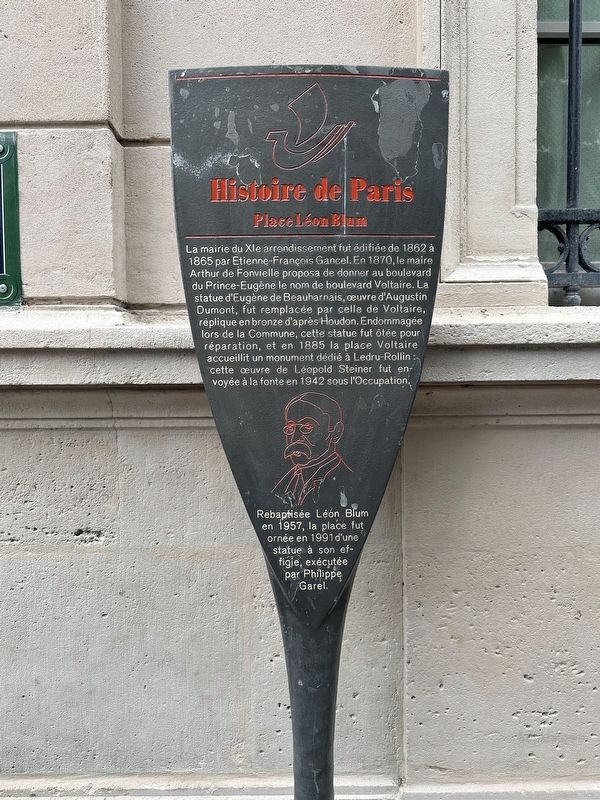
Photographed by Andrew Ruppenstein, September 10, 2024
1. Place Léon Blum Marker

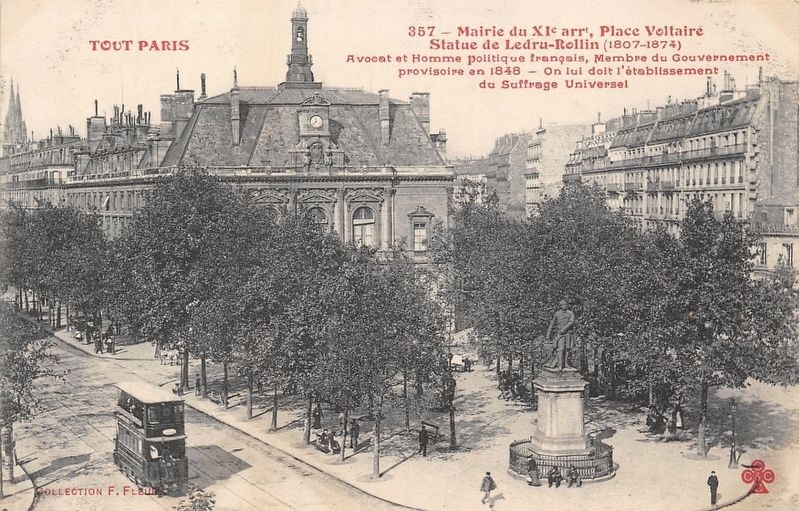
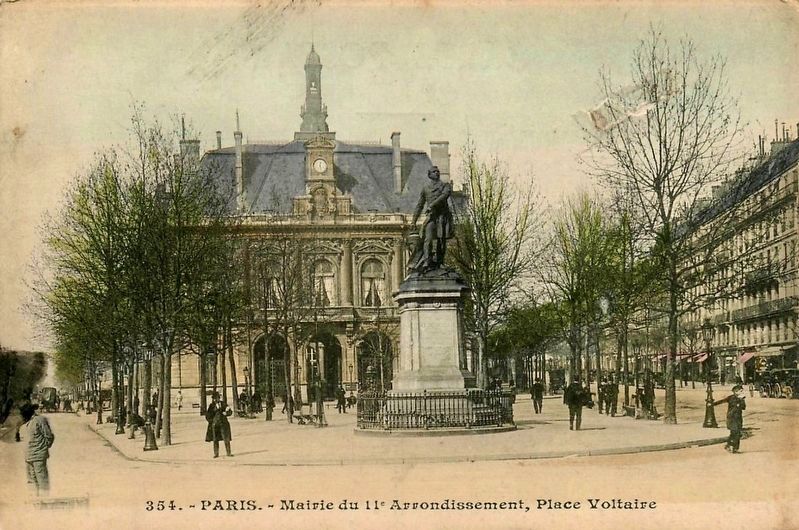
The town hall of the 11th arrondissement was built from 1862 to 1865 by Etienne-François Gancel. In 1870, Mayor Arthur de Fonvielle proposed to give the Boulevard du Prince-Eugène the name Boulevard Voltaire. The statue of Eugène de Beauharnais, the work of Augustin Dumont, was replaced by that of Voltaire, a bronze replica after Houdon. Damaged during the Commune, this statue was removed for repair, and in 1885
this page online
Topics and series. This historical marker is listed in this topic list: Notable Places. In addition, it is included in the Histoire de Paris series list. A significant historical year for this entry is 1862.
Location. 48° 51.515′ N, 2° 22.783′ E. Marker is in Paris, Île-de-France, in Département de Paris. It is in Roquette. It is at the intersection of Avenue Parmentier and Place Léon Blum, on the right when traveling south on Avenue Parmentier. Touch for map. Marker is at or near this postal address: 12 Place Léon Blum, Paris, Île-de-France 75011, France. Touch for directions.

Regionally, it is in the North Atlantic Region, Europe, the European Union, Atlantic Europe, the Schengen Area, Western Europe, a coastal Mediterranean country, and the Western World. Historically, it finds itself in what was once a French colony and also the Roman Empire.
Other nearby markers. At
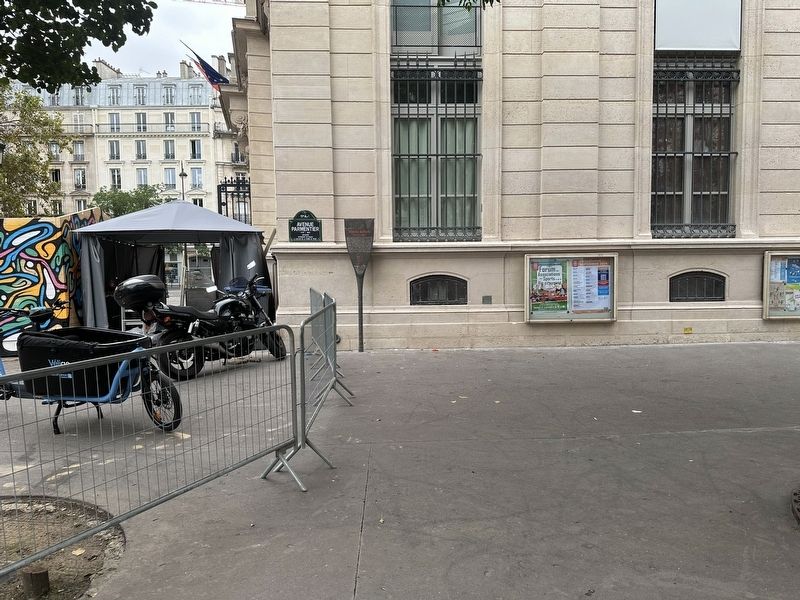
Photographed by Andrew Ruppenstein, September 10, 2024
2. Place Léon Blum Marker - wide view
Also see . . . Léon Blum summary (Britannica). Excerpt, with link to the full article.
Léon Blum, (born April 9, 1872, Paris, France—died March 30, 1950, Jouy-en-Josas), French politician and writer. He made a name as a brilliant literary and drama critic, then entered politics in the French Socialist Party. As a member of the Chamber of Deputies (1919–28, 1929–40), he became a leader of the Socialists from 1921. The chief architect(Submitted on October 12, 2024.)of an electoral alliance of the left, he became the first Socialist (and the first Jewish) premier of France as head of the Popular Front government (1936–37). He introduced such reforms as the 40-hour workweek and collective bargaining and nationalized the chief war industries and the Bank of France. Arrested by the Vichy government in 1940, he was imprisoned until 1945. In the postwar years he was one of France’s leading veteran statesmen.Photographed by Andrew Ruppenstein, September 10, 20243. Place Léon Blum Marker - wider viewThe marker is visible here at the corner of the 11th Arrondissement’s town hall.
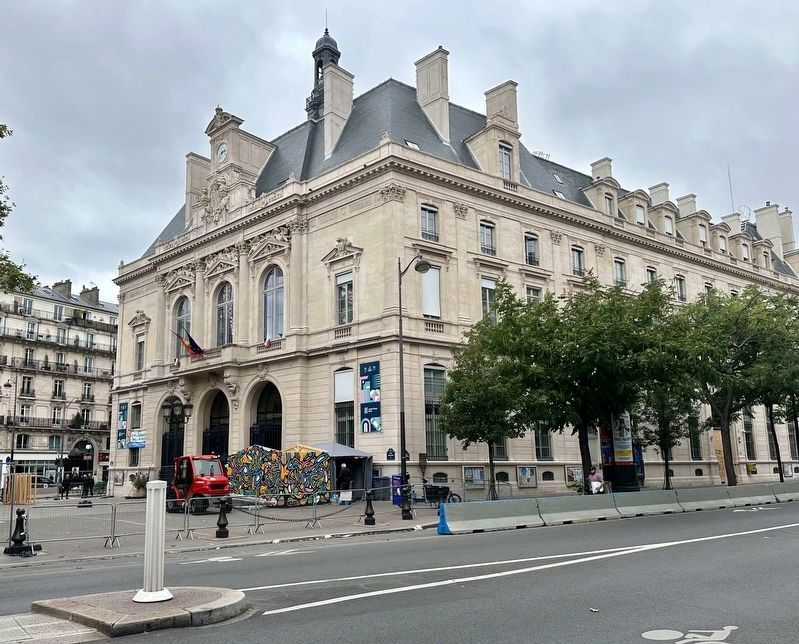
Additional keywords. panneau
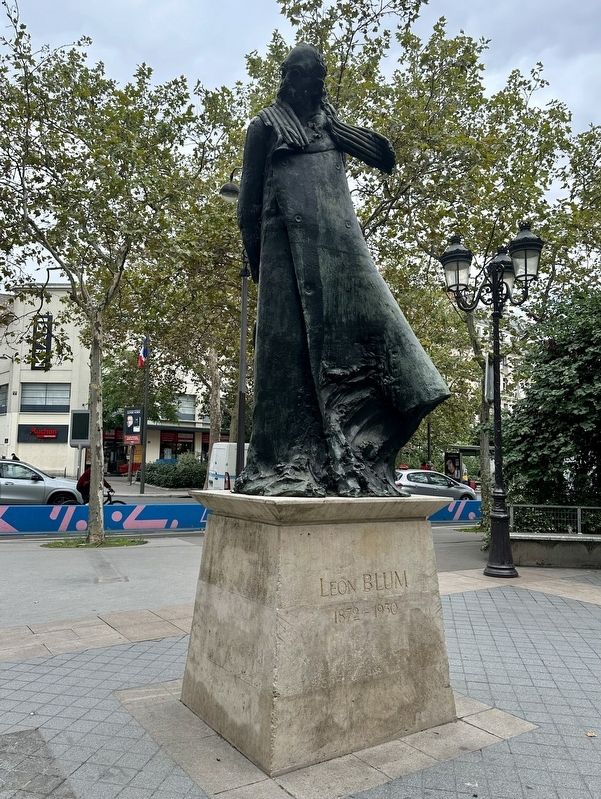
Photographed by Andrew Ruppenstein, September 10, 2024
4. Statue of Léon Blum at Place Léon Blum
Collection F. Fleury, circa 1900
5. Place Léon Blum - from above
View showing the 11th Arrondissement’s town hall and the Statue of Ledru-Rollin (removed in 1942) in Place Voltaire, which was renamed Place Léon Blum in 1957.
circa 1902
6. Place Léon Blum (formerly Place Voltaire)
Credits. This page was last revised on April 15, 2025. It was originally submitted on October 11, 2024, by Andrew Ruppenstein of Lamorinda, California. This page has been viewed 177 times since then and 31 times this year. Photos: 1, 2. submitted on October 11, 2024, by Andrew Ruppenstein of Lamorinda, California. 3, 4, 5, 6. submitted on October 12, 2024, by Andrew Ruppenstein of Lamorinda, California.
