Troy in Pike County, Alabama — The American South (East South Central)
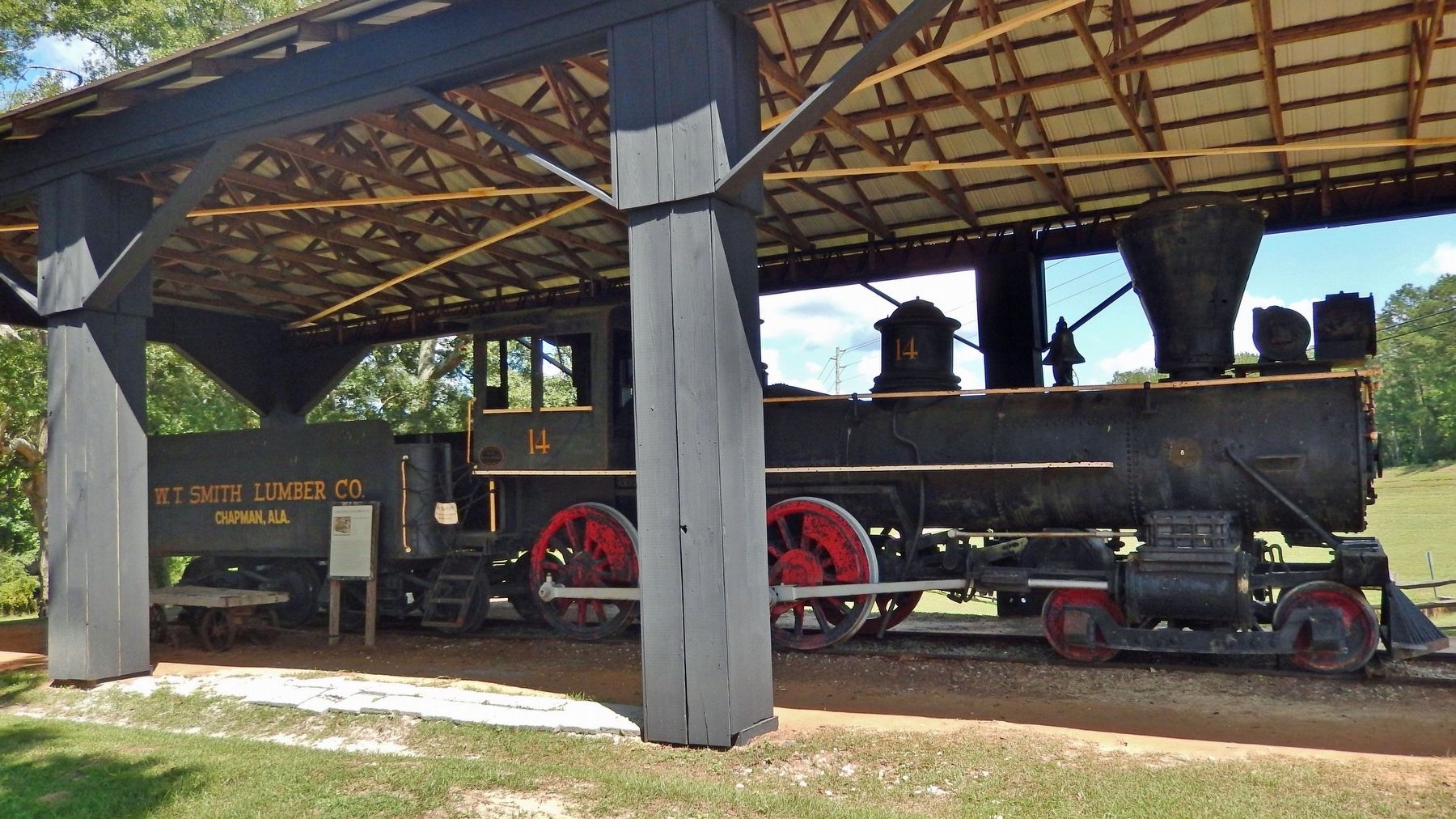
Logging Locomotive

Photographed by Cosmos Mariner, September 20, 2024
1. Logging Locomotive Marker
General Dimensions
Gauge — 4' 8-1/2"
Cylinders — 16" x 24"
Driving Wheels — 57" diameter
Truck Wheels — 24" diameter
Engine Weight — 86,700 pounds
Engine and Tender — 157,000 pounds
Tank Capacity — 3,500 gallons
Fuel Capacity — 3 cords of wood
The old logging locomotive was built in 1881 and given the number 5892 by the Baldwin Locomotive Works before the delivery to the Central Railroad and Banking Company of Georgia, later known as the Central of Georgia Railroad. The balloon stack of the locomotive is of the Bradley and Hunter pattern. The engine bore the name "Madison" when it was owned by the Central of Georgia. The locomotive was later sold to the Empire Lumber Company of Andalusia. The gauge was originally five feet but was modified to standard gauge. The designation of the engine is #14.
The W. T. Smith Lumber Company acquired the locomotive and other rolling stock when they purchased the Empire Lumber Company in 1912. The engine remained in operation for logging for fifteen more years, under the leadership of the McGowin family of Chapman, Alabama. After the sale of their forest lands, the locomotive was moved to the private
this page online
Topics. This historical marker is listed in these topic lists: Industry & Commerce • Railroads & Streetcars. A significant historical year for this entry is 1881.
Location. 31° 49.517′ N, 85° 59.733′ W. Marker is in Troy, Alabama, in Pike County. It can be reached from U.S. 231 0.2 miles south of Palos Verdes Drive, on the right when traveling south. The marker and subject locomotive are on the Pioneer Museum of Alabama grounds, near the entrance. Touch for map. Marker is at or near this postal address: 248 US Highway 231, Troy AL 36081, United States of America. Touch for directions.

Regionally, this marker is in the American South, specifically in the Deep South, in the Black Belt, and in the Wiregrass. Globally, it is in North America, a Gulf of Mexico state, the Western Hemisphere, the Western World, and the Anglosphere. Historically, it finds itself in what was once the territory of the Mississippian Culture, one of the Confederate States
Photographed by Cosmos Mariner, September 20, 2024
2. Logging Locomotive Exhibit
The marker is located on the left side of the locomotive exhibit, beside the tender.
Other nearby markers. At least 8 other markers are within 2 miles of this marker, measured as the crow flies: The Great Pensacola Trading Path (about 300 feet away, measured in a direct line); First Baptist Church (approx. 1.7 miles away); First United Methodist Church (approx. 1.8 miles away); Pike County War Veterans Memorial (approx. 1.8 miles away); Pike County Foreign Wars Veterans Memorial (approx. 1.8 miles away); Troy & Pike Pike County SCLC Scope Project, 1965 (approx. 1.8 miles away); Soldiers Memorial (approx. 1.8 miles away); Three Notch Road (approx. 1.8 miles away). Touch for a list and map of all markers in Troy.
Also see . . . 4-4-0 (Wikipedia).
4-4-0, in the Whyte notation, denotes a steam locomotive with a wheel arrangement of four leading wheels on two axles, four powered and coupled driving wheels on two axles, and no trailing wheels. First built in the 1830s, locomotives with this wheel arrangement were known as "standard" or "Eight-Wheeler" type. In the first half of the 19th century, almost every major railroad in North America owned and operated locomotives(Submitted on October 14, 2024, by Cosmos Mariner of Cape Canaveral, Florida.)of this type. By 1910, the 4-4-0 was considered obsolete being replaced by Mikados, Pacifics and other larger engines, although they continued to serve to an extent into the 1950s. The last 4-4-0 to be built was a diminutive Baldwin product in 1945. Fewer than forty 4-4-0s survive in preservation in the United States, reproductions excluded.Photographed by Cosmos Mariner, September 20, 20243. Logging Locomotive

Credits. This page was last revised on October 14, 2024. It was originally submitted on October 14, 2024, by Cosmos Mariner of Cape Canaveral, Florida. This page has been viewed 279 times since then and 69 times this year. Photos: 1, 2, 3. submitted on October 14, 2024, by Cosmos Mariner of Cape Canaveral, Florida.
