Near Zionsville in Lehigh County, Pennsylvania — The American Northeast (Mid-Atlantic)
Schubert-Graber Log Post Shop
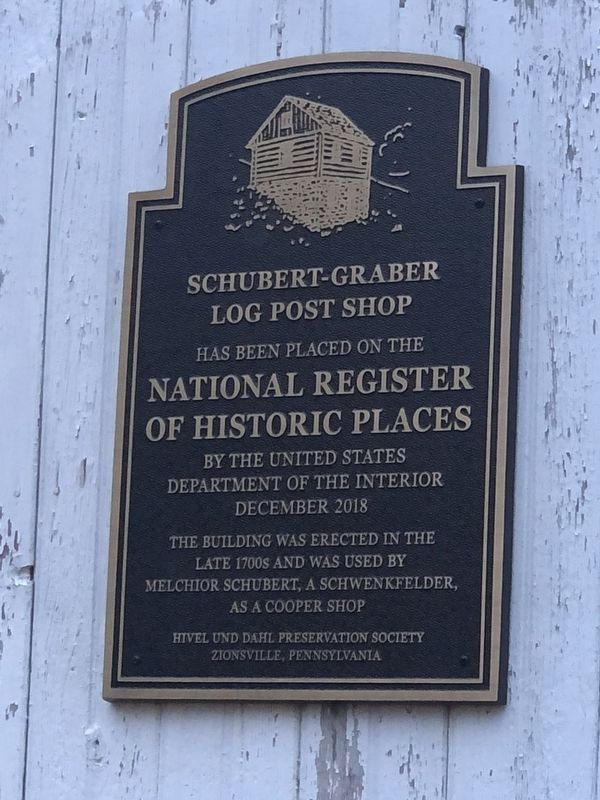
Photographed by Duane and Tracy Marsteller, September 27, 2024
1. Schubert-Graber Log Post Shop Marker
The building was erected in the late 1700s and was used by Melchior Schubert, a Schwenkfelder, as a cooper shop
Erected by Hivel und Dahl Preservation Society.
Topics and series. This historical marker is listed in these topic lists: Architecture • Industry & Commerce. In addition, it is included in the National Register of Historic Places (NRHP) series list. A significant historical year for this entry is 1791.
Location. 40° 28.381′ N, 75° 31.436′ W. Marker is near Zionsville, Pennsylvania, in Lehigh County. It is on Powder Valley Road (County Route 2025) north of Geissiger Road, on the right when traveling north. Touch for map. Marker is at or near this postal address: 6561 Powder Valley Rd, Zionsville PA 18092, United States of America. Touch for directions.

Regionally, this marker is in Southeast Pennsylvania and in Lehigh Valley. It is also in the American Northeast and in the Mid-Atlantic. Globally, it is in North America, the Western Hemisphere, the Western World,
this page online
Other nearby markers. At least 8 other markers are within 5 miles of this marker, measured as the crow flies: Indian Jasper Quarries (approx. 2.8 miles away); Jasper Park Indian (approx. 2.8 miles away); Palm (approx. 3.4 miles away); Veterans Memorial (approx. 3½ miles away); 9/11 World Trade Center Memorial (approx. 3½ miles away); World War I Memorial (approx. 3½ miles away); Servicing the Furnace (approx. 4.4 miles away); Casting Pigs (approx. 4.4 miles away).
Another marker is no longer nearby. Hereford Furnace (was approx. 2.2 miles away but has been confirmed missing).
Regarding Schubert-Graber Log Post Shop. Excerpts from the National Register nomination:
The Schubert-Graber log-post shop … is an important example of the design and engineering methods of the little-studied and inadequately-understood vertical log-post construction. Scant scholarly research has been performed to identify and explain the use of corner posts in log buildings. Corner-post constructionsrequired expert knowledge and skill to cut, fit and erect, unlike their cross-cornered cousins that littered the early settlements. …Photographed by Duane and Tracy Marsteller, September 27, 20242. Schubert-Graber Log Post Shop MarkerThe marker is on the frame garage that was added c. 1936. The stone and log portion was constructed c. 1795.
There is no solid documentary proof of who built the little two-story log shop, or what its original purpose was. Census data and Melchior Schubert's will, which he signed 2 August 1831 only a few months prior to his death that December, listed his occupation as a cooper. There is a strong possibility that Melchior had the log-post shop building erected as a cooperage. On the stair casing wall that leads to the loft there was a large circle scribed using a pair of compass points. The metal points of the compass were lodged in the ends of wooden handles and the tool was used in making large circles for laying out wheels, barrel bottoms, lids and many other items.

The Schwenkfelders were a religious group, composed primarily of Germans, who followed the teachings of radical-Protestant reformer Caspar Schwenckfeld von Ossig (1489/90–1561). They began emigrating to Pennsylvania in 1734 to escape religious persecution in Europe. Only four Schwenkfelder churches exist today, all in Montgomery or Philadelphia counties, Pennsylvania.
Also see . . . Schubert-Graber Log-Post Shop (PDF). National Register nomination for the building. (Prepared by Douglass C. Reed; via National Park Service) (Submitted on October 15, 2024, by Duane and Tracy Marsteller of Murfreesboro, Tennessee.)
Credits. This page was last revised on October 15, 2024. It was originally submitted on October 15, 2024, by Duane and Tracy Marsteller of Murfreesboro, Tennessee. This page has been viewed 247 times since then and 56 times this year. Photos: 1, 2. submitted on October 15, 2024, by Duane and Tracy Marsteller of Murfreesboro, Tennessee.
