Quartier Saint-Paul in Paris in Département de Paris, Île-de-France, France — Western Europe
La tour Barbeau
⎯⎯⎯
The Barbeau Tower
| — | Histoire de Paris | — |
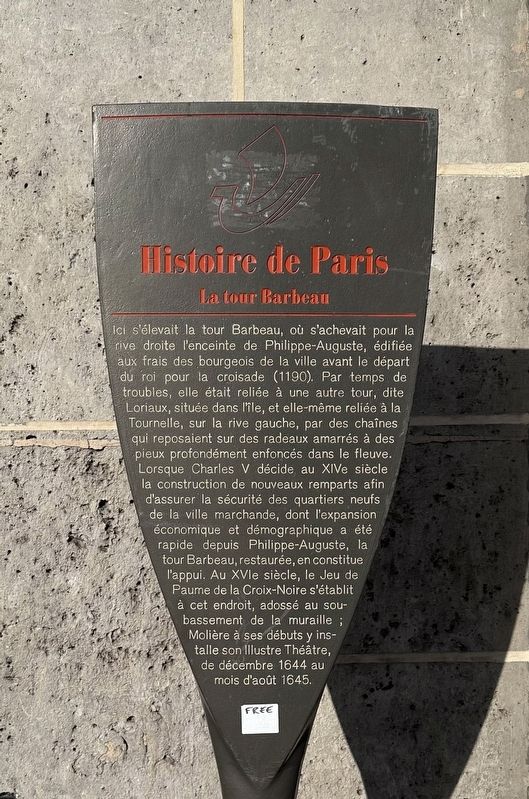
Photographed by Andrew Ruppenstein, September 11, 2024
1. La tour Barbeau / The Barbeau Tower Marker

Here stood the Barbeau Tower, where Philippe-Auguste's wall ended on the right bank, built at the expense of the town's bourgeoisie before the king left for the crusade (1190). In times of trouble, it was connected to another tower, called Loriaux, located on the island, and itself connected to the Tournelle, on the left bank, by chains that rested on rafts moored to stakes driven deep into the river. When Charles V decided in the 14th century to build new ramparts to ensure the security of the new districts of the merchant city, whose economic and demographic expansion had been rapid since Philippe-Auguste, the restored Barbeau Tower provided the support. In the 16th century, the Jeu de Paume de la Croix-Noire was established at this location, leaning against the base of the wall; Molière, at the beginning of his career, set up his Illustre
this page online
Topics and series. This historical marker is listed in these topic lists: Arts, Letters, Music • Forts and Castles. In addition, it is included in the Histoire de Paris series list.
Location. 48° 51.166′ N, 2° 21.58′ E. Marker is in Paris, Île-de-France, in Département de Paris. It is in Quartier Saint-Paul. It is on Quai des Célestins, on the left when traveling east. Touch for map. Marker is at or near this postal address: 32 Quai des Célestins, Paris, Île-de-France 75004, France. Touch for directions.

Regionally, it is in the North Atlantic Region, Europe, the European Union, Atlantic Europe, the Schengen Area, Western Europe, a coastal Mediterranean country, and the Western World. Historically, it finds itself in what was once a French colony and also the Roman Empire.
Other nearby markers. At least 8 other markers are within walking distance of this marker: François Rabelais (within shouting distance of this marker); Jardin Marie Trintignant (1933) (within shouting distance of this marker); Charles Baudelaire (1821 - 1867)

Photographed by Andrew Ruppenstein, September 11, 2024
2. La tour Barbeau / The Barbeau Tower Marker - wide view
Also see . . . Tour Barbeau (Wikipedia, in French). Excerpt (in translation):
The Barbeau Tower was one of the main towers of the old Philippe Auguste wall of Paris, built between 1190 and 1209.(Submitted on October 15, 2024.)
Additional keywords. panneau
Credits. This page was last revised on April 15, 2025. It was originally submitted on October 15, 2024, by Andrew Ruppenstein of Lamorinda, California. This page has been viewed 315 times since then and 53 times this year. Photos: 1, 2. submitted on October 15, 2024, by Andrew Ruppenstein of Lamorinda, California.
