Ile de la Cité in Paris in Département de Paris, Île-de-France, France — Western Europe
Edmond Fleg
Photographed by Andrew Ruppenstein, September 11, 2024
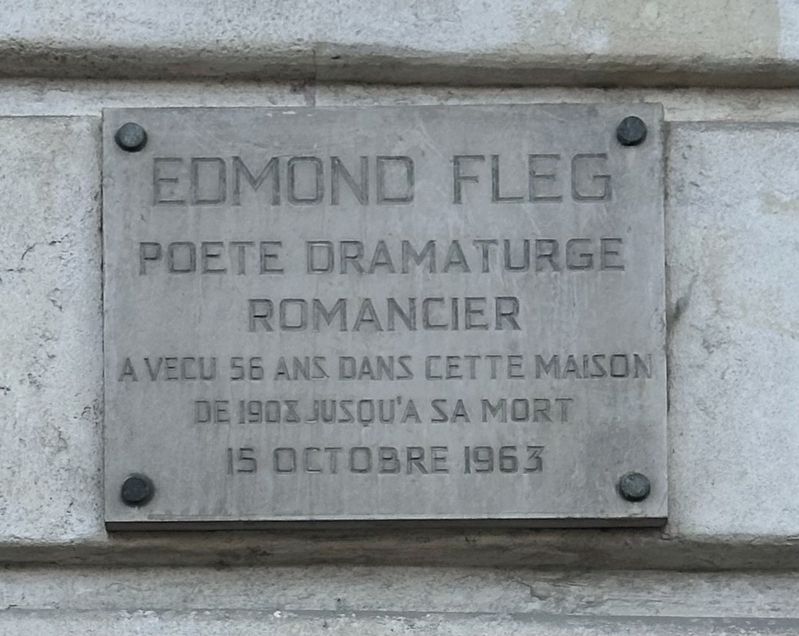
1. Edmond Fleg Marker

Poete Dramaturge
Romancier
A vecu 56 ans dans cette maison
de 1908 jusqu'a sa mort
15 octobre 1963
Edmond Fleg - Poet, Playwright, and Novelist - lived for 56 years in this house from 1908 until his death on October 15, 1963.
Topics. This historical marker is listed in this topic list: Arts, Letters, Music. A significant historical date for this entry is October 15, 1963.
Location. 48° 51.175′ N, 2° 21.121′ E. Marker is in Paris, Île-de-France, in Département de Paris. It is in Ile de la Cité. It is on Quai aux Fleurs, on the left when traveling north. Touch for map. Marker is at or near this postal address: 1 Quai aux Fleurs, Paris, Île-de-France 75004, France. Touch for directions.

Regionally, it is in the North Atlantic Region, Europe, the European Union, Atlantic Europe, the Schengen Area, Western Europe, a coastal Mediterranean country, and the Western World. Historically, it finds itself in what was once a French colony and also the Roman Empire.
Other nearby markers. At least 8 other markers are within walking distance of this marker: Vladimir Jankélévitch (here,
this page online
Also see . . . Edmond Fleg (Wikipedia). Overview:
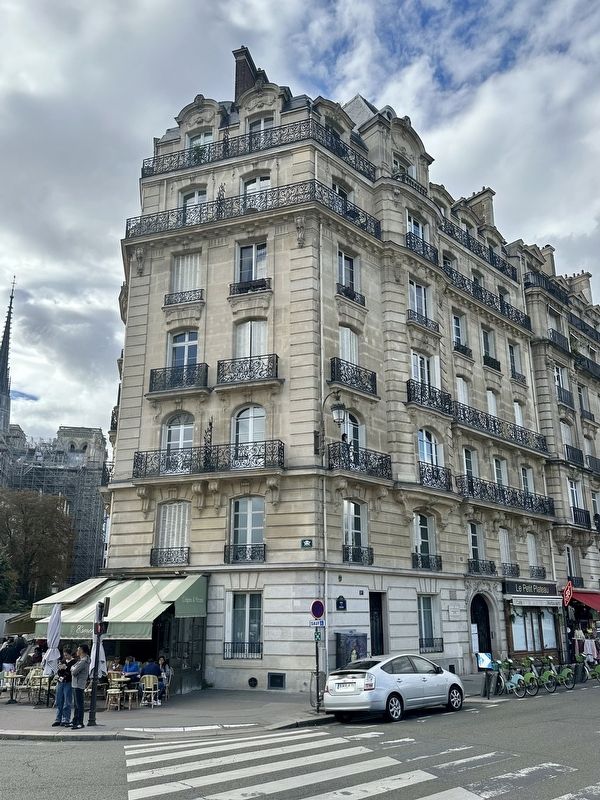
Edmond Flegenheimer, better known as Edmond Fleg, (26 November 1874 – 15 October 1963) was a Jewish French writer, thinker, novelist, essayist and playwright of the 20th century. Fleg's oeuvre was crucial in constructing a modern French Jewish identity, rendering him an instrumental figure in the Jewish awakening during the interwar years. After World War I, Jewish writers began articulating a new, cultural definition of what it meant to be a Jew within the context of French Third Republic universalism. Through his writings — based on Jewish and Christian texts—Fleg formed the foundation(Submitted on October 17, 2024.)of a modern French Jewish spirituality and self-understanding, which allowed secular French Jews to preserve their Jewish identity. In doing so, Fleg was calling for an exploration of the living texts of traditional Judaism as the basis for a modern Jewish identity, establishing a new literary direction devoted to re-interpreting biblical texts and legends, and liturgies.Photographed by Andrew Ruppenstein, September 11, 20242. Edmond Fleg Marker - wide viewThe marker is a little to the right and above the silver Prius, just above the marker for Vladimir Jankélévitch.
Additional keywords. Jewish
Credits. This page was last revised on October 17, 2024. It was originally submitted on October 17, 2024, by Andrew Ruppenstein of Lamorinda, California. This page has been viewed 123 times since then and 8 times this year. Photos: 1, 2. submitted on October 17, 2024, by Andrew Ruppenstein of Lamorinda, California.
