Maumee in Lucas County, Ohio — The American Midwest (Great Lakes)
House of Four Pillars
Ohio Historical Marker
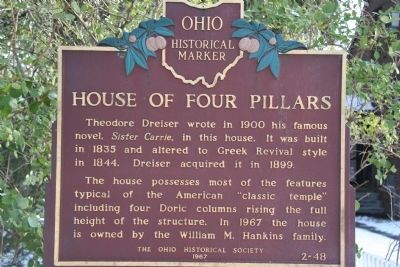
Photographed by Dale K. Benington, December 23, 2009
1. House of Four Pillars Marker
Erected 1967 by The Ohio Historical Society. (Marker Number 2-48.)
Topics and series. This historical marker is listed in this topic list: Notable Buildings. In addition, it is included in the Ohio Historical Society / The Ohio History Connection series list. A significant historical year for this entry is 1900.
Location. 41° 33.736′ N, 83° 38.914′ W. Marker is in Maumee, Ohio, in Lucas County. It is on East Broadway Street 0 miles Elizabeth Street, on the left when traveling west. Touch for map. Marker is in this post office area: Maumee OH 43537, United States of America. Touch for directions.

Regionally, this marker is on the Lake Erie Shore and in the Toledo Metropolitan Area. It is also in the American Midwest and in the Corn Belt.
this page online
Other nearby markers. At least 8 other markers are within walking distance of this marker: Pecan (about 400 feet away, measured in a direct line); Ohio Buckeye (about 600 feet away); First Presbyterian Church (about 700 feet away); Cottonwood (about 700 feet away); The Old Plantation (approx. 0.2 miles away); G.A.R. Civil War Monument (approx. ¼ mile away); Maumee Honor Roll (approx. ¼ mile away); Historic Buildings in the City of Maumee (approx. ¼ mile away). Touch for a list and map of all markers in Maumee.
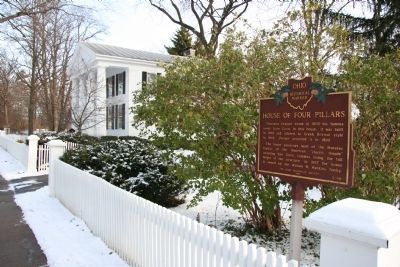
Photographed by Dale K. Benington, December 23, 2009
2. House of Four Pillars Marker
View of historical marker in the right foreground and the structure that is featured on the text of the marker, the House of Four Pillars, in the background.
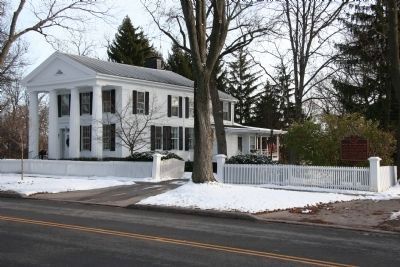
Photographed by Dale K. Benington, December 23, 2009
3. House of Four Pillars
View of the House of Four Pillars with the historic marker seen to the extreme right of the picture.
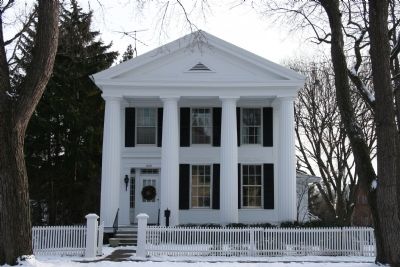
Photographed by Dale K. Benington, December 23, 2009
4. House of Four Pillars Marker
View of the House of Four Pillars.
Photographed by Allen C. Browne, November 29, 2015
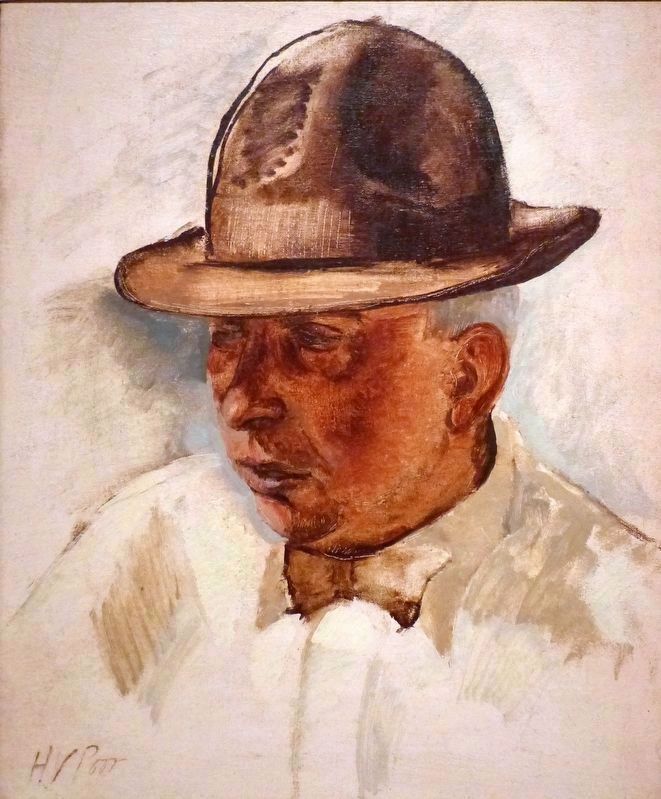
5. Theodore Dreiser
This 1933 portrait of Theodore Dreiser (1871 – 1945) by Henry Varnum Poor hangs in the National Portrait Gallery in Washington, DC.
“When the young journalist Theodore Dreiser published his first novel, Sister Carrie, in 1900, even his publisher was shocked, and the book was virtually banned. Nevertheless, this tale of compromised virtue within a harsh urban environment would ultimately be regarded as a watershed move toward greater frankness in American fiction. Dreiser continued to probe the unvarnished realities of urban life in such works from the 1910s as Jennie Gerhardt, The Titan, and The Genius. But it was not until the appearance of An American Tragedy in 1925 that Dreiser finally received serious attention as one of the most significant realists in American literary history. Nonetheless Dreiser, a lifelong advocate of freedom of expression, battled censorship his whole career. Henry Varnum Poor made this portrait at the time the contentious author had begun to get involved in the politics of radical protest.” – National Portrait Gallery
“When the young journalist Theodore Dreiser published his first novel, Sister Carrie, in 1900, even his publisher was shocked, and the book was virtually banned. Nevertheless, this tale of compromised virtue within a harsh urban environment would ultimately be regarded as a watershed move toward greater frankness in American fiction. Dreiser continued to probe the unvarnished realities of urban life in such works from the 1910s as Jennie Gerhardt, The Titan, and The Genius. But it was not until the appearance of An American Tragedy in 1925 that Dreiser finally received serious attention as one of the most significant realists in American literary history. Nonetheless Dreiser, a lifelong advocate of freedom of expression, battled censorship his whole career. Henry Varnum Poor made this portrait at the time the contentious author had begun to get involved in the politics of radical protest.” – National Portrait Gallery
Credits. This page was last revised on February 27, 2018. It was originally submitted on December 26, 2009, by Dale K. Benington of Toledo, Ohio. This page has been viewed 3,612 times since then and 120 times this year. Photos: 1, 2, 3, 4. submitted on December 26, 2009, by Dale K. Benington of Toledo, Ohio. 5. submitted on February 25, 2018, by Allen C. Browne of Silver Spring, Maryland.
