
Altstadt in Würzburg, Bavaria, Germany — Central Europe
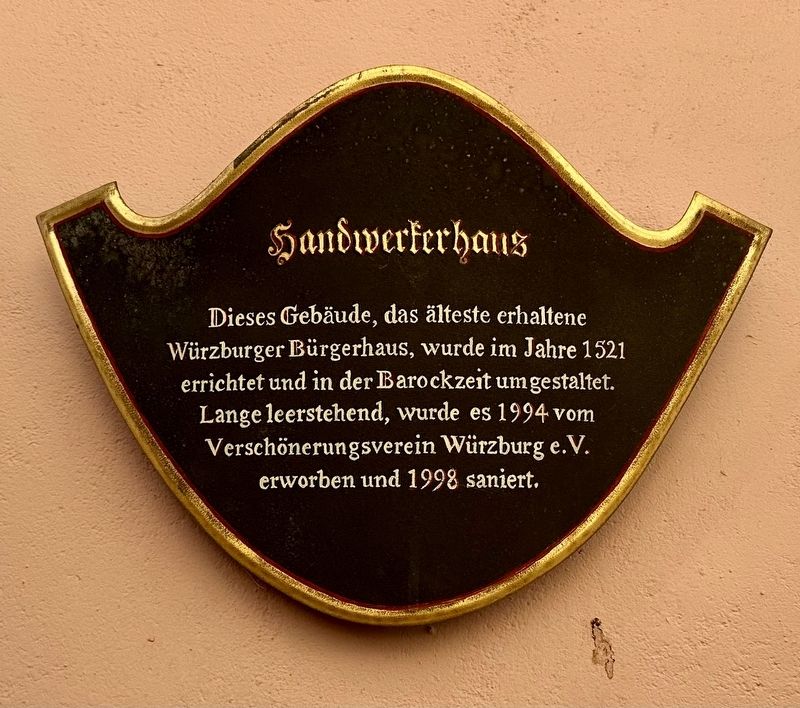
Pleicher Handwerkerhaus
⎯⎯⎯
Pleicher Craftsman’s House
Photographed by Andrew Ruppenstein, August 22, 2024
1. Pleicher Handwerkerhaus / Pleicher Craftsman’s House Marker

Topics. This historical marker is listed in this topic list: Notable Buildings. A significant historical year for this entry is 1521.
Location. 49° 47.843′ N, 9° 55.668′ E. Marker is in Würzburg, Bayern (Bavaria). It is in Altstadt. It is on Pleicherkirchgasse. Touch for map. Marker is at or near this postal address: Pleicherkirchgasse 16, Würzburg BY 97070, Germany. Touch for directions.

Regionally, it is in Europe, the European Union, Atlantic Europe, Central Europe, the Schengen Area, Western Europe, and the Western World. Historically, it finds itself in what was once the Holy Roman Empire.
Other nearby markers. At
this page online
Also see . . . Das Pleicher Handwerkerhaus in Würzburg (Verschönerungsvereins Würzburg e.V., in German). Excerpt (in translation):
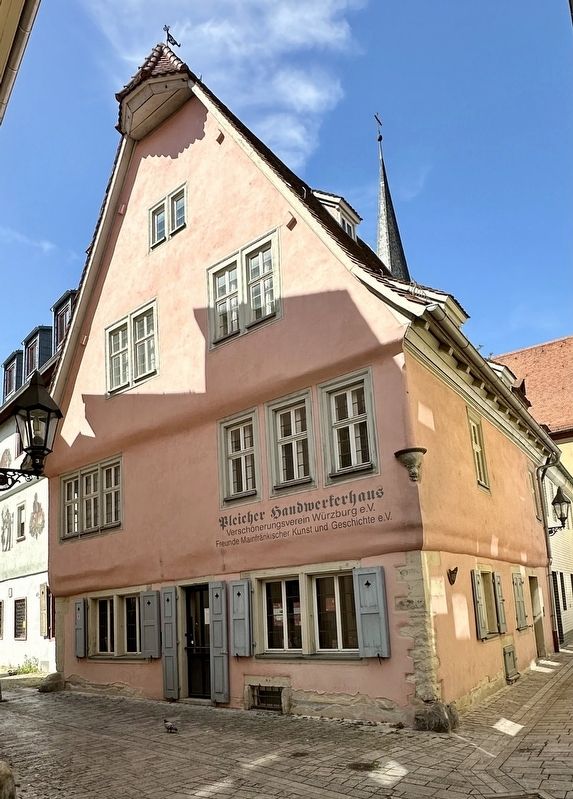
Archival sources allow us to reconstruct the ownership history of the Pleicher craftsmen's house with relative certainty. The builder and first owner was a butcher who was admitted as a citizen in 1510. He finally built the house in 1521. This can be said with a fair degree of certainty, as dendrochronological studies,(Submitted on October 19, 2024.)i.e. studies of the annual rings of the timber, date the felling date of the timber to the winter of 1520/21. Another reason for the relatively certain determination of the date of completion is the fact that a weather vane was found in the attic with that very year.Photographed by Andrew Ruppenstein, August 22, 20242. Pleicher Handwerkerhaus / Pleicher Craftsman’s House and MarkerThe marker is visible here on the right corner of the building.
Even then it had five floors. The basement and ground floor were brick, the floors above were half-timbered floors, the inside and outside of which were decorated in colour. The ground floor served as a workshop and shop, the upper floors as living spaces, which could only be reached via a staircase on the outside of the building. At least in the first few years, the fireplace in the kitchen had no chimney. The craftsman's house was, as was usual at the time, a smoke house, with smoke drifting through the upper floors. The attic floors, whose beams show traces of soot, can therefore hardly have been used as living space.
In contrast, the technique of half-timbering was extremely innovative. Without getting too lost in building research, it should be mentioned that it was previously believed that the technique of mortising the individual components only became established around 1550. Before that, buildings actually only used the lamination technique or both techniques at the same time. The craftsman's house, on the other hand, has mortised joints throughout and is therefore one of the earliest houses in Lower Franconia in which this technique was consistently used.
Credits. This page was last revised on October 19, 2024. It was originally submitted on October 19, 2024, by Andrew Ruppenstein of Lamorinda, California. This page has been viewed 146 times since then and 20 times this year. Photos: 1, 2. submitted on October 19, 2024, by Andrew Ruppenstein of Lamorinda, California.
