Ossining in Westchester County, New York — The American Northeast (Mid-Atlantic)
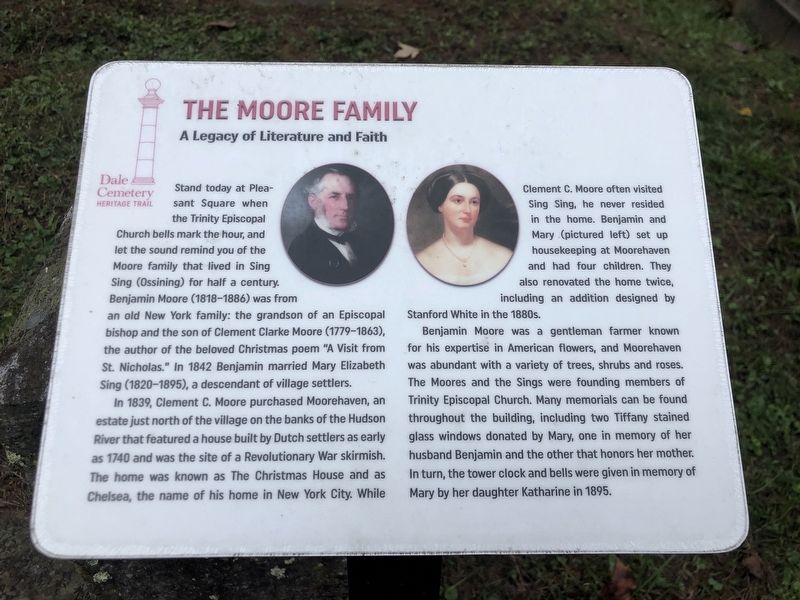
The Moore Family
A Legacy of Literature and Faith
| — | Dale Cemetery Heritage Trail | — |
Photographed by Duane and Tracy Marsteller, September 29, 2024
1. The Moore Family Marker
In 1839, Clement C. Moore purchased Moorehaven, an estate just north of the village on the banks of the Hudson River that featured a house built by Dutch settlers as early as 1740 and was the site of a Revolutionary War skirmish. The home was known as The Christmas House and as Chelsea, the name of his home in New York City. While Clement C. Moore often visited Sing Sing, he never resided in the home. Benjamin and Mary (pictured left) set up housekeeping at Moorehaven and had four children. They also renovated the home twice, including an addition designed by Stanford White in the 1880s.
Benjamin Moore
this page online
Erected by Dale Cemetery. (Marker Number 32.)
Topics. This historical marker is listed in these topic lists: Architecture • Arts, Letters, Music • Religion & Religious Structures. A significant historical year for this entry is 1842.
Location. 41° 10.255′ N, 73° 51.366′ W. Marker is in Ossining, New York, in Westchester County. It can be reached from the intersection of Havell Street and Jenkins Court. Marker is in Section H of Dale Cemetery. Touch for map. Marker is at or near this postal address: 104 Havell St, Ossining NY 10562, United States of America. Touch for directions.

Regionally, this marker is in the Hudson

Photographed by Duane and Tracy Marsteller, September 29, 2024
2. The Moore Family Marker
Other nearby markers. At least 8 other markers are within walking distance of this marker: The Receiving Tomb (a few steps from this marker); Capt. Elijah Hunter (1749-1815) (within shouting distance of this marker); Munson I. Lockwood (1810-1875) (within shouting distance of this marker); John Thompson Hoffman (1828-1888) (within shouting distance of this marker); John Edward Holla (1860-1939) (within shouting distance of this marker); The Pilat Family (within shouting distance of this marker); Samuel Youngs (1760-1839) (within shouting distance of this marker); The O'Brien Family (within shouting distance of this marker). Touch for a list and map of all markers in Ossining.

"Significant Sites and Structures Guide", Village of Ossining, New York (Public Domain), circa 2010
3. Moorehaven AKA The Christmas House
Originally a rural Dutch farmhouse built c. 1740, it was later remodeled in the Gothic Revival and Shingle styles (the section, with the porch and steeply pitched central gable is the original house). On the front door knocker is written in Dutch: “Please take the trouble to close the door behind you.”

Daniel Case via Wikimedia Commons (CC BY-SA 3.0), August 29, 2012
4. Trinity Episcopal Church
The Moores were founding members of the church, which was built in 1891 and is a contributing property in the Downtown Ossining Historic District.
Credits. This page was last revised on October 23, 2024. It was originally submitted on October 22, 2024, by Duane and Tracy Marsteller of Murfreesboro, Tennessee. This page has been viewed 499 times since then and 43 times this year. Photos: 1, 2. submitted on October 22, 2024, by Duane and Tracy Marsteller of Murfreesboro, Tennessee. 3, 4. submitted on October 23, 2024, by Duane and Tracy Marsteller of Murfreesboro, Tennessee.
