
Rheinau in Schwetzingen in Rhein-Neckar-Kreis, Baden-Württemberg, Germany — Central Europe
Nicolas de Pigage
Photographed by James Hulse, September 23, 2024
1. Nicolas de Pigage Marker

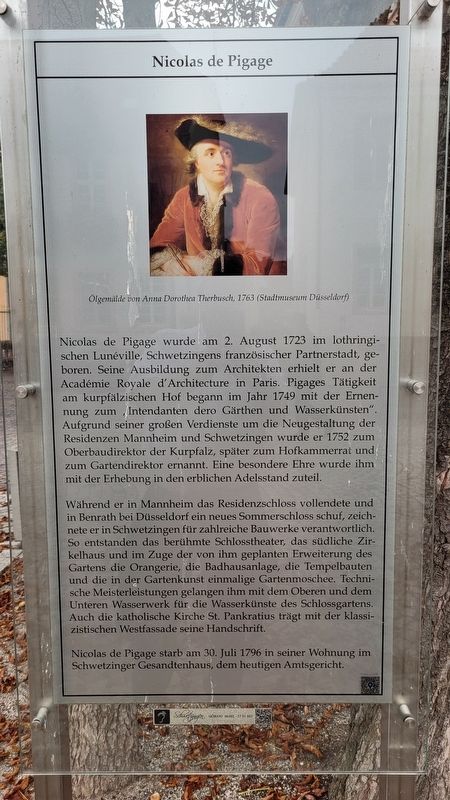
Nicolas de Pigage wurde am 2. August 1723 im lothringischen Lunéville, Schwetzingens französischer Partnerstadt, geboren. Seine Ausbildung zum Architekten erhielt er an der Académie Royale d'Architecture in Paris. Pigages Tätigkeit am kurpfälzischen Hof begann im Jahr 1749 mit der Ernennung zum Intendanten dero Gärthen und Wasserkünsten". Aufgrund seiner großen Verdienste um die Neugestaltung der Residenzen Mannheim und Schwetzingen wurde er 1752 zum Oberbaudirektor der Kurpfalz, später zum Hofkammerrat und zum Gartendirektor ernannt. Eine besondere Ehre wurde ihm mit der Erhebung in den erblichen Adelsstand zuteil.
Während er in Mannheim das Residenzschloss vollendete und in Benrath bei Düsseldorf ein neues Sommerschloss schuf, zeichnete er in Schwetzingen für zahlreiche Bauwerke verantwortlich. So entstanden das berühmte Schlosstheater, das südliche Zirkelhaus und im Zuge der von ihm geplanten Erweiterung des Gartens die Orangerie, die Badhausanlage, die Tempelbauten und die in der Gartenkunst einmalige Gartenmoschee. Technische Meisterleistungen gelangen ihm mit dem Oberen und dem Unteren Wasserwerk
this page online
Nicolas de Pigage starb am 30. Juli 1796 in seiner Wohnung im Schwetzinger Gesandtenhaus, dem heutigen Amtsgericht.
Bildunterschriften
(Foto Nr. 1) Ölgemälde von Anna Dorothea Therbusch, 1763 (Stadtmuseum Düsseldorf)
Nicolas de Pigage was born on August 2, 1723 in Lunéville, Lorraine, Schwetzingen's French twin town. He received his training as an architect at the Académie Royale d'Architecture in Paris. Pigage's work at the Electorate of the Palatinate court began in 1749 with his appointment as "Intendant of the Gardens and Water Features". Due to his great services to the redesign of the Mannheim and Schwetzingen residences, he was appointed Chief Building Director of the Electorate of the Palatinate in 1752, later as Court Chamberlain and Garden Director. He was given a special honour when he was raised to the hereditary nobility.
While he completed the residential palace in Mannheim and created a new summer palace in Benrath near Düsseldorf, he was responsible for numerous buildings in Schwetzingen. The famous palace theater, the southern Zirkelhaus and, as part of his planned expansion of the garden, the orangery,
Photographed by James Hulse, September 23, 2024
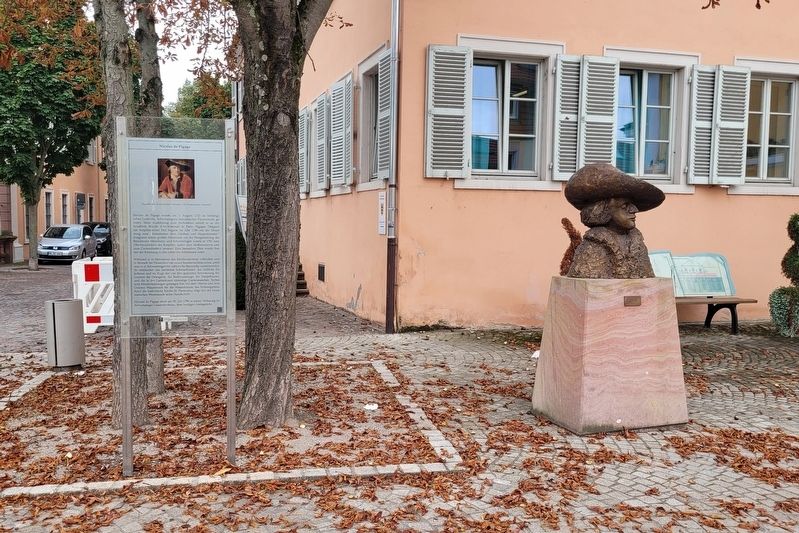
2. Nicolas de Pigage bust and Marker
Nicolas de Pigage died on July 30, 1796 in his apartment in the Schwetzingen Ambassador's House, today's district court.
Captions
(Photo #1) Oil painting by Anna Dorothea Therbusch, 1763 (Stadtmuseum Düsseldorf)
Topics. This historical marker is listed in this topic list: Architecture. A significant historical date for this entry is July 30, 1796.
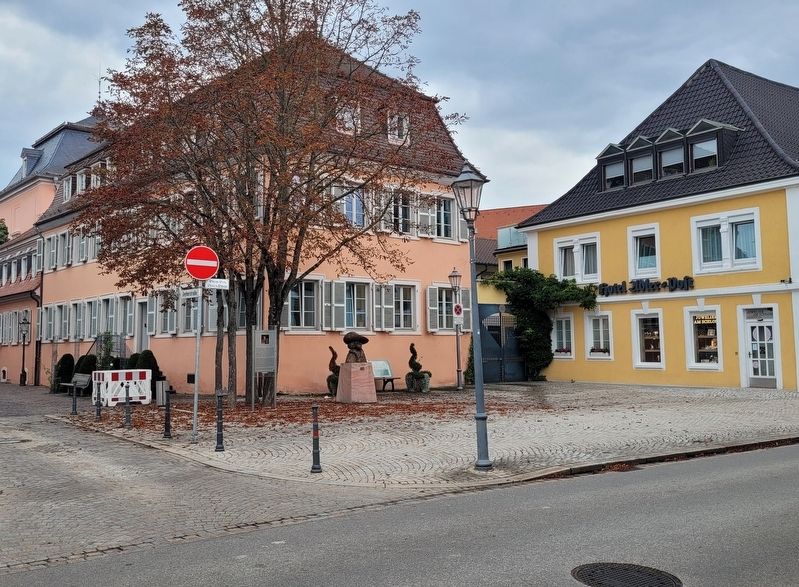
Location. 49° 23.085′ N, 8° 34.297′ E. Marker is in Schwetzingen, Baden-Württemberg, in Rhein-Neckar-Kreis. It is in Rheinau. It is at the intersection of Schloßstraße and Zeyherstraße, on the right when traveling south on Schloßstraße. The marker is located at the corner of the intersection. Touch for map. Marker is at or near this postal address: Zeyherstraße 9, Schwetzingen BW 68723, Germany. Touch for directions.

Regionally, it is in Europe, the European Union, Atlantic Europe, Central Europe, the Schengen Area, Western Europe, and the Western World. Historically, it finds itself in what was once the Roman Empire and specifically also the Holy Roman Empire.
Other nearby markers. At least 8 other markers are within walking distance of this marker: Gedenkstätte für die Opfer des Nationalsozialismus / Memorial for the Victims of National Socialism (within shouting distance of this marker); Katholische Kirche St. Pankratius / Catholic Church of St. Pankratius (within shouting distance
Photographed by James Hulse, September 23, 2024
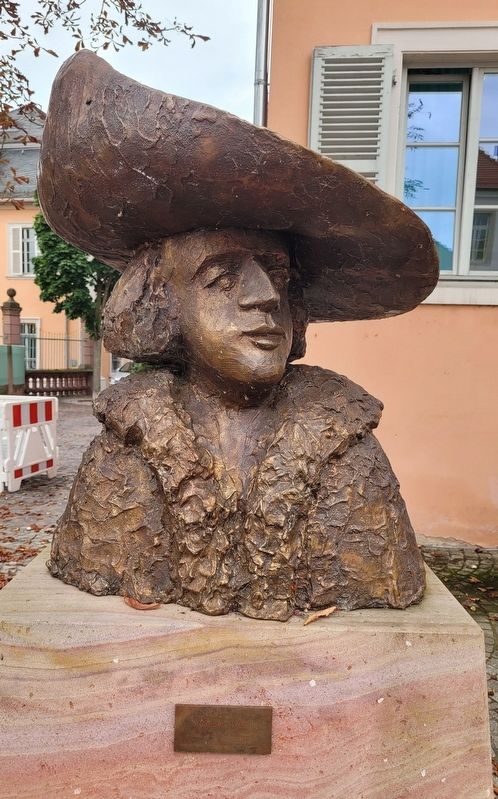
3. Nicolas de Pigage bust
Also see . . .
1. Electoral Tour. Schwetzingen
Starting from Schwetzingen Palace, the Electoral Tour leads to several stops in the city, where aspects of the courtly life of the enlightened and art-loving Elector Carl Theodor of the Palatinate are explained and the effects of the economic factor “Electoral Court” on the then market town of Schwetzingen become visible.(Submitted on October 23, 2024, by James Hulse of Medina, Texas.)
2. Nicolas de Pigage. Wikipedia
Pigage was born in Lunéville. His father was a stonemason. In 1743 he began his studies(Submitted on October 23, 2024, by James Hulse of Medina, Texas.)at the École Militaire, changing to the Académie Royale d'Architecture after only one year studying under Jacques-François Blondel. Elector Karl Theodor summoned him to his court in Mannheim and in 1752 he became the Oberbaudirector.Photographed by James Hulse, September 23, 20244. The view of the Nicolas de Pigage Marker from across the street
Credits. This page was last revised on October 23, 2024. It was originally submitted on October 22, 2024, by James Hulse of Medina, Texas. This page has been viewed 122 times since then and 25 times this year. Photos: 1, 2, 3, 4. submitted on October 23, 2024, by James Hulse of Medina, Texas.
