Rheinau in Schwetzingen in Rhein-Neckar-Kreis, Baden-Württemberg, Germany — Central Europe
Evangelische Stadtkirche
⎯⎯⎯
Evangelical City Church
Photographed by James Hulse, September 23, 2024
1. Evangelische Stadtkirche / Evangelical City Church Marker

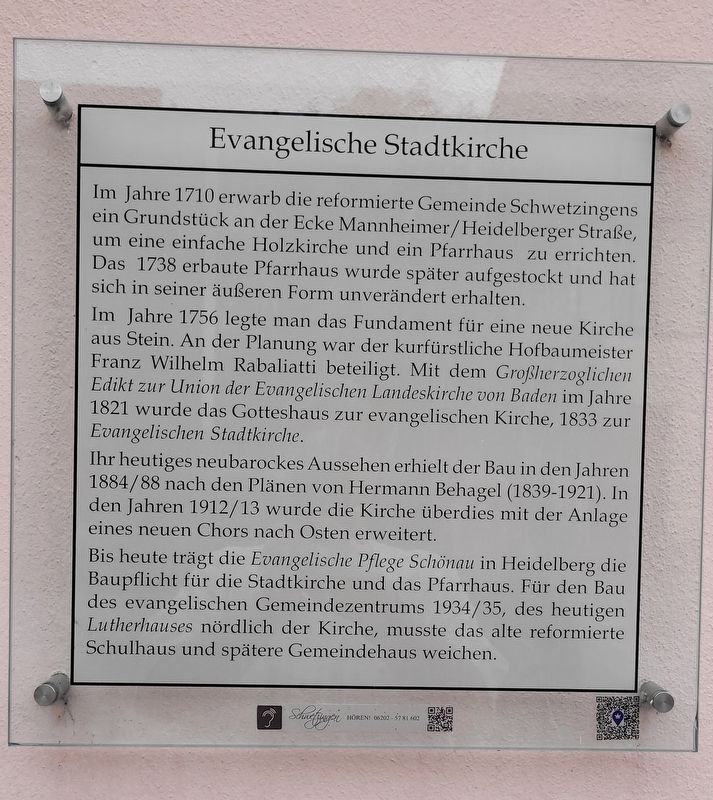
Im Jahre 1710 erwarb die reformierte Gemeinde Schwetzingens ein Grundstück an der Ecke Mannheimer/Heidelberger Straße, um eine einfache Holzkirche und ein Pfarrhaus zu errichten. Das 1738 erbaute Pfarrhaus wurde später aufgestockt und hat sich in seiner äußeren Form unverändert erhalten.
Im Jahre 1756 legte man das Fundament für eine neue Kirche aus Stein. An der Planung war der kurfürstliche Hofbaumeister Franz Wilhelm Rabaliatti beteiligt. Mit dem Großherzoglichen Edikt zur Union der Evangelischen Landeskirche von Baden im Jahre 1821 wurde das Gotteshaus zur evangelischen Kirche, 1833 zur Evangelischen Stadtkirche.
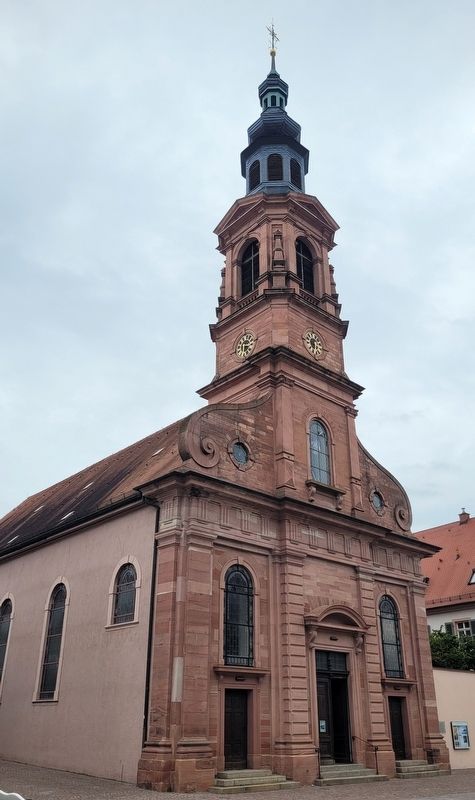
Ihr heutiges neubarockes Aussehen erhielt der Bau in den Jahren 1884/88 nach den Plänen von Hermann Behagel (1839-1921). In den Jahren 1912/13 wurde die Kirche überdies mit der Anlage eines neuen Chors nach Osten erweitert.
Bis heute trägt die Evangelische Pflege Schönau in Heidelberg die Baupflicht für die Stadtkirche und das Pfarrhaus. Für den Bau des evangelischen Gemeindezentrums 1934/35, des heutigen Lutherhauses nördlich der Kirche, musste das alte reformierte Schulhaus und spätere
this page online
In 1710, the reformed community of Schwetzingen acquired a plot of land on the corner of Mannheimer and Heidelberger Strasse to build a simple wooden church and a parsonage. The parsonage, built in 1738, was later extended and its external form has remained unchanged.
In 1756, the foundations for a new stone church were laid. The electoral court architect Franz Wilhelm Rabaliatti was involved in the planning. With the Grand Ducal Edict on the Union of the Evangelical State Church of Baden in 1821, the church became an evangelical church, and in 1833 it became Evangelical City Church.
The building received its current neo-baroque appearance in 1884/88 according to plans by Hermann Behagel (1839-1921). In 1912/13, the church was also extended to the east with the addition of a new choir.
To this day, the Evangelical Care Schönau in Heidelberg is responsible for building the town church and the parsonage. The old Reformed schoolhouse and later parish hall had to be demolished to make way for the construction of the Protestant community center in 1934/35, today's Luther House, north
Photographed by James Hulse, September 23, 2024
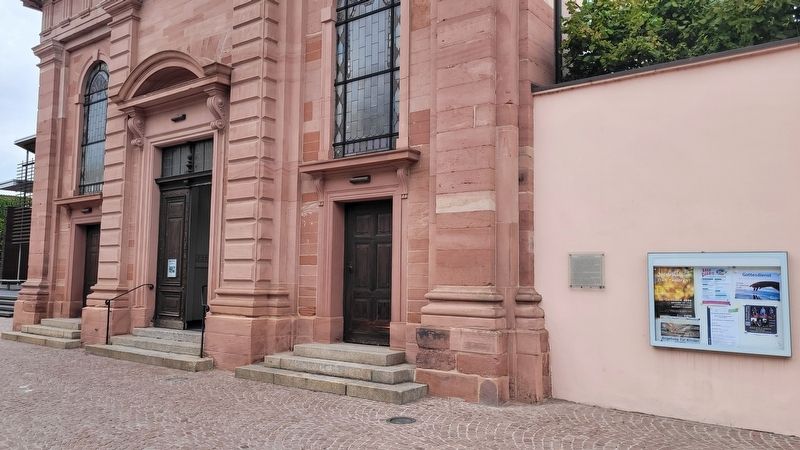
2. The view of the entrance to the Evangelical City Church and Marker
Erected by Schwetzingen.
Topics. This historical marker is listed in this topic list: Religion & Religious Structures. A significant historical year for this entry is 1710.
Location. 49° 23.198′ N, 8° 34.401′ E. Marker is in Schwetzingen, Baden-Württemberg, in Rhein-Neckar-Kreis. It is in Rheinau. It is on Mannheimer Straße just north of Dreikönigstraße. The marker is located on the southwest corner of the church. Touch for map. Marker is at or near this postal address: Mannheimer Str 32, Schwetzingen BW 68723, Germany. Touch for directions.

Regionally, this marker is on the German Upper Rhine. Globally, it is in Europe, the European Union, Atlantic Europe, Central Europe, the Schengen Area, Western Europe, and the Western World. Historically, it finds itself in what was once the Roman Empire, the Holy Roman Empire, and the former West Germany.
Other nearby markers. At least 8 other markers are within walking distance of this marker: Friedrichschule / Frederick School (within shouting distance of this marker); Die kurfürstliche Hofmusik / The Electoral Court Music (about 150 meters away, measured in
Photographed by James Hulse, September 23, 2024
3. The view of the Evangelical City Church from the street
Also see . . . Electoral Tour. Schwetzingen
Starting from Schwetzingen Palace, the Electoral Tour leads to several stops in the city, where aspects of the courtly life of the enlightened and art-loving Elector Carl Theodor of the Palatinate are explained and the effects of the economic factor “Electoral Court” on the then market town of Schwetzingen become visible.(Submitted on October 23, 2024, by James Hulse of Medina, Texas.)
Credits. This page was last revised on October 24, 2024. It was originally submitted on October 23, 2024, by James Hulse of Medina, Texas. This page has been viewed 118 times since then and 28 times this year. Photos: 1, 2, 3. submitted on October 24, 2024, by James Hulse of Medina, Texas.
