Rheinau in Schwetzingen in Rhein-Neckar-Kreis, Baden-Württemberg, Germany — Central Europe
Das Wappen Carl Theodors
⎯⎯⎯
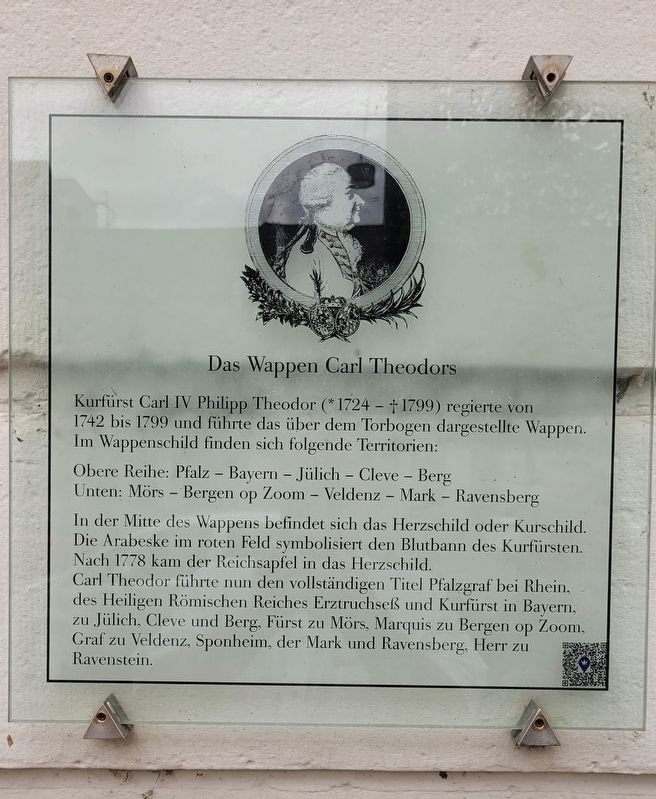
The Coat of Arms of Carl Theodor
Photographed by James Hulse, September 23, 2024
1. Das Wappen Carl Theodors / The Coat of Arms of Carl Theodor Marker

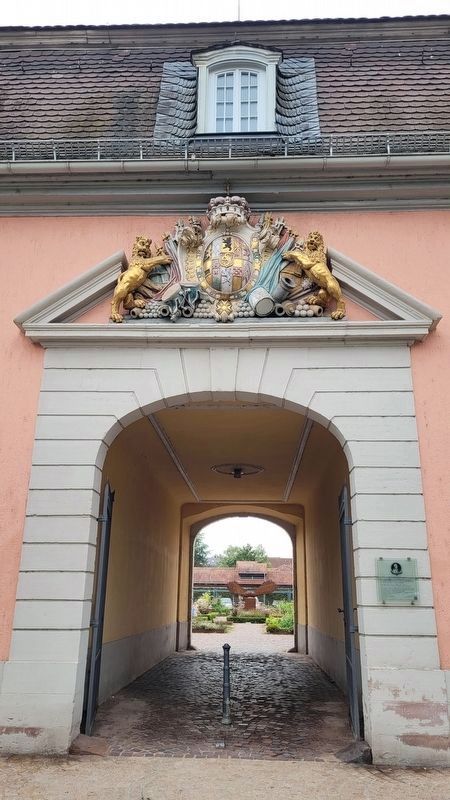
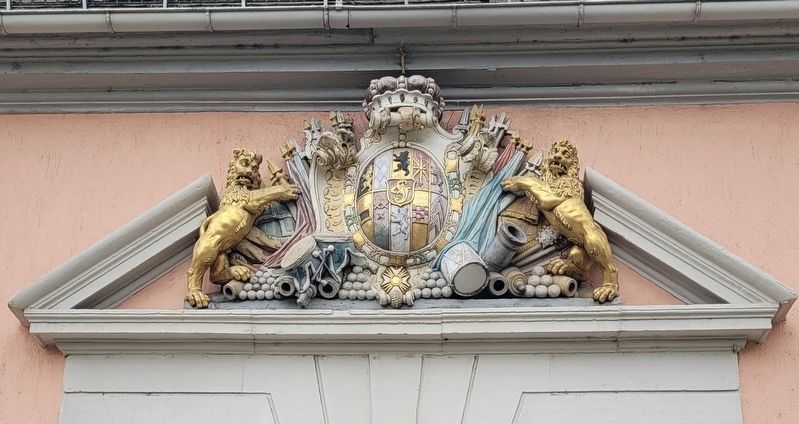
Kurfürst Carl IV Philipp Theodor (* 1724 - † 1799) regierte von 1742 bis 1799 und führte das über dem Torbogen dargestellte Wappen. Im Wappenschild finden sich folgende Territorien:
Obere Reihe: Pfalz - Bayern - Jülich – Cleve - Berg
Unten: Mörs - Bergen op Zoom - Veldenz – Mark – Ravensberg
In der Mitte des Wappens befindet sich das Herzschild oder Kurschild. Die Arabeske im roten Feld symbolisiert den Blutbann des Kurfürsten. Nach 1778 kam der Reichsapfel in das Herzschild.
Carl Theodor führte nun den vollständigen Titel Pfalzgraf bei Rhein, des Heiligen Römischen Reiches Erztruchseß und Kurfürst in Bayern, zu Jülich, Cleve und Berg, Fürst zu Mörs, Marquis zu Bergen op Zoom, Graf zu Veldenz, Sponheim, der Mark und Ravensberg, Herr zu Ravenstein.
Elector Carl IV Philipp Theodor (* 1724 - † 1799) ruled from 1742 to 1799 and bore the coat of arms shown above the archway. The following territories can be found in the coat of arms:
Top row: Palatinate - Bavaria - Jülich - Cleve - Berg
Bottom: Mörs - Bergen op Zoom - Veldenz - Mark - Ravensberg
In the middle of the coat
this page online
Carl Theodor now bore the full title of Count Palatine by Rhine, Arch-Teacher and Elector of the Holy Roman Empire in Bavaria, of Jülich, Cleve and Berg, Prince of Mörs, Marquis of Bergen op Zoom, Count of Veldenz, Sponheim, the Mark and Ravensberg, Lord of Ravenstein.
Erected by Schwetzingen.
Topics. This historical marker is listed in this topic list: Notable Buildings. A significant historical year for this entry is 1724.
Location. 49° 23.074′ N, 8° 34.512′ E. Marker is in Schwetzingen, Baden-Württemberg, in Rhein-Neckar-Kreis. It is in Rheinau. It is on Carl-Theodor-Straße just east of Friedrichstraße, on the right when traveling east. The marker is located at the entrance to the building. Touch for map. Marker is at or near this postal address: Carl-Theodor-Straße 8D, Schwetzingen BW 68723, Germany. Touch for directions.

Regionally, this marker is on the German Upper Rhine. Globally, it is in Europe, the European Union, Atlantic Europe,
Photographed by James Hulse, September 23, 2024
2. The Coat of Arms of Carl Theodor above the entrance to the Royal Stables
Other nearby markers. At least 8 other markers are within walking distance of this marker: Ehemalige Mälzerei der Schwanenbrauerei / Former Malthouse of the Schwanen Brewery (within shouting distance of this marker); Kurfürstlicher Marstall / Electoral Royal Stables (within shouting distance of this marker); Rabaliatti-Haus / Rabaliatti House (about 120 meters away, measured in a direct line); Franziskaner-Kloster / Franciscan Monastery (about 150 meters away); Schloss Schwetzingen und der Schlossplatz / Schwetzingen Palace and the Palace Square (about 180 meters away); Suezzo (about 180 meters away); Jungsteinzeitliches Gräberfeld / Neolithic Burial Ground (about 180 meters away); Elisabeth Charlotte (about 180 meters away). Touch for a list and map of all markers in Schwetzingen.
Also see . . . Electoral Tour. Schwetzingen
Starting from Schwetzingen Palace, the Electoral Tour leads to several stops in the city, where aspects of the courtly life of the enlightened and art-loving Elector Carl Theodor of the Palatinate are explained and the effects of the economic factor “Electoral Court” on the then market town of Schwetzingen become visible.(Submitted on October 23, 2024, by James Hulse of Medina, Texas.)
Photographed by James Hulse, September 23, 2024
3. The Coat of Arms of Carl Theodor
Photographed by James Hulse, September 23, 2024
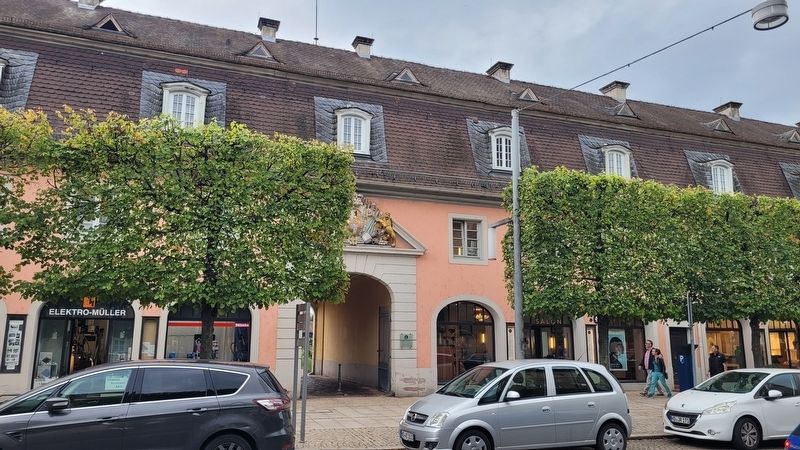
4. The view of the Coat of Arms of Carl Theodor Marker from across the street
Credits. This page was last revised on October 24, 2024. It was originally submitted on October 23, 2024, by James Hulse of Medina, Texas. This page has been viewed 131 times since then and 20 times this year. Photos: 1, 2, 3, 4. submitted on October 24, 2024, by James Hulse of Medina, Texas.
