York in York County, Pennsylvania — The American Northeast (Mid-Atlantic)
Workers' Homes
| — | The History of Rail Walking Tour | — |
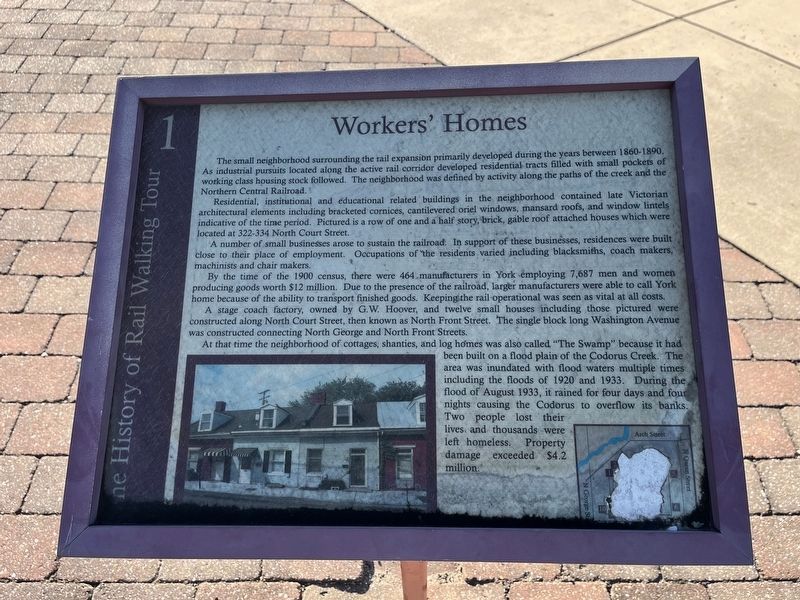
The small neighborhood surrounding the rail expansion primarily developed during the years between 1860-1890. As industrial pursuits located along the active rail corridor developed residential tracts filled with small pockets of working class housing stock followed. The neighborhood was defined by activity along the paths of the creek and the Northern Central Railroad.
Residential, institutional and educational related buildings in the neighborhood contained late Victorian architectural elements including bracketed cornices, cantilevered oriel windows, mansard roofs, and window lintels indicative of the time period. Pictured is a row of one and a half story, brick, gable roof attached houses which were located at 322-334 North Court Street.
A number of small businesses arose to sustain the railroad. In support of these businesses, residences were built close to their place of employment. Occupations of the residents varied including blacksmiths, coach makers, machinists and chair makers.
By the time of the 1900 census, there were 464 manufacturers in York employing 7,687 men and women producing goods worth $12
this page online
A stage coach factory, owned by G.W. Hoover, and twelve small houses including those pictured were constructed along North Court Street, then known as North Front Street. The single block long Washington Avenue was constructed connecting North George and North Front Streets.
At that time the neighborhood of cottages, shanties, and log homes was also called "The Swamp" because it had been built on a flood plain of the Codorus Creek. The area was inundated with flood waters multiple times including the floods of 1920 and 1933. During the flood of August 1933, it rained for four days and four nights causing the Codorus to overflow its banks. Two people lost their lives and thousands were left homeless. Property damage exceeded $4.2 million. (Marker Number 1.)
Topics. This historical marker is listed in these topic lists: Architecture • Industry & Commerce • Railroads & Streetcars • Settlements & Settlers. A significant historical month for this entry is August 1933.
Location. 39° 58.064′ N,
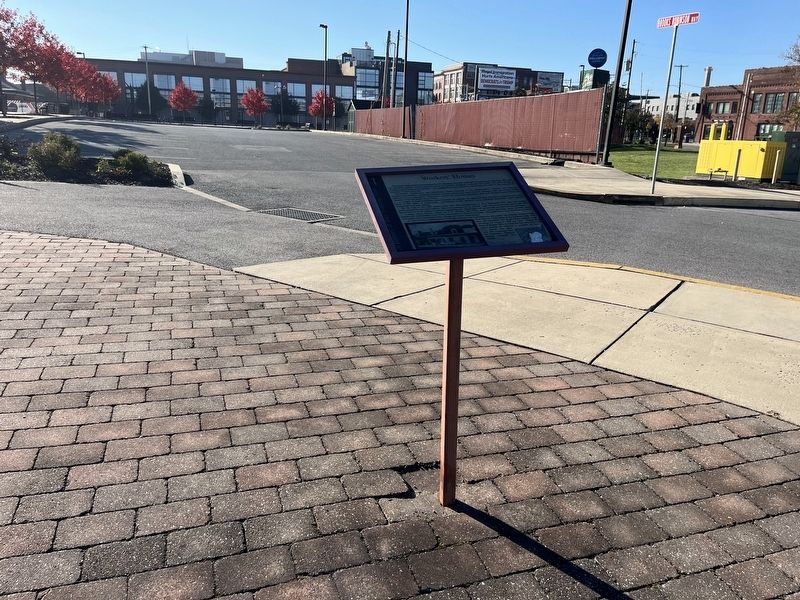

Regionally, this marker is in South-Central Pennsylvania, specifically in Pennsylvania Dutch Country, in the Susquehanna Valley, and in Greater Harrisburg. It is also in the American Northeast and in the Mid-Atlantic. Globally, it is in North America, the Western Hemisphere, the Western World, and the Anglosphere. Historically, it finds itself in what was once the Haudenosaunee (Iroquois) Confederacy and also one of the original Thirteen Colonies.
Other nearby markers. At least 8 other markers are within walking distance of this marker: The Western Maryland Railway Depot (a few steps from this marker); Brooks Robinson (within shouting distance of this marker); a different marker also named Brooks Robinson (within shouting distance of this marker); a different marker also named Brooks Robinson (within shouting distance of this marker); a different marker also named Brooks Robinson (within shouting distance of this marker); a different marker also named Brooks Robinson (within shouting distance of this marker); a different marker also named Brooks Robinson (within shouting distance of this marker); a different marker also named Brooks Robinson (within shouting distance of this marker). Touch for a list and map of all markers in York.
Credits. This page was last revised on October 24, 2024. It was originally submitted on October 24, 2024, by Devry Becker Jones of Washington, District of Columbia. This page has been viewed 117 times since then and 13 times this year. Photos: 1, 2. submitted on October 24, 2024, by Devry Becker Jones of Washington, District of Columbia.
