Rheinau in Schwetzingen in Rhein-Neckar-Kreis, Baden-Württemberg, Germany — Central Europe
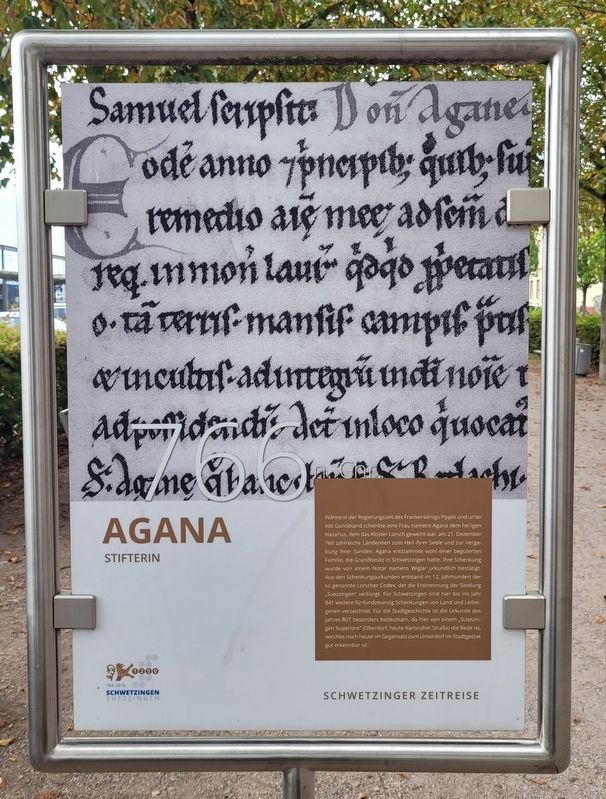
Agana
766 n. Chr.
⎯⎯⎯
766 AD
Photographed by James Hulse, September 23, 2024
1. Agana Marker

Stifterin
Während der Regierungszeit des Frankenkönigs Pippin und unter Abt Gundeland schenkte eine Frau namens Agana dem heiligen Nazarius, dem das Kloster Lorsch geweiht war, am 21. Dezember 766 zahlreiche Ländereien zum Heil ihrer Seele und zur Vergebung ihrer Sünden. Agana entstammte wohl einer begüterten Familie, die Grundbesitz in Schwetzingen hatte. Ihre Schenkung wurde von einem Notar namens Wiglar urkundlich bestätigt. Aus den Schenkungsurkunden entstand im 12. Jahrhundert der so genannte Lorscher Codex, der die Erstnennung der Siedlung „Suezzingen" verbürgt. Für Schwetzingen sind hier bis ins Jahr 841 weitere fünfundzwanzig Schenkungen von Land und Leibeigenen verzeichnet. Für die Stadtgeschichte ist die Urkunde des Jahres 807 besonders bedeutsam, da hier von einem „Suezzingen Superiore" (Oberdorf, heute Karlsruher Straße) die Rede ist, welches noch heute im Gegensatz zum Unterdorf im Stadtgebiet gut erkennbar ist.
Founder
During the reign of the Frankish King Pippin and under Abbot Gundeland, a woman named Agana donated numerous pieces of land to Saint Nazarius,
this page online
Erected by Schwetzingen Zeitreise.
Topics. This historical marker is listed in this topic list: Settlements & Settlers. A significant historical date for this entry is December 21, 766 CE.
Location. 49° 23.085′ N, 8° 34.659′ E. Marker is in Schwetzingen, Baden-Württemberg, in Rhein-Neckar-Kreis. It is in Rheinau. It is on Bahnhofanlage just south of Carl-Theodor-Straße.
Photographed by James Hulse, September 23, 2024
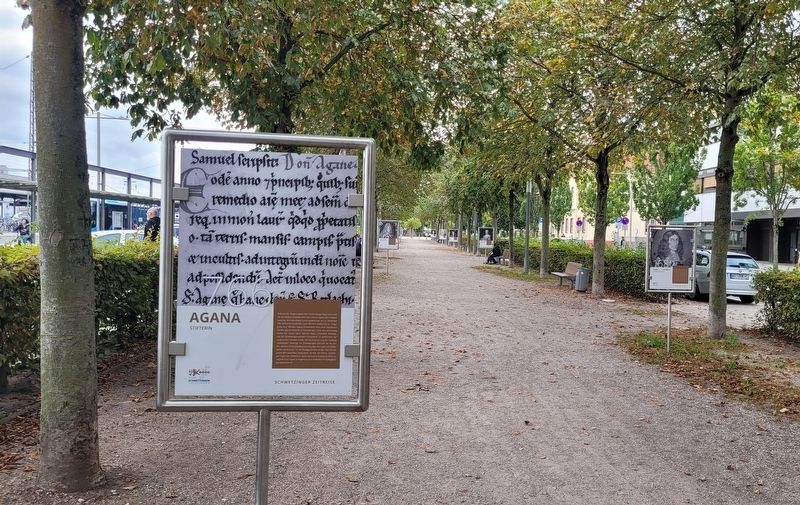
2. The view of the Agana Marker in the park

Regionally, this marker is on the German Upper Rhine. Globally, it is in Europe, the European Union, Atlantic Europe, Central Europe, the Schengen Area, Western Europe, and the Western World. Historically, it finds itself in what was once the Roman Empire, the Holy Roman Empire, and the former West Germany.
Other nearby markers. At least 8 other markers are within walking distance of this marker: Rittergeschlecht der Erligheimer / Knightly Family of Erligheim (here, next to this marker); Suezzo (here, next to this marker); Jungsteinzeitliches Gräberfeld / Neolithic Burial Ground (here, next to this marker); Elisabeth Charlotte (a few steps from this marker); Karl I. Ludwig (a few steps from this marker); Johann Wilhelm (within shouting distance of this marker); Carl Philipp (within shouting distance of this marker); Franziskaner-Kloster / Franciscan Monastery (within shouting distance of this marker). Touch for a list and map of all markers in Schwetzingen.
More about this marker. There is a non-related marker attached on the other side of the post.
Credits. This page was last revised on October 27, 2024. It was originally submitted on October 25, 2024, by James Hulse of Medina, Texas. This page has been viewed 116 times since then and 15 times this year. Photos: 1, 2. submitted on October 26, 2024, by James Hulse of Medina, Texas.
