Rheinau in Schwetzingen in Rhein-Neckar-Kreis, Baden-Württemberg, Germany — Central Europe
Rittergeschlecht der Erligheimer
⎯⎯⎯
Knightly Family of Erligheim
1350
Photographed by James Hulse, September 23, 2024
1. Rittergeschlecht der Erligheimer / Knightly Family of Erligheim Marker

Eigentümer der Schwetzinger Wasserburg
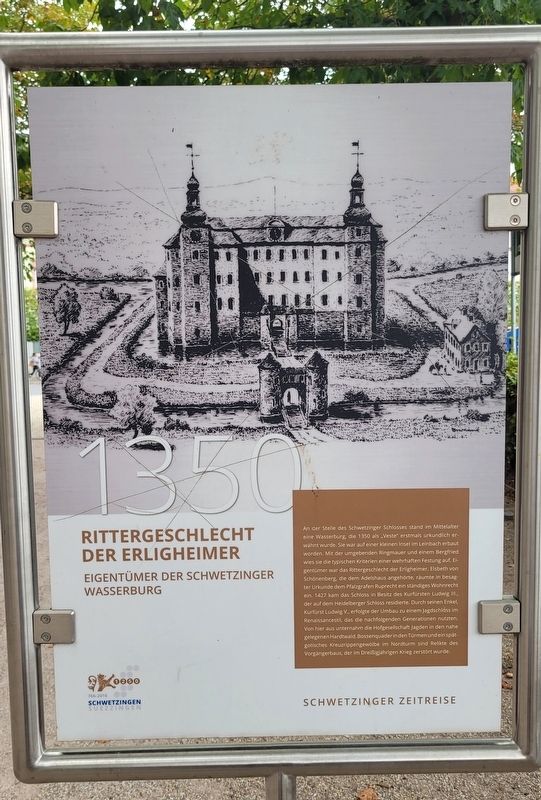
An der Stelle des Schwetzinger Schlosses stand im Mittelalter eine Wasserburg, die 1350 als „Veste" erstmals urkundlich erwähnt wurde. Sie war auf einer kleinen Insel im Leinbach erbaut worden. Mit der umgebenden Ringmauer und einem Bergfried wies sie die typischen Kriterien einer wehrhaften Festung auf. Eigentümer war das Rittergeschlecht der Erligheimer. Elsbeth von Schönenberg, die dem Adelshaus angehörte, räumte in besagter Urkunde dem Pfalzgrafen Ruprecht ein ständiges Wohnrecht ein. 1427 kam das Schloss in Besitz des Kurfürsten Ludwig III., der auf dem Heidelberger Schloss residierte. Durch seinen Enkel, Kurfürst Ludwig V., erfolgte der Umbau zu einem Jagdschloss im Renaissancestil, das die nachfolgenden Generationen nutzten. Von hier aus unternahm die Hofgesellschaft Jagden in den nahe gelegenen Hardtwald. Bossenquader in den Türmen und ein spätgotisches Kreuzrippengewölbe im Nordturm sind Relikte des Vorgängerbaus, der im Dreißigjährigen Krieg zerstört wurde.
Owner of the Schwetzingen Water Castle
In the Middle Ages, a moated castle stood on the site of Schwetzingen Castle, which was first mentioned in documents in 1350 as a "Veste". It was built on a small island in the Leinbach. With the surrounding ring wall and a keep, it had the typical criteria of a defensive fortress. The owner was the knightly family of Erligheim. Elsbeth von Schönenberg, who belonged to the noble family, granted the Count Palatine Ruprecht a permanent right of residence in the said document. In 1427, the castle came into the possession of Elector Ludwig III, who resided in Heidelberg Castle. His grandson, Elector Ludwig V, converted it into a hunting lodge in the Renaissance style, which subsequent generations used. From here, the court society
this page online
Erected by Schwetzinger Zeitreise.
Topics. This historical marker is listed in this topic list: Forts and Castles. A significant historical year for this entry is 1350.
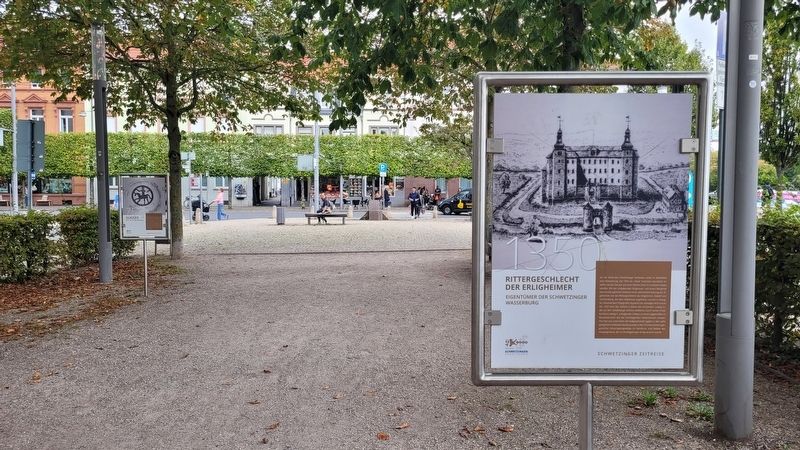
Location. 49° 23.084′ N, 8° 34.659′ E. Marker is in Schwetzingen, Baden-Württemberg, in Rhein-Neckar-Kreis. It is in Rheinau. It is on Bahnhofanlage just south of Carl-Theodor-Straße. The marker is located in a small park with a group of 28 panel markers on the west side of the transportation center. Touch for map. Marker is at or near this postal address: Bahnhofanlage 2, Schwetzingen BW 68723, Germany. Touch for directions.

Regionally, this marker is on the German Upper Rhine. Globally, it is in Europe, the European Union, Atlantic Europe, Central Europe, the Schengen Area, Western Europe, and the Western World. Historically, it finds itself in what was once the Roman Empire, the Holy Roman Empire, and the former West Germany.
Other nearby markers. At
Photographed by James Hulse, September 23, 2024
2. Rittergeschlecht der Erligheimer / Knightly Family of Erligheim Marker
More about this marker. There is a non-related marker attached on the other side of the post.
Credits. This page was last revised on October 27, 2024. It was originally submitted on October 26, 2024, by James Hulse of Medina, Texas. This page has been viewed 121 times since then and 29 times this year. Photos: 1. submitted on October 26, 2024, by James Hulse of Medina, Texas. 2. submitted on October 27, 2024, by James Hulse of Medina, Texas.
