Greenville in Greenville County, South Carolina — The American South (South Atlantic)
"Shoeless Joe" Jackson House

Photographed by Brian Scott, June 29, 2011
1. "Shoeless Joe" Jackson House Marker (Front)
(Front)
This house, built in 1940, was originally 3 mi. SW at 119 E. Wilburn Ave. It was the last home of Joseph Jefferson Wofford "Shoeless Joe" Jackson (1888-1951), one of the greatest natural hitters in the history of baseball. Jackson, born in Pickens Co., moved to Greenville as a boy. He worked at the Brandon Mill, joined the mill baseball team as a teenager, and was a star long before he made the major leagues in 1908.
Erected 2011 by Shoeless Joe Jackson Museum and Baseball Library. (Marker Number 23-43.)
Topics. This historical marker is listed in this topic list: Sports. A significant historical year for this entry is 1940.
Location. 34° 50.48′ N, 82° 24.506′ W. Marker is in Greenville, South Carolina, in Greenville County. It is at the intersection of Field Street and South Markley Street, on the right when traveling east on Field Street. Touch for map. Marker is at or near this postal address: 356 Field Street, Greenville SC 29601, United States of America. Touch for directions.

Regionally, this marker is in Upstate. It is also in the American South, specifically in the Deep South, in Appalachia, and specifically in Southern Appalachia. Globally, it is in North America, the Western Hemisphere, the Western World, and the Anglosphere. Historically, it finds itself in what was once the original Cherokee
this page online
Other nearby markers. At least 8 other markers are within walking distance of this marker: Joseph Jefferson Jackson (here, next to this marker); Greenville High School (within shouting distance of this marker); Allen Temple AME Church Bell (within shouting distance of this marker); John Henry Moss (about 300 feet away, measured in a direct line); Clay Buchholz (about 400 feet away); Jim Rice (about 400 feet away); Tommy Lasorda (about 400 feet away); Lou Brissie (about 400 feet away). Touch for a list and map of all markers in Greenville.
More about this marker. In 2020 the Shoeless Joe Jackson Museum and marker were moved 350 west of the original location (GPS 34.84156N, 82.40729W) to make room for an apartment development.
Also see . . .
1. Shoeless Joe Jackson. Joseph Jefferson Jackson (July 16, 1888 – December 5, 1951), nicknamed "Shoeless Joe", was an American baseball player who played Major League Baseball in the early part of the 20th century.

Photographed by Brian Scott, June 29, 2011
2. "Shoeless Joe" Jackson House Marker (Reverse)
2. Shoeless Joe Jackson Museum and Baseball Library. Open every Saturday, 10:00am - 2:00pm. (Submitted on July 2, 2011, by Brian Scott of Anderson, South Carolina.)
3. Shoeless Joe Jackson Virtual Hall of Fame. This site is devoted to the memory of Shoeless Joe Jackson and the movement to persuade Major League Baseball to remove Joe Jackson from their ineligible list, thereby making him eligible for election to the National Baseball Hall of Fame. (Submitted on July 2, 2011, by Brian Scott of Anderson, South Carolina.)
4. "Shoeless" Joe Jackson - Find-a-Grave. He is best known today for being the most recognizable of the eight Chicago White Sox players who were banned forever from Major League baseball for his role in the 1919 "Black Sox" Scandal. (Submitted on November 23, 2011, by Brian Scott of Anderson, South Carolina.)
5. Oakland Athletics (former Philadelphia Athletics 1901-1954). The "Athletics" name originates from the late 19th century "athletic clubs", specifically the Philadelphia Athletics baseball

Photographed by Brian Scott, June 29, 2011
3. "Shoeless Joe" Jackson House Marker (Front)
6. Cleveland Indians (former Cleveland Naps 1903-1914). The Cleveland team originated in 1900 as the Lake Shores, when the American League (AL) was officially a minor league. (Submitted on November 23, 2011, by Brian Scott of Anderson, South Carolina.)
7. 1911 Cleveland Naps Season. In his rookie season, Shoeless Joe Jackson hit .408, which ranked second in the American League. (Submitted on July 2, 2011, by Brian Scott of Anderson, South Carolina.)
8. Chicago White Sox. The Chicago White Sox are a Major League Baseball team based in Chicago, Illinois. (Submitted on July 2, 2011, by Brian Scott of Anderson, South Carolina.)
9. About The Shoeless Joe Jackson Museum and Baseball Library. A history of Shoeless Joe Jackson house, including the two relocations.
In late 2018/early 2019, the museum was approached by Woodfield Development out of Charlotte, asking us if we would be willing to move our building again. They offered to move us to the corner of South Markley and Field streets, a distance of about(Submitted on October 26, 2024, by Mark Parker of Hickory, North Carolina.)100 yards.Photographed by Brian Scott, June 29, 20114. "Shoeless Joe" Jackson House Marker (Reverse)
To thank us for accommodating them, they paid for the move (which took place July 31, 2020), a new roof for the museum, a new HVAC system, and built us an addition which essentially doubled our size.

Additional commentary.
1. "Shoeless Joe" Jackson
Joseph Jefferson Jackson, like many thousands in the South Carolina Piedmont, was the son of a tenant farmer who found his way into the textile mill. Born in 1888 in Pickens County, Jackson moved with his parents and their nine children to Brandon Mill, where Joe went to work at age thirteen. Unable to read or write, he showed promise as a baseball player and joined the Brandon team-first as catcher, then pitcher, and eventually as an outfielder. In 1907 Jackson was spotted by Tom Stauch, who soon became manager of the Greenville Spinners. Stauch hired Jackson for the handsome salary of seventy-five dollars a month, almost double his pay at Brandon.
Playing for the Spinners, Jackson made his reputation as a hitter and gained a nickname. Wearing a new pair of spiked shoes that hurt his feet,he decided to play in his stocking feet. No one noticed until the seventh inning when Jackson hit a triple. Someone called him "Shoeless Joe," and the name stuck. Near the end of the season Connie Mack gave Jackson a major league contract for $325, and his reputation as a hitter soared. Washington pitcher Walter Johnson once said that he considered Jackson the greatest natural ballplayer he had ever seen. In 1915 Charles Comiskey secured him for the Chicago White Sox for sixty-five thousand dollars.Photographed by Brian Scott, June 29, 20115. "Shoeless Joe" Jackson House Marker
Jackson became part of a fast, new culture accustomed to money and flashy clothes. He purchased a pool hall and a farm in Greenville, as well as a house for his parents in Brandon. But his salary was never more than six thousand dollars. During the 1919 World Series, Jackson and seven of his teammates agreed to throw the series as their only defense against Comiskey. On September 28, 1920, Jackson appeared before the grand jury in Chicago and testified that he had received only five thousand dollars for his part in the conspiracy. According to the Chicago Herald and Examiner) "as Jackson departed from the Grand Jury room, a small boy clutchedat his sleeve and tagged along after him. 'Say it ain't so, Joe,' he pleaded. 'Say it ain't so.'" Jackson was reported to have replied: "Yes, kid, I'm afraid it is."Photographed by Brian Scott, June 29, 20116. "Shoeless Joe" Jackson House & Marker
The Black Sox case did not come to trial until 1921. On August 2 the jury found Jackson and the others not guilty. But the baseball commissioner, Judge Kennesaw Mountain Landis, ended the celebration. "Regardless of the verdict of juries," he said, "no player who throws a ballgame ... will ever play professional baseball.
"Shoeless Joe" Jackson returned to Savannah where he and his wife Katie lived in the off-seasons, and played semiprofessional baseball. In 1929 the Jacksons moved to Greenville, and Joe opened a dry-cleaning business and continued to play semiprofessional baseball in the summers. In 1933 the Greenville club rejoined organized baseball and offered Jackson the position of player-manager, but Judge Landis refused to alter his ruling. In his last years, Jackson operated a liquor store and played baseball with the neighborhood children. He died on December 5, 1951, at the age of sixty three. His funeral was held in the Baptist church in Brandon where he hadlived as a young man. (Source: Greenville: The History of the City and County in the South Carolina Piedmont by Archie Vernon Huff, Jr. (1995), pgs 299-300.)Photographed by Brian Scott, June 29, 20117. "Shoeless Joe" Jackson House

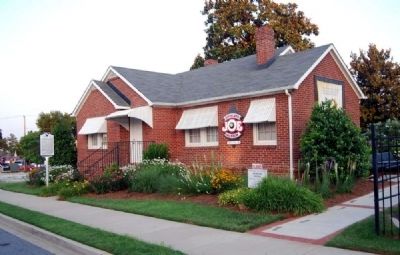
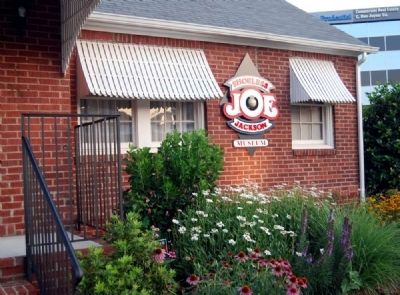
— Submitted July 2, 2011, by Brian Scott of Anderson, South Carolina.

Photographed by Brian Scott, June 29, 2011
8. "Shoeless Joe" Jackson House Sign
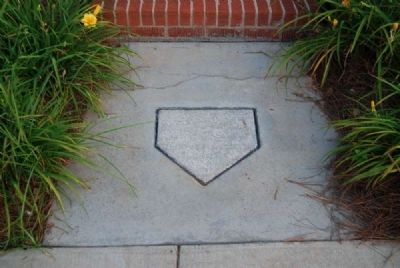
Photographed by Brian Scott, June 29, 2011
9. Walkway Showing Base Outline
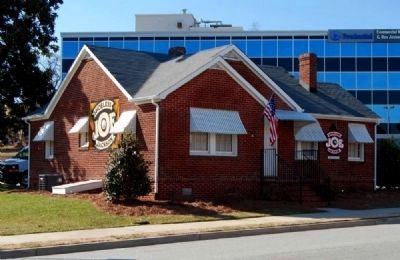
Photographed by Brian Scott, February 20, 2010
10. Shoeless Joe Jackson Museum and Library
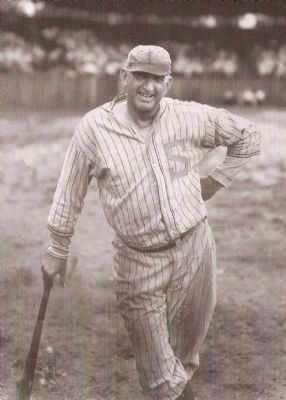
William B. Coxe Collection, Greenville County Historical Society
11. Joseph Jefferson
"Shoeless Joe" Jackson
1888–1951
"Shoeless Joe" Jackson
1888–1951

Photographed by Mark Parker, October 25, 2024
12. "Shoeless Joe" Jackson House and Marker
Relocated at the entrance to Fluor Field complex, located across from the Jackson Museum.

Photographed by Mark Parker, October 25, 2024
13. Former location of Shoeless Joe Jackson Museum and marker
House and marker were both moved from this location. New development is named .408 Jackson in honor of Jackson.
Credits. This page was last revised on October 27, 2024. It was originally submitted on July 2, 2011, by Brian Scott of Anderson, South Carolina. This page has been viewed 2,913 times since then and 96 times this year. Last updated on October 26, 2024, by Mark Parker of Hickory, North Carolina. Photos: 1, 2, 3, 4, 5, 6, 7, 8, 9. submitted on July 2, 2011, by Brian Scott of Anderson, South Carolina. 10. submitted on March 4, 2010, by Brian Scott of Anderson, South Carolina. 11. submitted on April 15, 2009, by Brian Scott of Anderson, South Carolina. 12, 13. submitted on October 26, 2024, by Mark Parker of Hickory, North Carolina. • Bernard Fisher was the editor who published this page.
