Nob Hill in San Francisco City and County, California — The American West (Pacific Coastal)
San Francisco Cable Car System
Ferries & Cliff House Railway Company
| — | Cable Car Museum | — |

Photographed by Craig Baker, October 22, 2024
1. San Francisco Cable Car System Marker
California Historic Civil Engineering Landmark.
San Francisco Cable Car System - 1873.
San Francisco Section ASCE - 1976.
National Historic Mechanical Engineering Landmark.
Ferries & Cliff House Cable Railway - 1887.
Howard C. Holmes (1854-1921), designer.
American Society of Mechanical Engineers - 1973.
Ferries & Cliff House Railway Company
The Building
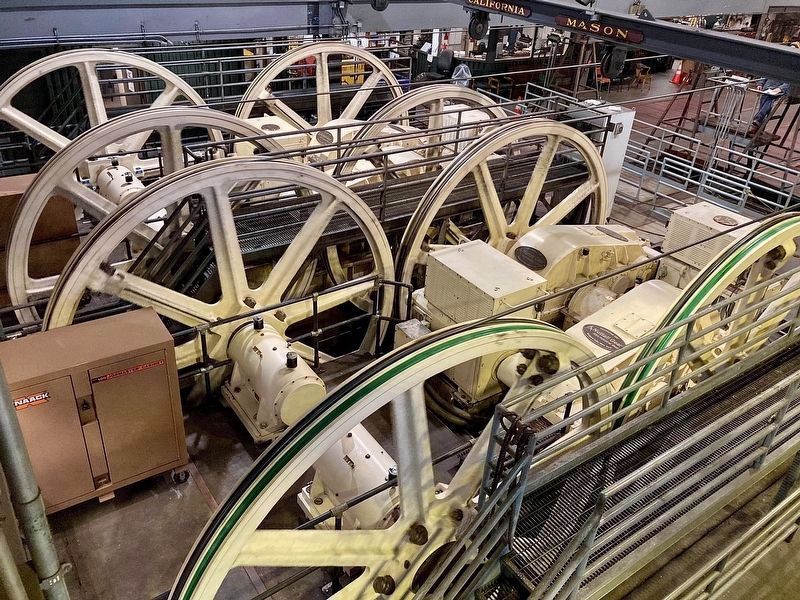
This building was originally built in 1887 for the Ferries & Cliff House Railway Company. Rebuilt after April 1906 earthquake and fire, refurbished in 1967 and almost entirely rebuilt again in 1982-84 during the system wide cable car rehabilitation project. During the 1967 refurbishing, the observation gallery was constructed on the mezzanine floor allowing visitors to view the "heart and soul" of the cable operation - the cables, sheaves, gears and electric motors that run the system. Today, this building serves as a fully functional cable car barn and powerhouse for the three cable car lines of the San Francisco
this page online
The Company
In 1887, Ferries & Cliff House Railway Company (also called Powell Street Railway) built this powerhouse and carbarn at the corner of Washington and Mason streets. Cable car service on Powell Street began on March 28, 1888. Full service on the Powell-Mason line began a few days later (this route has never been changed). At the same time, the company extended a route to the city's Western Addition with the opening of the Powell-Jackson line. This line also started at Powell and Market, but turned west on Jackson Street to Central (now Presidio Avenue), then down the hill to a turntable at the intersection of Central and California Street. Presidio Avenue, then down the hill to California Street. At California Street, it made a connection with a steam train to the ocean which started service that July.
The Great Merger on 1893 saw the Ferris and Cliff House Railway becoming a division of the 2nd Market Street Railway Co., a major

Photographed by Craig Baker, October 22, 2024
2. Mechanical Engineering Landmark
photo captions:
The original powerhouse and car barn was a large three story building as seen by this photo taken c.1903. The first floor consited of the steam driven cable winding machinery, a car washing area and

Photographed by Craig Baker
3. San Francisco Cable Car System Markers
The crew of a Powell Street Railway Co. car poses as the car is about to leave the turntable at Bay and Tayler Streets. At the time this photo was taken (1888) the bay was adjacent to this location and the surrounding area was largely residential with some light industry. Present day Fisherman Wharf would emerge in some twelve years.
August 1914 finds a pair of cars passing one another on Powell Street just north of Bush. The vacant lots on the west side of Powell Street were cleared of debris after the 1906 disaster to await new commercial construction.
Washington-Mason Carbarn & Powerhouse
The Carbarn
The carbarn is the storage and maintenance area for all the cable

Photographed by Craig Baker
4. Ferries & Cliff House Railway
The Powerhouse
On the ground floor is the powerhouse, where each of the four cables, Powell, Mason, Hyde and California travel in a continues loop around three large sheaves in a figure eight pattern. The drive sheave is mounted to the output shaft of a gear reducer powered by a 510 horsepower DC electric motor. The sound of this machinery can be heard 19 hours a day. This powerhouse was converted from steam to electric power in 1911. Through

Photographed by Craig Baker, October 22, 2024
5. Washington-Mason Carbarn
The Museum
The San Francisco cable car system was designated a National Historic Landmark in 1964. In tribute, the Washington-Mason and powerhouse were refurbished. The Washington-Mason carbarn was completely rebuilt, except the chimney and exterior walls, which were retained and reinforced so that the building's traditional appearance could be preserved. An observation deck and museum space were created to tell the story of the only working cable car system in the world. A small gift shop area was also added. Because the museum has never charged admission, profits from sales and monies from donations are essential for both maintaining and expanding the museum's operation.
Friends of the Cable Car Museum
The operator of the museum is a non-profit group called Friends of the Cable Car Museum. A goal of the Friends is to expand the role of the museum

Photographed by Craig Baker
6. Cable Car Museum
Erected 1976 by American Society of Civil Engineers; American Society of Mechanical Engineers; and Cable Car Museum.
Topics and series. This historical marker is listed in this topic list: Railroads & Streetcars. In addition, it is included in the ASCE Civil Engineering Landmarks,
Photographed by Craig Baker, October 22, 2024
7. Powerhouse / Museum
Location. 37° 47.676′ N, 122° 24.691′ W. Marker is in San Francisco, California, in San Francisco City and County. It is in Nob Hill. It can be reached from the intersection of Mason Street and Washington Street, on the left when traveling north. Touch for map. Marker is at or near this postal address: 1201 Mason St, San Francisco CA 94108, United States of America. Touch for directions.

Regionally, this marker is on the Coast Ranges. It is also on the American Pacific Coast. Globally, it is in North America, on the Ring of Fire, on the Pacific Rim, in the Western Hemisphere, in the Western World, and in the Anglosphere. Historically, it finds itself in what was once New Spain and also Mexico’s Alta California.
Other nearby markers. At least 8 other markers are within walking distance of this marker: First Chinese American Boy Scout Troop in America (approx. 0.2 miles away); Huntington Park/Fountain of the Tortoises
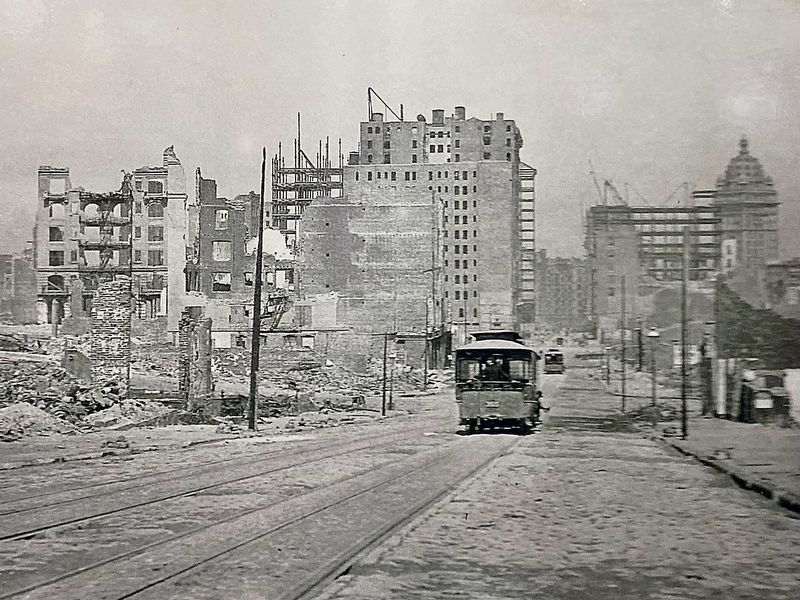
8. Cable Car, After Earthquake/Fire
This photo is on display in the museum.
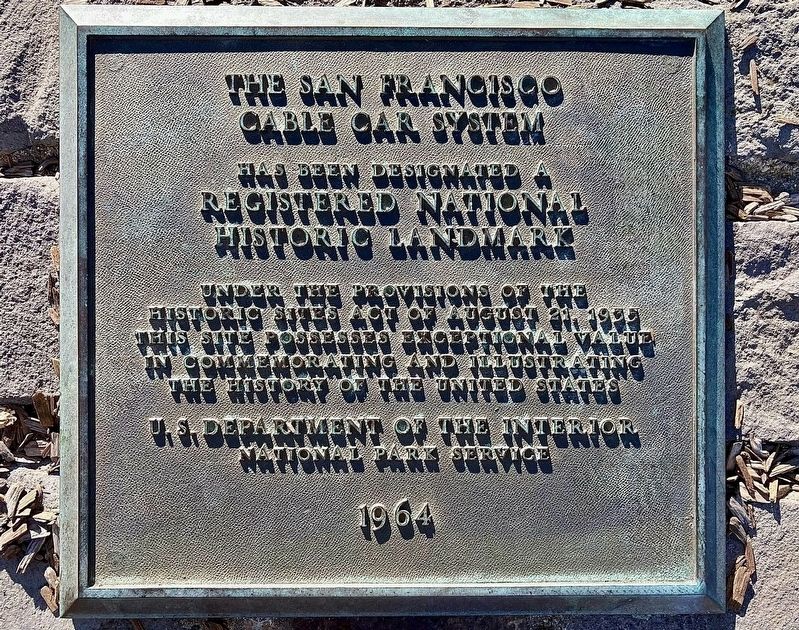
Related marker. Click here for another marker that is related to this marker. - National Historic Landmark plaque.
Photographed by Craig Baker, October 22, 2024
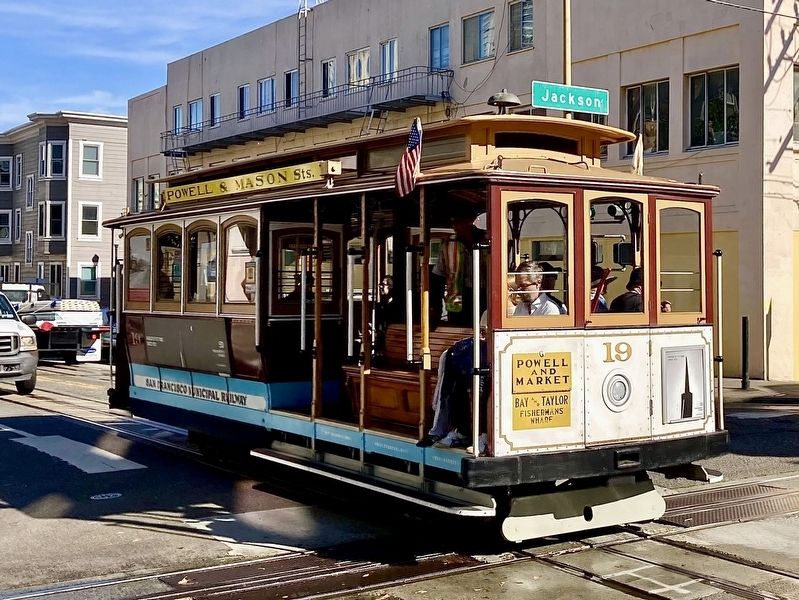
9. San Francisco Cable Car
Photographed by Craig Baker, October 22, 2024
10. National Historic Landmark
Plaque located near the north end of the Powel-Hyde line.

from Wikimedia Commons
11. Cable Car System Map
Credits. This page was last revised on July 17, 2025. It was originally submitted on October 27, 2024, by Craig Baker of Sylmar, California. This page has been viewed 581 times since then and 154 times this year. Photos: 1, 2, 3, 4, 5, 6, 7, 8, 9, 10, 11. submitted on October 27, 2024, by Craig Baker of Sylmar, California.
