Rheinau in Schwetzingen in Rhein-Neckar-Kreis, Baden-Württemberg, Germany — Central Europe
Carl Theodor
1724-1799
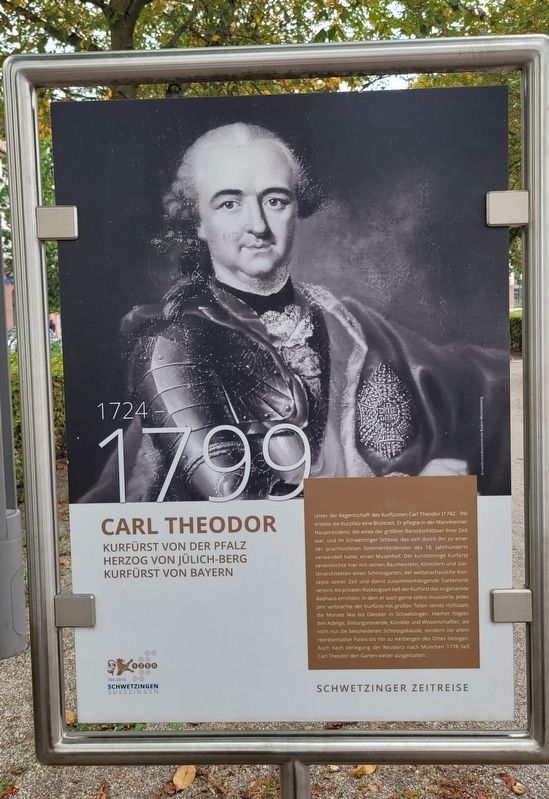
Photographed by James Hulse, September 23, 2024
1. Carl Theodor Marker

Kurfürst von der Pfalz, Herzog von Jülich-Berg, Kurfürst von Bayern
Unter der Regentschaft des Kurfürsten Carl Theodor (1742-99) erlebte die Kurpfalz eine Blütezeit. Er pflegte in der Mannheimer Hauptresidenz, die eines der größten Barockschlösser ihrer Zeit war, und im Schwetzinger Schloss, das sich durch ihn zu einer der prachtvollsten Sommerresidenzen des 18. Jahrhunderts verwandelt hatte, einen Musenhof. Der kunstsinnige Kurfürst verwirklichte hier mit seinen Baumeistern, Künstlern und Gartenarchitekten einen Schlossgarten, der weltanschauliche Konzepte seiner Zeit und damit zusammenhängende Gartenstile vereint. Als privaten Rückzugsort ließ der Kurfürst das so genannte Badhaus errichten, in dem er auch gerne selbst musizierte. Jedes Jahr verbrachte der Kurfürst mit großen Teilen seines Hofstaats die Monate Mai bis Oktober in Schwetzingen. Hierher folgten ihm Adelige, Bildungsreisende, Künstler und Wissenschaftler, die nicht nur die bescheidenen Schlossgebäude, sondern vor allem repräsentative Palais bis hin zu Herbergen des Ortes bezogen. Auch nach Verlegung der Residenz nach München 1778 ließ Carl Theodor den Garten weiter ausgestalten.
Elector of the Palatinate, Duke of Jülich-Berg, Elector of Bavaria
Under the reign of Elector Carl Theodor (1742-99), the Electorate of the Palatinate experienced a golden age. He cultivated a court of the muses in the main residence in Mannheim, which was one of the largest baroque palaces of its time, and in Schwetzingen Palace, which he transformed into one of the most magnificent summer residences of the 18th century. The art-loving Elector, together with his architects, artists and landscape architects, created a palace garden that combined the ideological concepts of his time and related garden styles. The Elector had
this page online
Erected by Schwetzinger Zeitreise.
Topics. This historical marker is listed in this topic list: Forts and Castles. A significant historical year for this entry is 1778.
Location. 49° 23.063′ N, 8° 34.658′ E. Marker is in Schwetzingen, Baden-Württemberg, in Rhein-Neckar-Kreis. It is in Rheinau. It is on Bahnhofanlage just south of Carl-Theodor-Straße. The marker is located in a small park with a group of 28 panel markers on the west side of the transportation center. Touch for map. Marker is at or near this postal address: Bahnhofanlage 2-4, Schwetzingen BW 68723, Germany. Touch for directions.

Regionally, this marker is on the German Upper
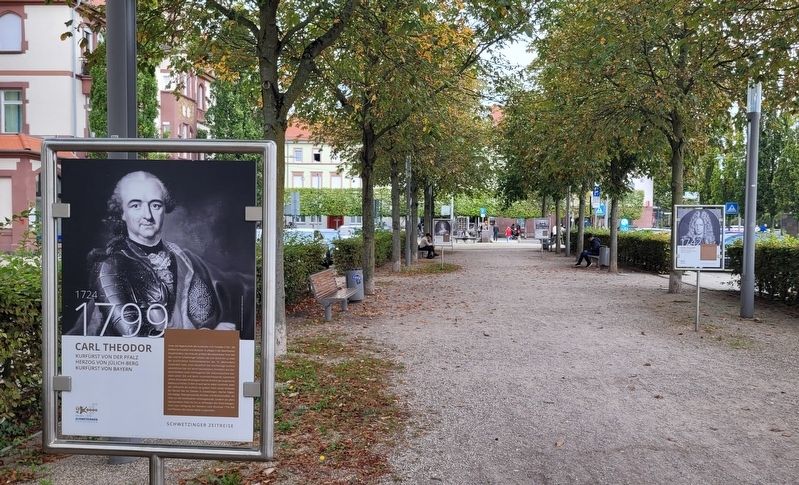
Photographed by James Hulse, September 23, 2024
2. The Carl Theodor Marker is the left side marker
Other nearby markers. At least 8 other markers are within walking distance of this marker: Elisabeth Auguste (here, next to this marker); Johann Stamitz* (a few steps from this marker); Carl Philipp (a few steps from this marker); Johann Wilhelm (a few steps from this marker); Christian Cannabich (a few steps from this marker); Nicolas de Pigage (a few steps from this marker); Karl I. Ludwig (a few steps from this marker); Friedrich Ludwig von Sckell (a few steps from this marker). Touch for a list and map of all markers in Schwetzingen.
More about this marker. There is a non-related marker attached on the other side of the post.
Also see . . . Charles Theodore, Elector of Bavaria. Wikipedia
Charles Theodore (German: Karl Theodor; 11 December 1724 – 16 February 1799) was a German nobleman of the Sulzbach branch of the House of Wittelsbach. He became Count Palatine of Sulzbach at the age of six following the death of his father Johann Christian in 1733. With the death of his cousin, Charles III Philip, he became Prince-elector and Count Palatine of the Rhine in 1742, being eighteen. In his fifties, he became Prince-Elector of Bavaria at the death of another cousin, Maximilian III Joseph, in 1777.(Submitted on October 27, 2024, by James Hulse of Medina, Texas.)
Credits. This page was last revised on October 27, 2024. It was originally submitted on October 27, 2024, by James Hulse of Medina, Texas. This page has been viewed 110 times since then and 17 times this year. Photos: 1, 2. submitted on October 27, 2024, by James Hulse of Medina, Texas.
