
Rheinau in Schwetzingen in Rhein-Neckar-Kreis, Baden-Württemberg, Germany — Central Europe
Christian Cannabich
1731-1798
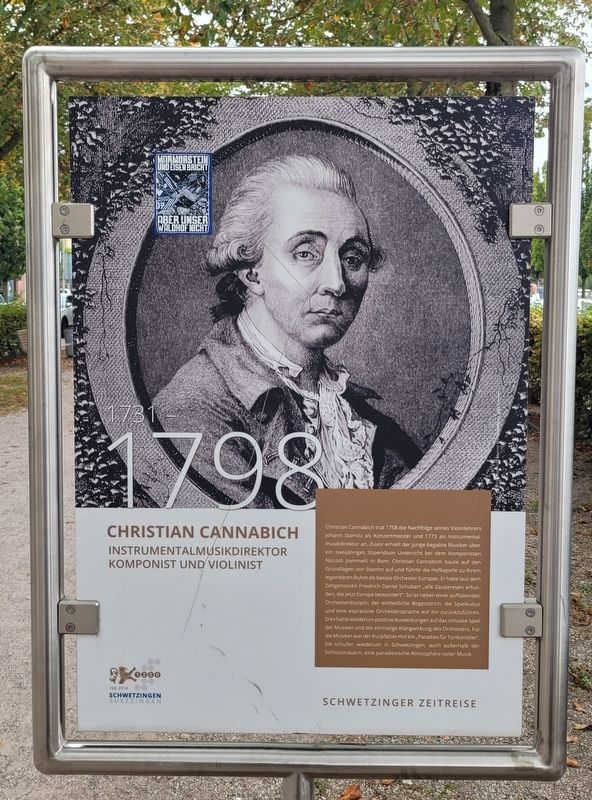
Photographed by James Hulse, September 23, 2024
1. Christian Cannabich Marker

Instrumentalmusikdirektor Komponist und Violinist
Christian Cannabich trat 1758 die Nachfolge seines Violinlehrers Johann Stamitz als Konzertmeister und 1773 als instrumental-musikdirektor an. Zuvor erhielt der junge begabte Musiker über ein zweijähriges Stipendium Unterricht bei dem Komponisten Niccolò Jiommelli in Rom. Christian Cannabich baute auf den Grundlagen von Stamitz auf und führte die Hofkapelle zu ihrem legendären Ruhm als bestes Orchester Europas. Er habe laut dem Zeitgenossen Friedrich Daniel Schubart „alle Zaubereyen erfunden, die jetzt Europa bewundert". So ist neben einer auffallenden Orchesterdisziplin der einheitliche Bogenstrich, die Spielkultur und eine expressive Orchestersprache auf ihn zurückzuführen. Dies hatte wiederum positive Auswirkungen auf das virtuose Spiel der Musiker und die einmalige Klangwirkung des Orchesters. Für die Musiker war der Kurpfälzer Hof ein „Paradies für Tonkünstler". Sie schufen wiederum in Schwetzingen, auch außerhalb der Schlossmauern, eine paradiesische Atmosphäre voller Musik.
Instrumental Music Director Composer and Violinist
Christian
this page online
Erected by Schwetzinger Zeitreise.
Topics. This historical marker is listed in this topic list: Arts, Letters, Music. A significant historical year for this entry is 1758.
Location. 49° 23.059′ N,
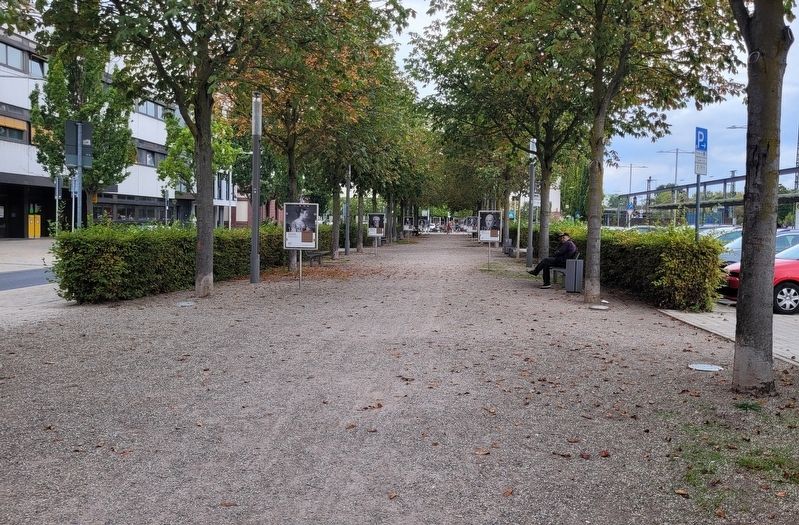
Photographed by James Hulse, September 23, 2024
2. The Christian Cannabich Marker is the second marker on the right side

Regionally, it is in Europe, the European Union, Atlantic Europe, Central Europe, the Schengen Area, Western Europe, and the Western World. Historically, it finds itself in what was once the Roman Empire and specifically also the Holy Roman Empire.
Other nearby markers. At least 8 other markers are within walking distance of this marker: Johann Stamitz* (here, next to this marker); Elisabeth Auguste (a few steps from this marker); Carl Theodor (a few steps from this marker); Nicolas de Pigage (a few steps from this marker); Friedrich Ludwig von Sckell (a few steps from this marker); Carl Philipp (a few steps from this marker); Christian Mayer (a few steps from this marker); Johann Wilhelm (a few steps from this marker). Touch for a list and map of all markers in Schwetzingen.
More about this marker. There is a non-related marker attached on the other side of the post.
Also see . . . Christian Cannabich. Wikipedia
Johann Christian Innocenz Bonaventura Cannabich (28 December 1731 (bapt.) – 20 January 1798), was a German violinist, composer, and Kapellmeister of the Classical era. A composer of some 200 works, he continued the legacy of Johann Stamitz and helped turn the Mannheim orchestra into what Charles Burney described as "the most complete and best disciplined in Europe.". The orchestra was particularly noted for the carefully graduated crescendos and diminuendos characteristic of the Mannheim school. Together with Stamitz and the other composers of the Mannheim court, he helped develop the orchestral texture that paved the way for the orchestral treatment of the First Viennese School.(Submitted on October 27, 2024, by James Hulse of Medina, Texas.)
Credits. This page was last revised on October 27, 2024. It was originally submitted on October 27, 2024, by James Hulse of Medina, Texas. This page has been viewed 119 times since then and 24 times this year. Photos: 1, 2. submitted on October 27, 2024, by James Hulse of Medina, Texas.
