Rheinau in Schwetzingen in Rhein-Neckar-Kreis, Baden-Württemberg, Germany — Central Europe
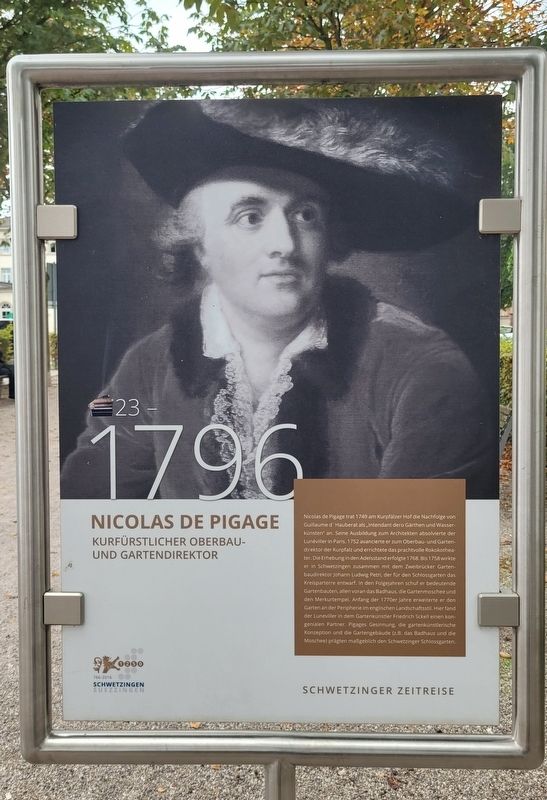
Nicolas de Pigage
1723-1796
Photographed by James Hulse, September 23, 2024
1. Nicolas de Pigage Marker

Kurfürstlicher Oberbau- und Gartendirektor
Nicolas de Pigage trat 1749 am Kurpfälzer Hof die Nachfolge von Guillaume d'Hauberat als „Intendant dero Gärthen und Wasserkünsten" an. Seine Ausbildung zum Architekten absolvierte der Lunéviller in Paris. 1752 avancierte er zum Oberbau- und Gartendirektor der Kurpfalz und errichtete das prachtvolle Rokokotheater. Die Erhebung in den Adelsstand erfolgte 1768, Bis 1758 wirkte er in Schwetzingen zusammen mit dem Zweibrücker Gartenbaudirektor Johann Ludwig Petri, der für den Schlossgarten das Kreisparterre entwarf. In den Folgejahren schuf er bedeutende Gartenbauten, allen voran das Badhaus, die Gartenmoschee und den Merkurtempel. Anfang der 1770er Jahre erweiterte er den Garten an der Peripherie im englischen Landschaftsstil. Hier fand der Luneviller in dem Gartenkünstler Friedrich Sckell einen kongenialen Partner. Pigages Gesinnung, die gartenkünstlerische Konzeption und die Gartengebäude (z. B. das Badhaus und die Moschee) prägten maßgeblich den Schwetzinger Schlossgarten.
Electoral Chief Building and Garden Director
In 1749, Nicolas de Pigage succeeded Guillaume d'Hauberat as "Intendant of the Gardens and Water Features" at the Electorate of the Palatinate court. The Lunéviller completed his training as an architect in Paris. In 1752 he was promoted to the position of chief building and garden director of the Electorate of the Palatinate and built the magnificent Rococo theater. He was raised to the nobility in 1768. Until 1758 he worked in Schwetzingen together with the Zweibrücken gardening director Johann Ludwig Petri, who designed the circular parterre for the palace garden. In the following years he created important garden buildings, most notably the bathhouse, the garden mosque and the Mercury Temple. In the early
this page online
Erected by Schwetzinger Zeitreise.
Topics. This historical marker is listed in this topic list: Horticulture & Forestry. A significant historical year for this entry is 1749.
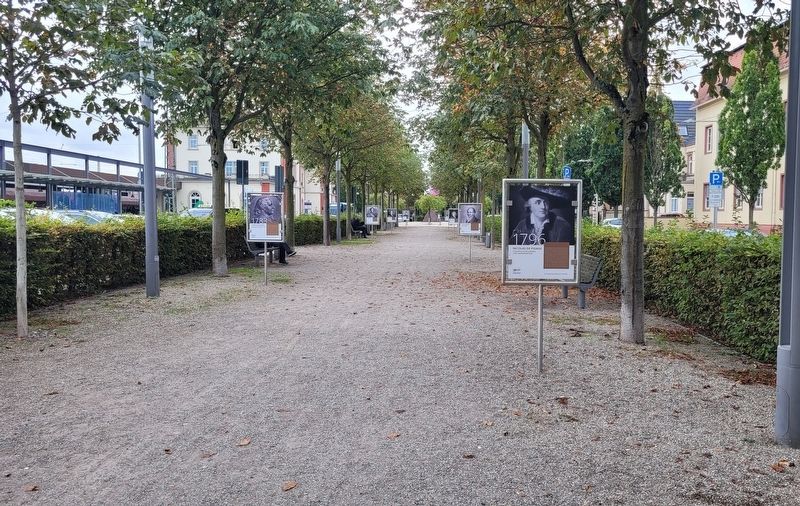
Location. 49° 23.053′ N, 8° 34.662′ E. Marker is in Schwetzingen, Baden-Württemberg, in Rhein-Neckar-Kreis. It is in Rheinau. It is on Bahnhofanlage just south of Carl-Theodor-Straße. The marker is located in a small park with a group of 28 panel markers on the west side of the transportation center. Touch for map. Marker is at or near this postal address: Bahnhofanlage 2-4, Schwetzingen BW 68723, Germany. Touch for directions.

Regionally, this marker is on the German Upper Rhine. Globally, it is in Europe, the European Union, Atlantic Europe, Central Europe, the Schengen Area, Western Europe, and the Western World. Historically,
Photographed by James Hulse, September 23, 2024
2. The Nicolas de Pigage Marker is on the right side of the markers
Other nearby markers. At least 8 other markers are within walking distance of this marker: Friedrich Ludwig von Sckell (here, next to this marker); Christian Mayer (here, next to this marker); Johann Jakob Hemmer (a few steps from this marker); Maximilian I Joseph (a few steps from this marker); Christian Cannabich (a few steps from this marker); Johann Stamitz* (a few steps from this marker); Stéphanie de Beauharnais (a few steps from this marker); Elisabeth Auguste (a few steps from this marker). Touch for a list and map of all markers in Schwetzingen.
More about this marker. There is a non-related marker attached on the other side of the post.
Also see . . . Nicolas de Pigage. Wikipedia
Nicolas de Pigage (3 August 1723 – 30 July 1796) was a French builder. Pigage was born in Lunéville. His father was a stonemason. In 1743 he began his studies at the École Militaire, changing to the Académie Royale d'Architecture after only one year studying under Jacques-François Blondel. Elector Karl Theodor summoned him to his court in Mannheim and in 1752 he became the Oberbaudirector.(Submitted on October 27, 2024, by James Hulse of Medina, Texas.)
Credits. This page was last revised on October 27, 2024. It was originally submitted on October 27, 2024, by James Hulse of Medina, Texas. This page has been viewed 114 times since then and 13 times this year. Photos: 1, 2. submitted on October 27, 2024, by James Hulse of Medina, Texas.
