Rheinau in Schwetzingen in Rhein-Neckar-Kreis, Baden-Württemberg, Germany — Central Europe
Friedrich Ludwig von Sckell
1750-1823
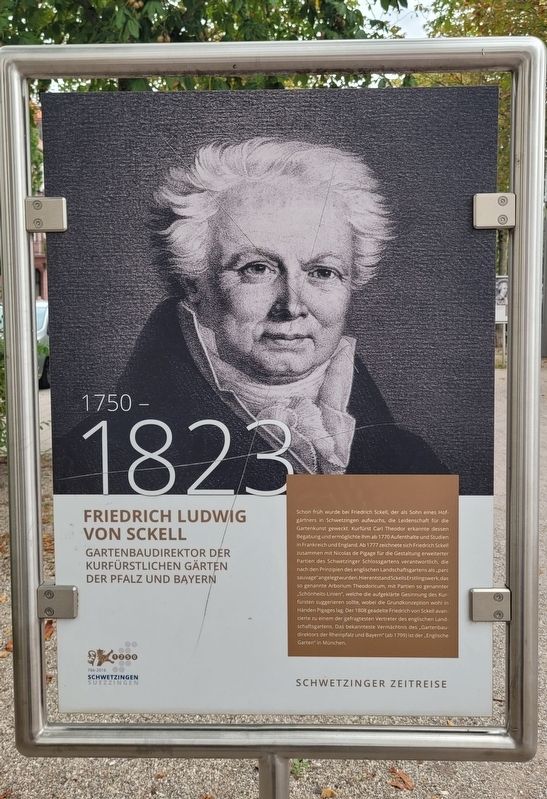
Photographed by James Hulse, September 23, 2024
1. Friedrich Ludwig von Sckell Marker

Gartenbaudirektor der Kurfürstlichen Gärten der Pfalz und Bayern
Schon früh wurde bei Friedrich Sckell, der als Sohn eines Hofgärtners in Schwetzingen aufwuchs, die Leidenschaft für die Gartenkunst geweckt. Kurfürst Carl Theodor erkannte dessen Begabung und ermöglichte ihm ab 1770 Aufenthalte und Studien in Frankreich und England. Ab 1777 zeichnete sich Friedrich Sckell zusammen mit Nicolas de Pigage für die Gestaltung erweiterter Partien des Schwetzinger Schlossgartens verantwortlich, die nach den Prinzipien des englischen Landschaftsgartens als „parc sauvage” angelegtwurden. Hierentstand Sckells Erstlingswerk, das so genannte Arborium Theodoricum, mit Partien so genannter „Schönheits-Linien", welche die aufgeklärte Gesinnung des Kurfürsten suggerieren sollte, wobei die Grundkonzeption wohl in Händen Pigages lag. Der 1808 geadelte Friedrich von Sckell avancierte zu einem der gefragtesten Vertreter des englischen Landschaftsgartens. Das bekannteste Vermächtnis des „Gartenbaudirektors der Rheinpfalz und Bayern" (ab 1799) ist der „Englische Garten" in München.
Horticultural Director of the Electoral Gardens of the Palatinate and Bavaria
Friedrich Sckell, who grew up in Schwetzingen as the son of a court gardener, developed a passion for gardening at an early age. Elector Carl Theodor recognized his talent and, from 1770, enabled him to stay and study in France and England. From 1777, Friedrich Sckell, together with Nicolas de Pigage, was responsible for the design of extended sections of the Schwetzingen palace gardens, which were laid out as a "wild park" according to the principles of the English landscape garden. This is where Sckell's first work, the so-called Arborium Theodoricum, was created, with sections of so-called "beauty lines" that were intended to
this page online
Erected by Schwetzinger Zeitreise.
Topics. This historical marker is listed in this topic list: Horticulture & Forestry. A significant historical year for this entry is 1770.
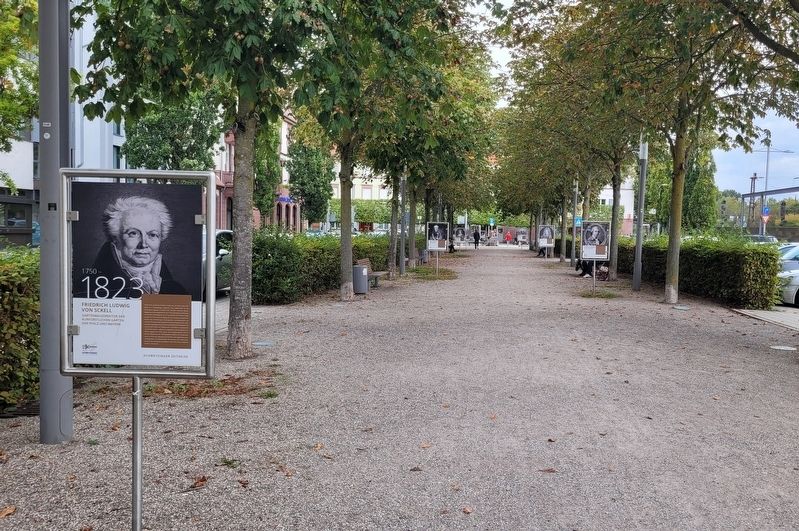
Location. 49° 23.051′ N, 8° 34.663′ E. Marker is in Schwetzingen, Baden-Württemberg, in Rhein-Neckar-Kreis. It is in Rheinau. It is on Bahnhofanlage just south of Carl-Theodor-Straße. The marker is located in a small park with a group of 28 panel markers on the west side of the transportation center. Touch for map. Marker is at or near this postal address: Bahnhofanlage 2-4, Schwetzingen BW 68723, Germany. Touch for directions.

Regionally, this marker is on the German Upper Rhine. Globally, it is in Europe, the European Union, Atlantic Europe, Central Europe, the Schengen Area,
Photographed by James Hulse, September 23, 2024
2. The view of the Friedrich Ludwig von Sckell Marker along the park pathway
Other nearby markers. At least 8 other markers are within walking distance of this marker: Nicolas de Pigage (here, next to this marker); Christian Mayer (here, next to this marker); Johann Jakob Hemmer (here, next to this marker); Maximilian I Joseph (a few steps from this marker); Stéphanie de Beauharnais (a few steps from this marker); Christian Cannabich (a few steps from this marker); Johann Stamitz* (a few steps from this marker); Elisabeth Auguste (a few steps from this marker). Touch for a list and map of all markers in Schwetzingen.
More about this marker. There is a non-related marker attached on the other side of the post.
Also see . . . Friedrich Ludwig von Sckell. Wikipedia
Friedrich Ludwig von Sckell (13 September 1750, in Weilburg – 24 February 1823, in Munich) was a German landscape gardener from Weilburg an der Lahn. He is regarded as the founder of the English gardens in Germany, which he introduced to the German experts with his writings on garden design. His manner of grouping and choice of plants is still used to an extent in German landscaping today.(Submitted on October 27, 2024, by James Hulse of Medina, Texas.)
Credits. This page was last revised on October 27, 2024. It was originally submitted on October 27, 2024, by James Hulse of Medina, Texas. This page has been viewed 174 times since then and 33 times this year. Photos: 1, 2. submitted on October 27, 2024, by James Hulse of Medina, Texas.
