Rheinau in Schwetzingen in Rhein-Neckar-Kreis, Baden-Württemberg, Germany — Central Europe
Leopold I.
1790-1852
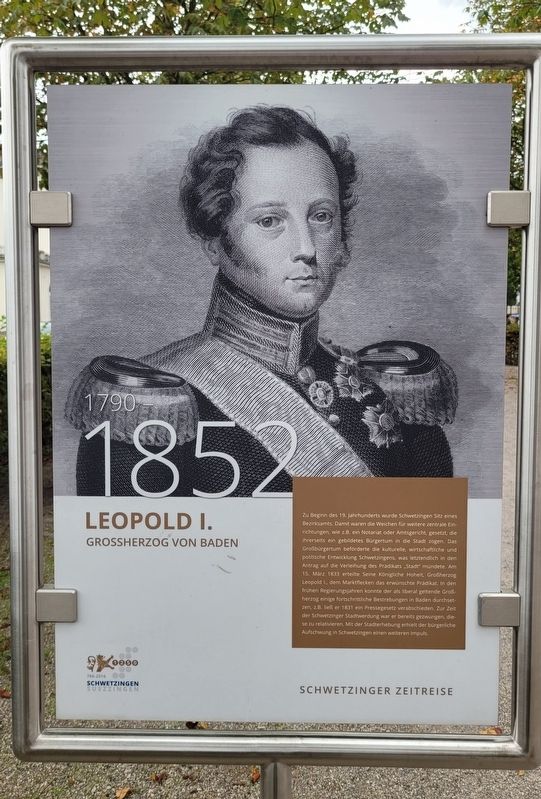
Photographed by James Hulse, September 23, 2024
1. Leopold I. Marker

Grossherzog von Baden
Zu Beginn des 19. Jahrhunderts wurde Schwetzingen Sitz eines Bezirksamts. Damit waren die Weichen für weitere zentrale Einrichtungen, wie z.B. ein Notariat oder Amtsgericht, gesetzt, die ihrerseits ein gebildetes Bürgertum in die Stadt zogen. Das Großbürgertum beförderte die kulturelle, wirtschaftliche und politische Entwicklung Schwetzingens, was letztendlich in den Antrag auf die Verleihung des Prädikats „Stadt" mündete. Am 15. März 1833 erteilte Seine Königliche Hoheit, Großherzog Leopold I., dem Marktflecken das erwünschte Prädikat. In den frühen Regierungsjahren konnte der als liberal geltende Großherzog einige fortschrittliche Bestrebungen in Baden durchsetzen, z.B. ließ er 1831 ein Pressegesetz verabschieden. Zur Zeit der Schwetzinger Stadtwerdung war er bereits gezwungen, diese zu relativieren. Mit der Stadterhebung erhielt der bürgerliche Aufschwung in Schwetzingen einen weiteren Impuls.
Grand Duke of Baden
At the beginning of the 19th century, Schwetzingen became the seat of a district office. This set the stage for further central institutions, such as a notary office or a district court, which in turn attracted an educated bourgeoisie to the city. The affluent bourgeoisie promoted the cultural, economic, and political development of Schwetzingen, ultimately leading to the application for the designation of "city." On March 15, 1833, His Royal Highness, Grand Duke Leopold I, granted the desired title to the market town. In the early years of his reign, the liberal Grand Duke was able to implement some progressive initiatives in Baden, for example, he enacted a press law in 1831. By the time of Schwetzingen's elevation to city status, he was already forced to qualify these efforts. With the city's elevation, the civic revival in
this page online
Erected by Schwetzinger Zeitreise.
Topics. This historical marker is listed in this topic list: Government & Politics. A significant historical date for this entry is March 15, 1833.
Location. 49° 23.04′ N, 8° 34.671′ E. Marker is in Schwetzingen, Baden-Württemberg, in Rhein-Neckar-Kreis. It is in Rheinau. It is on Bahnhofanlage just south of Carl-Theodor-Straße. The marker is located in a small park with a group of 28 panel markers on the west side of the transportation center. Touch for map. Marker is at or near this postal address: Bahnhofanlage 4, Schwetzingen BW 68723, Germany. Touch for directions.

Regionally, this marker is on the German Upper Rhine. Globally, it is in Europe, the European Union, Atlantic Europe, Central Europe, the Schengen Area, Western Europe, and the Western World. Historically, it finds itself in what was once the Roman Empire, the Holy Roman Empire, and the former West Germany.
Other nearby markers. At least 8 other markers are within walking distance of this marker: Friedrich I. (here, next to this marker); Karl Friedrich Schimper (a few steps from this
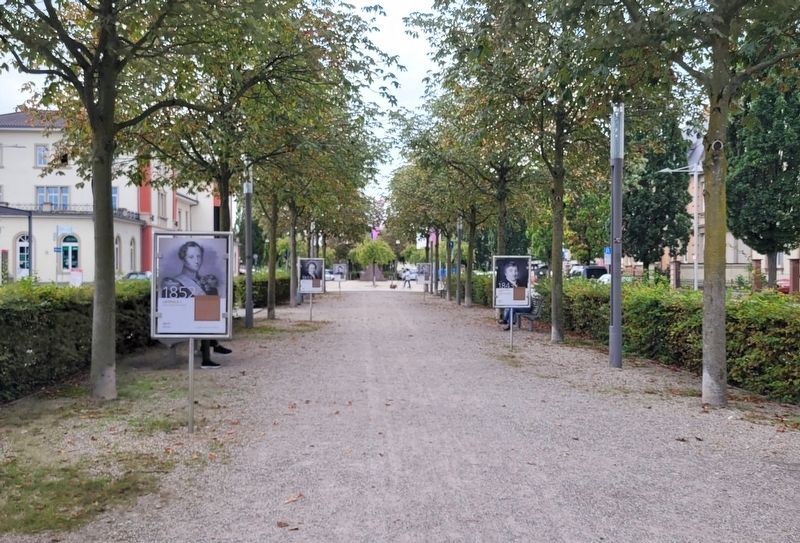
Photographed by James Hulse, September 23, 2024
2. The Leopold I. Marker is on the left side of the markers
More about this marker. There is a non-related marker attached on the other side of the post.
Also see . . . Leopold, Grand Duke of Baden. Wikipedia
Although a younger child, Leopold was the first son of Margrave Karl Friederich of Baden by his second, morganatic wife, Louise Karoline Geyer von Geyersberg. Since Luise Karoline was not of equal birth with the Margrave, the marriage was deemed morganatic and the resulting children were perceived as incapable of inheriting their father's dynastic status or the sovereign rights of the Zähringen House of Baden. Luise Karoline and her children were given the titles of baron and baroness, in 1796 count or countess von Hochberg.(Submitted on October 29, 2024, by James Hulse of Medina, Texas.)
Credits. This page was last revised on October 29, 2024. It was originally submitted on October 28, 2024, by James Hulse of Medina, Texas. This page has been viewed 114 times since then and 18 times this year. Photos: 1, 2. submitted on October 29, 2024, by James Hulse of Medina, Texas.
