Greenville in Greenville County, South Carolina — The American South (South Atlantic)
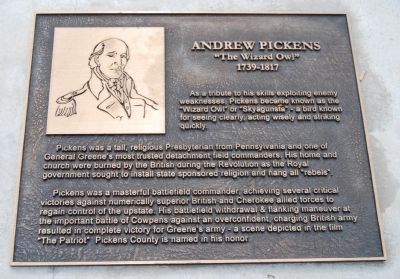
Andrew Pickens
"The Wizard Owl"
| — | 1739 - 1817 | — |
Photographed by Brian Scott, August 24, 2008
1. Andrew Pickens Marker
As a tribute to his skills exploiting enemy weaknesses, Pickens became known as the "Wizard Owl" or "Skyagunsta" - a bird known for seeing clearly, acting wisely and striking quickly.
Pickens was a tall, religious Presbyterian from Pennsylvania and one of General Greene's most trusted detachment field commanders. His home and church were burned by the British during the Revolution as the Royal government sought to install state sponsored religion and hang all "rebels."
Pickens was a masterful battlefield commander, achieving several critical victories against numerically superior British and Cherokee allied forces to regain control of the upstate. His battlefield withdrawal & flanking maneuver at the important battle of Cowpens against an overconfident, charging British army resulted in complete victory for Greene's army - a scene depicted in the film "The Patriot." Pickens County is named in his honor.
Erected 2006.
Topics. This historical marker is listed in these topic lists: Patriots & Patriotism • War, US Revolutionary.
Location. Marker has been permanently removed. It was located near
this page online
We have been informed that this marker is no longer there and will not be replaced. This page is an archival view of what was.
Regionally, this marker was in Upstate. It was also in the American South, specifically in the Deep South, in Appalachia, and specifically in Southern Appalachia. Globally, it was in North America, the Western Hemisphere, the Western World, and the Anglosphere. Historically, it found itself in what was once the original Cherokee Nation, the territory of the Mississippian Culture, one of the original Thirteen Colonies, one of the Confederate States of America, and the Antebellum South.

Photographed by Brian Scott, August 24, 2008
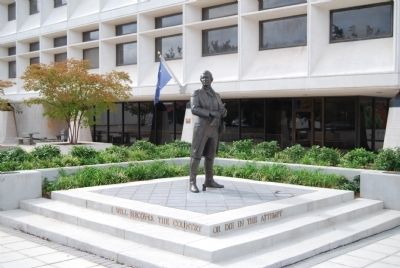
2. Nathanael Greene Park
The marker is located at the left end of the bench surrounding Greene.
Other nearby markers. At least 8 other markers are within walking distance of this location: Harper Plaza (within shouting distance of this marker); Roger Craft Peace Plaza (within shouting distance of this marker); Spirit of Freedom (within shouting distance of this marker); City of Greenville 9-11 Memorial (within shouting distance of this marker); Chamber of Commerce Building (about 400 feet away, measured in a direct line); Nick Strange (about 400 feet away); Joel Roberts Poinsett (about 500 feet away); Wyche Pavilion (about 500 feet away). Touch for a list and map of all markers in Greenville.
Other markers no longer nearby. Greenville's General (was here, next to this marker but has been permanently removed); Francis Marion (was here, next to this marker but has been permanently removed); Thomas Sumter (was here, next to this marker but has been permanently removed); Old Glory (was a few steps from this marker but has been permanently removed); The South Carolina Flag (was a few steps from this marker but has been permanently removed); Guilford Courthouse Flag (was a few steps from this marker but has been permanently
Fort Hill Collection, Clemson, South Carolina
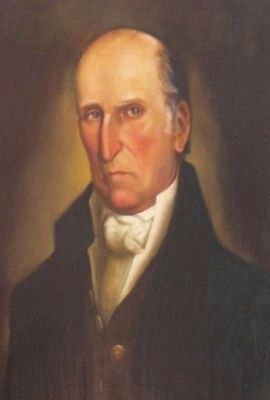
3. Brig. Gen. Andrew Pickens (1739–1817)
U.S. House of Representatives (1793-1795)
More about this marker. The marker and adjacent Nathanael Greene statue were removed as part of the Greenville News Building demolition in 2017 and plaza renovation
Also see . . .
1. Andrew Pickens. Andrew Pickens (September 13, 1739 – August 11, 1817) was a militia leader in the American Revolution and a member of the United States House of Representatives from South Carolina. (Submitted on August 28, 2008, by Brian Scott of Anderson, South Carolina.)
2. Nathanael Greene. Nathanael Greene (August 7, 1742 – June 19, 1786) was a major general of the Continental Army in the American Revolutionary War. (Submitted on September 11, 2009, by Brian Scott of Anderson, South Carolina.)
3. Battle of Cowpens. The Battle of Cowpens (January 17, 1781) was a decisive victory by American Revolutionary forces under Brigadier General Daniel Morgan, in the Southern campaign of the American Revolutionary
Photographed by Brian Scott, November 28, 2008
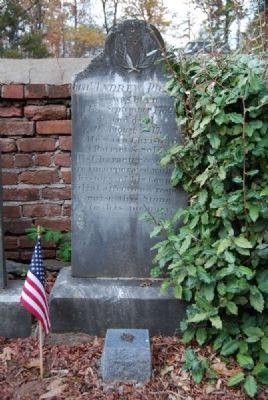
4. Andrew Pickens Tombstone -
Old Stone Church, Clemson, SC
Old Stone Church, Clemson, SC
4. The Patriot (2000 film). The Patriot is a 2000 epic war film directed by Roland Emmerich, written by Robert Rodat, and starring Mel Gibson and Heath Ledger. (Submitted on September 11, 2009, by Brian Scott of Anderson, South Carolina.)
5. Nathanael Greene statue finds new home in Greenville. An overview of the Greenville News Building and adjacent plaza and the relocation of the Nathanael Greene statue.
The building, which housed The News for nearly 50 years before the organization moved its headquarters feet away to East Broad and Falls streets in February, won’t be imploded, but instead will undergo a gradual demolition that will be complete in August.(Submitted on October 28, 2024, by Mark Parker of Hickory, North Carolina.)
The building has been prepped over the past two weeks with crews removing windows and furniture and determining what can be recycled, said Debra Nelson, a spokeswoman for Brasfield & Gorrie, the contractor handling the work.
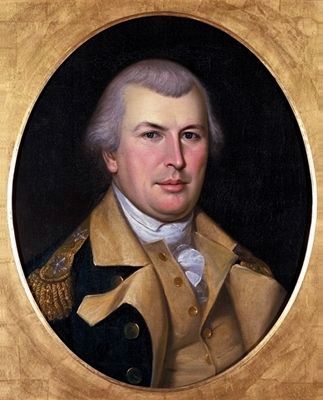
The demolition will clear the land for a new hotel, which as part of the 4-acre campus will include apartments, condos and office and retailspace. (Greenville News, 5/29/2017)Photographed by Charles Wilson Peale, 17835. Maj. Gen. Nathanael Greene
(1742–1786)
Additional commentary.
1. Andrew Pickens (1739-1817)
Pickens, Andrew, (grandfather of Francis Wilkinson Pickens), a Representative from South Carolina; born in Paxton, Bucks County, Pa., September 13, 1739; attended the common schools; moved with his parents to the Waxhaw settlement in South Carolina in 1752; served in the provincial militia in the campaign against the Cherokee Indians in 1760; entered the Revolutionary Army as captain of militia and attained the rank of brigadier general; commanded an expedition against the Cherokee Indians in 1782; member of the state house of representatives 1781-1794; one of the commissioners named to settle the boundary line between South Carolina and Georgia in 1787; member of the state constitutional convention in 1790; elected as an Anti-Administration candidate to the Third Congress (March 4, 1793-March 3, 1795); appointed major general of militia in 1795; unsuccessful candidate for election to the United States Senate in 1797; member of the state house of representatives
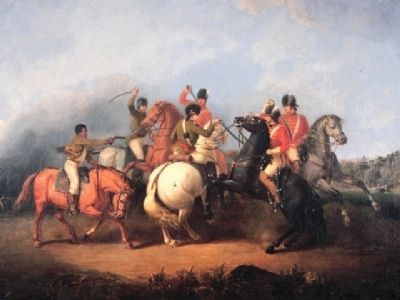
Photographed by William Ranney, 1845
6. Battle of Cowpens
— Submitted September 11, 2009, by Brian Scott of Anderson, South Carolina.
2. Andrew Pickens Helps to Defeat the British
When Sumter rode northward into the mountains to nurse his wounded shoulder, another gallant Carolinian came into the field. This was Andrew Pickens. He was a Scot, and as a child, came to the Waxhaws settlement with his parents. Before he was twenty-one he took part in the war against the Cher- okees. At the beginning of the Revolution he was made captain of a company of riflemen. He also sat in the legislature of the new state of South Carolina. In 1779 Pickens assembled a body of five hundred men from the upper country, led them across the Savannah River into Georgia, and defeated a much larger British force at Kettle Creek.
Pickens Refuses to Fight for the King — When the British captured Charles Town, Pickens retired to his plantation on the upper Saluda River, in the western highlands. With a great many others
Photographed by Brian Scott
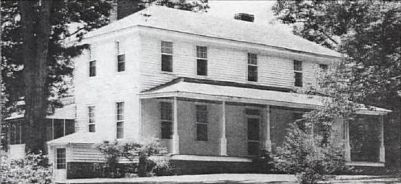
7. Hopewell -
Pickens' Plantation After the War
Now on the Campus of Clemson University
Pickens' Plantation After the War
Now on the Campus of Clemson University
Pickens usually wore a three-cornered hat. His hair was put smoothly back and was tied in a long roll called a queue. He wore heavy silver spurs, and the two large pistols in his holsters were bright with silver ornaments.
Battle of Cowpens — When Pickens left his home on the Saluda to
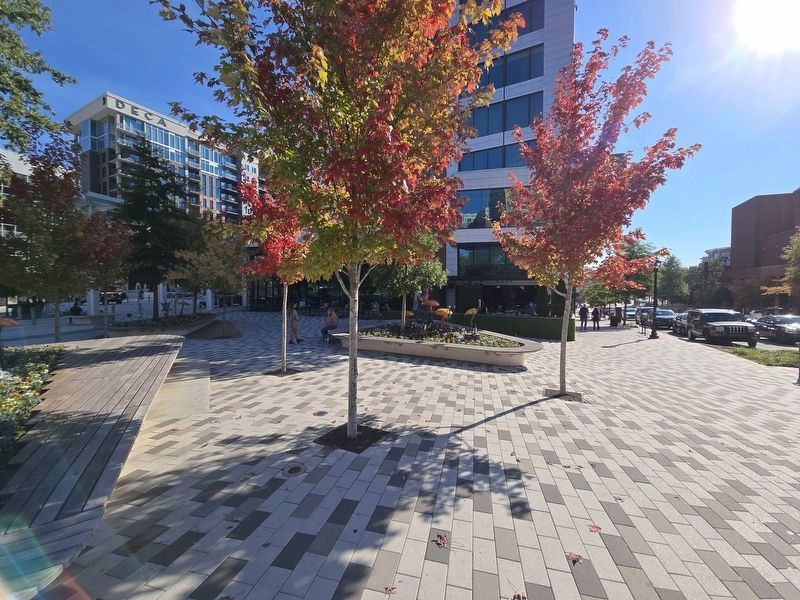
Photographed by Mark Parker, October 25, 2024
8. Southeast corner of Main and Broad
Location of the former Greenville News Building, which was demolished in 2017. The entire plaza with renovated with the relocation of the Nathanael Greene statue. Previous markers in the area were removed
Cunningham, of Georgia. Pickens himself moved around from soldier to soldier, giving his orders in a cool, quiet way. He told them that if the British cavalry advanced, every third man must fire, while two held their loaded rifles in reserve. They were advised to take careful aim and fire low. As a last word, Pickens told his men to mark for their first fire the officers of the advancing line. These would be known by the epaulettes or badges which they wore upon their arms or shoulders.
Tarleton's force amounted to about eleven hundred men. He had also two cannon. These opened fire upon the Americans, and at the same time the British foot soldiers and horsemen moved forward with a rush and with loud shouts. It was about the hour of sunrise and the red coats of the British soldiers were seen advancing through the smoke that was rolling from the mouths of the cannon. When the enemy had come within fifty yards of the line of Pickens, the latter gave the word. With a crash the mountain rifles roared out as if one great gun had been fired. Again and again the rifles spoke, and down fell the officers who were leading the British attack. Then the men who carried the muskets in Tarleton's line staggered. As they paused, another volley from the Americans stretched many of them upon the ground. The force of Tarleton's attack was broken. The American victory was really won among the trees in the front part of the field where the men of Pickens fought.
But Tarleton would not give up. He dashed forward on his horse and cheered his men. They fixed bayonets and advanced. Pickens and his men fell slowly back and the British met the American rear line near the top of the long slope. Then William Washington and James McCall swept around with thsir horsemen against the right end of the British line. At the same time Pickens led his men around to the left end of Tarleton's line. There at close range they poured in a deadly volley. The greater part of the British troops threw down their muskets and surrendered. A few of them escaped from the field, among them Tarleton himself. The victory of the Americans was complete. Eight hundred British soldiers were lost. Tarleton's bloody work was brought to a sudden end, and a staggering blow was given to Cornwallis himself. One third of his army was snatched from him by the victory at the Cowpens. The Carolina riflemen, led by Pickens, played the chief part in winning that glorious field.
Pickens Harasses the British — The defeat of Tarleton did not hold back Cornwallis from his northward march. He moved his forces into North Carolina and fought against Greene at Guilford Courthouse. Pickens and his mounted men gave Cornwallis much trouble in the movements that took place just before that battle. Then Pickens led his soldiers swiftly back again, for there was work to do in his own state. Rawdon's British force lay at Camden. Pickens swept down through the western highlands, and called the men of that region to seize their arms and enter the battle. They heard and answered his call. All the inhabitants of the upland
country were aroused, and they followed Pickens to Augusta, just beyond the Savannah, in Georgia. Lines were drawn around the town, and in June the British force located there surrendered to Pickens. (Source: The Mking of South Carolina by Henry Alexander White, pgs 145-149.)
— Submitted September 11, 2009, by Brian Scott of Anderson, South Carolina.
Credits. This page was last revised on October 31, 2024. It was originally submitted on August 28, 2008, by Brian Scott of Anderson, South Carolina. This page has been viewed 3,731 times since then and 98 times this year. Last updated on October 28, 2024, by Mark Parker of Hickory, North Carolina. Photos: 1, 2. submitted on August 28, 2008, by Brian Scott of Anderson, South Carolina. 3, 4, 5, 6, 7. submitted on September 11, 2009, by Brian Scott of Anderson, South Carolina. 8. submitted on October 28, 2024, by Mark Parker of Hickory, North Carolina. • Bernard Fisher was the editor who published this page.
