Rheinau in Schwetzingen in Rhein-Neckar-Kreis, Baden-Württemberg, Germany — Central Europe
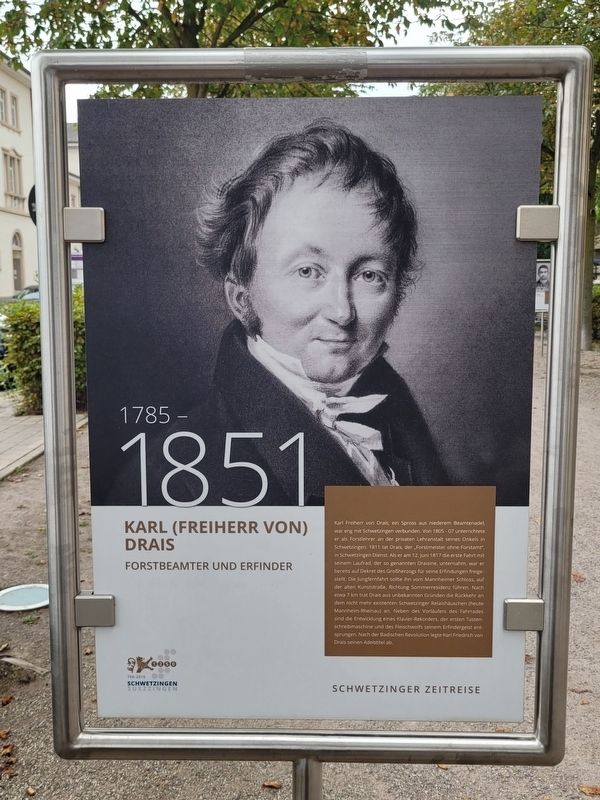
Karl (Freiherr Von) Drais
1785-1851
Photographed by James Hulse, September 23, 2024
1. Karl (Freiherr Von) Drais Marker

Forstbeamter und Erfinder
Karl Freiherr von Drais, ein Spross aus niederem Beamtenadel, war eng mit Schwetzingen verbunden. Von 1805-07 unterrichtete er als Forstlehrer an der privaten Lehranstalt seines Onkels in Schwetzingen. 1811 tat Drais, der „Forstmeister ohne Forstamt", in Schwetzingen Dienst. Als er am 12. Juni 1817 die erste Fahrt mit seinem Laufrad, der so genannten Draisine, unternahm, war er bereits auf Dekret des Großherzogs für seine Erfindungen freigestellt. Die Jungfernfahrt sollte ihn vom Mannheimer Schloss, auf der alten Kunststraße, Richtung Sommerresidenz führen. Nach etwa 7 km trat Drais aus unbekannten Gründen die Rückkehr an dem nicht mehr existenten Schwetzinger Relaishäuschen (heute Mannheim-Rheinau) an. Neben des Vorläufers des Fahrrades sind die Entwicklung eines Klavier-Rekorders, der ersten Tastenschreibmaschine und des Fleischwolfs seinem Erfindergeist entsprungen. Nach der Badischen Revolution legte Karl Friedrich von Drais seinen Adelstitel ab.
Forestry Officer and Inventor
Karl Freiherr von Drais, a scion of the lower civil service nobility,
this page online
Erected by Schwetzinger Zeitreise.
Topics. This historical marker is listed in this topic list: Horticulture & Forestry. A significant historical date for this entry is June 12, 1817.
Location. 49° 23.026′ N, 8° 34.675′ E. Marker is in Schwetzingen, Baden-Württemberg,
Photographed by James Hulse, September 23, 2024
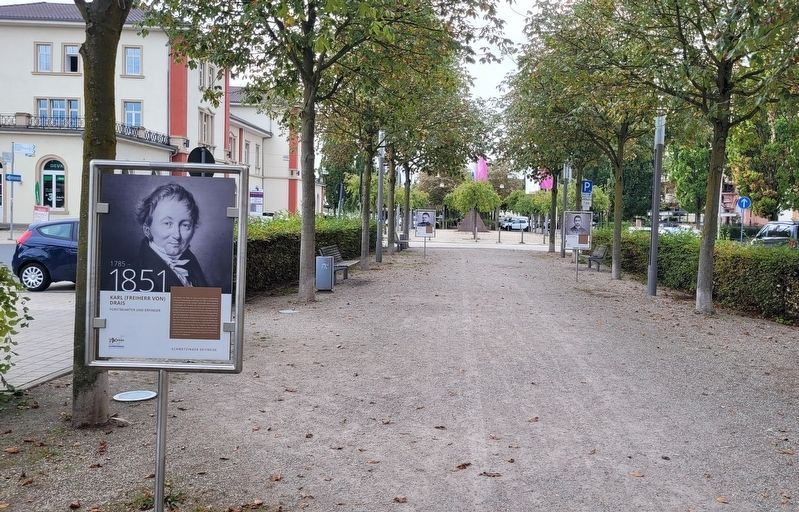
2. The view of the Karl (Freiherr Von) Drais Marker in the park

Regionally, this marker is on the German Upper Rhine. Globally, it is in Europe, the European Union, Atlantic Europe, Central Europe, the Schengen Area, Western Europe, and the Western World. Historically, it finds itself in what was once the Roman Empire, the Holy Roman Empire, and the former West Germany.
Other nearby markers. At least 8 other markers are within walking distance of this marker: Heinrich Tiedemann* (here, next to this marker); Louis Lingg (a few steps from this marker); Clementine Bassermann (a few steps from this marker); Hans Hirsch (a few steps from this marker); Max Bassermann (a few steps from this marker); Karl Friedrich Schimper (a few steps from this marker); Johann Michael Zeyher (a few steps from this marker); Leopold I. (within shouting distance of this marker). Touch for a list and map of all markers in Schwetzingen.
More about this marker. There is a non-related marker attached on the other side of the post.
Also see . . . Karl Drais. Wikipedia
Drais was a prolific inventor, who invented the Laufmaschine ("running machine"), also later called the velocipede, draisine (English) or draisienne (French), also nicknamed the hobby horse or dandy horse. This was his most popular and widely recognized invention. It incorporated the two-wheeler principle that is basic to the bicycle and motorcycle and was the beginning of mechanized personal transport. This was the earliest form of a bicycle, without pedals.(Submitted on October 29, 2024, by James Hulse of Medina, Texas.)
Credits. This page was last revised on October 29, 2024. It was originally submitted on October 28, 2024, by James Hulse of Medina, Texas. This page has been viewed 139 times since then and 27 times this year. Photos: 1, 2. submitted on October 29, 2024, by James Hulse of Medina, Texas.
