Cape Elizabeth in Cumberland County, Maine — The American Northeast (New England)
Battery 201 - Protecting Casco Bay
Photographed by Darren Jefferson Clay, October 18, 2024
1. Battery 201 - Protecting Casco Bay marker
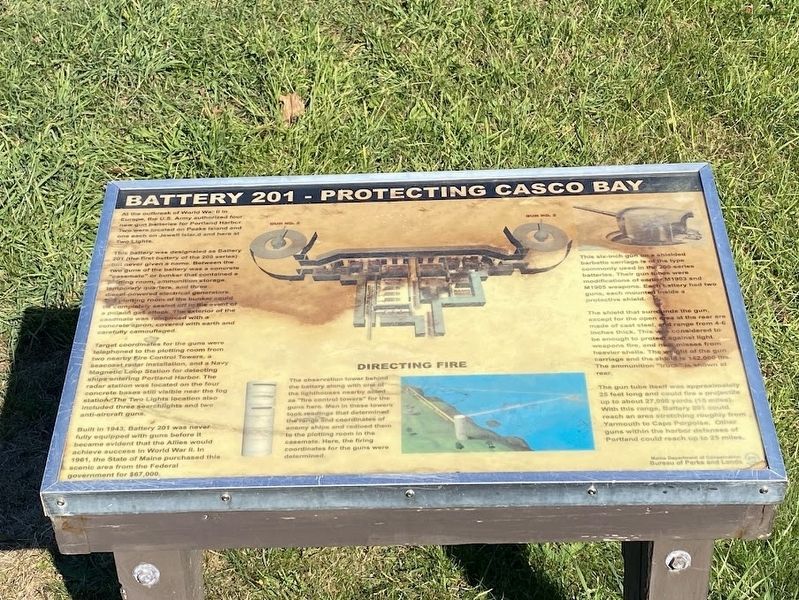
This battery was designated as Battery 201 (the first battery of the 200 series) but never given a name. Between the two guns of the battery was a concrete "casemate" or bunker that contained a planning room, ammunition storage, temporary quarters, and three diesel-powered electrical generators. The plotting room of the bunker could be completely sealed off in the event of a poison gas attack The exterior of the casemate was reinforced with a concrete apron, covered with earth and carefully camouflaged.
Target coordinates for the guns were telephoned to the plotting room from two nearby Fire Control Towers, a seacoast radar installation, and a Navy Magnetic Loop Station for detecting ships entering Portland Harbor. The radar station was located on the four concrete bases still visible near the fog station. The Two Lights location also included three searchlights and two anti-aircraft guns.
Built in 1943, Battery 201 was
this page online
This six-inch gun on a shielded barbetts carriage is of the type commonly used in the 200-series batteries. Their gun tubes were modifications of earlier M1003 and M1905 weapons. Each battery had two guns, each mounted inside a protective shield.
The shield that surrounds the gun, except for the open area at the rear are made of cast steel, and range from 4-6 Inches thick. This is considered to be enough to protect against light weapons fire, and he misses from heavier shells. The weight of the gun carriage and the shield is 142,000 lbs The ammunition "truck" is shown at rear.
The gun tube itself was approximately 25 feet long and could fire a projectile up to about 27,000 yards (15 miles). With this range, Battery 201 could reach an area stretching roughly from Yarmouth to Cape Porpoise. Other guns within the harbor defenses of Portland could reach up to 25 miles.
Directing Fire The observation tower behind the battery
Photographed by Darren Jefferson Clay, October 18, 2024
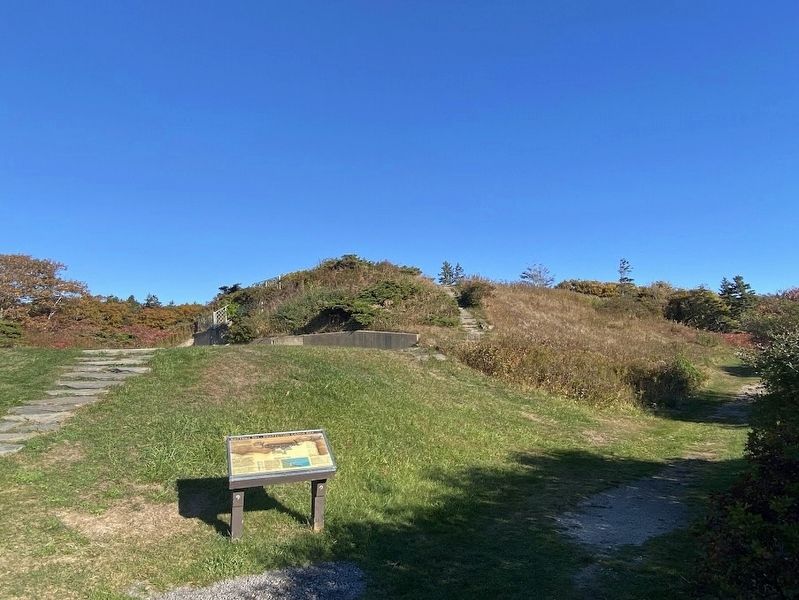
2. Battery 201 - Protecting Casco Bay marker
Topics. This historical marker is listed in this topic list: Forts and Castles.
Location. 43° 33.553′ N, 70° 12.302′ W. Marker is in Cape Elizabeth, Maine, in Cumberland County. It can be reached from Tower Drive, on the right when traveling north. Touch for map. Marker is at or near this postal address: 7 Tower Dr, Cape Elizabeth ME 04107, United States of America. Touch for directions.

Regionally, this marker is on Southern Maine Coast. It is also in the American Northeast, in New England, and on the Eastern Seaboard. Globally, it is in the North Atlantic Region, North America, the Western Hemisphere, the Western World, and the Anglosphere.
Other nearby markers. At least 8 other markers are within 5 miles of this marker, measured as the crow flies: Spurwink Church (approx. 2.7 miles
Photographed by Darren Jefferson Clay, October 18, 2024
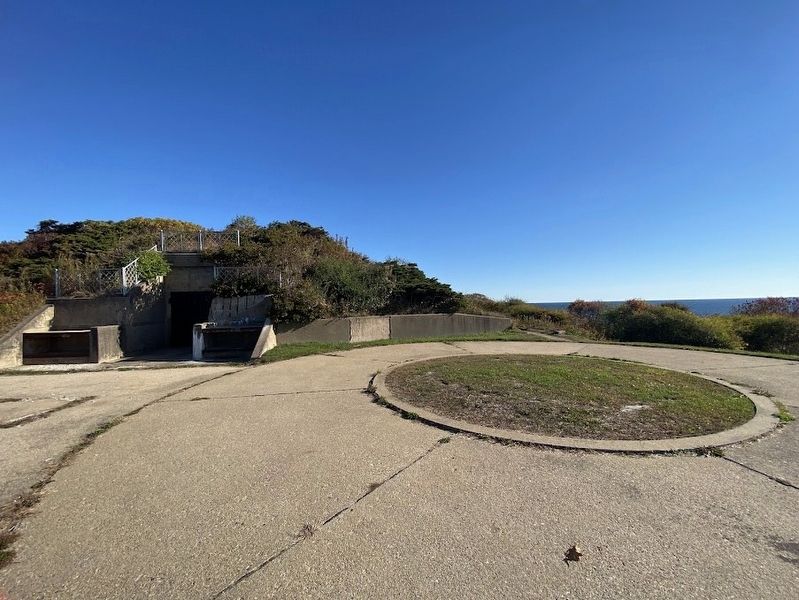
3. The view looking north to the casemate. Round circle in the foreground is the six-inch gun mount.
Credits. This page was last revised on November 4, 2024. It was originally submitted on October 28, 2024, by Darren Jefferson Clay of Duluth, Georgia. This page has been viewed 281 times since then and 104 times this year. Photos: 1, 2, 3. submitted on October 28, 2024, by Darren Jefferson Clay of Duluth, Georgia. • Bill Pfingsten was the editor who published this page.
