Rheinau in Schwetzingen in Rhein-Neckar-Kreis, Baden-Württemberg, Germany — Central Europe
Hans Hirsch
1891-1959
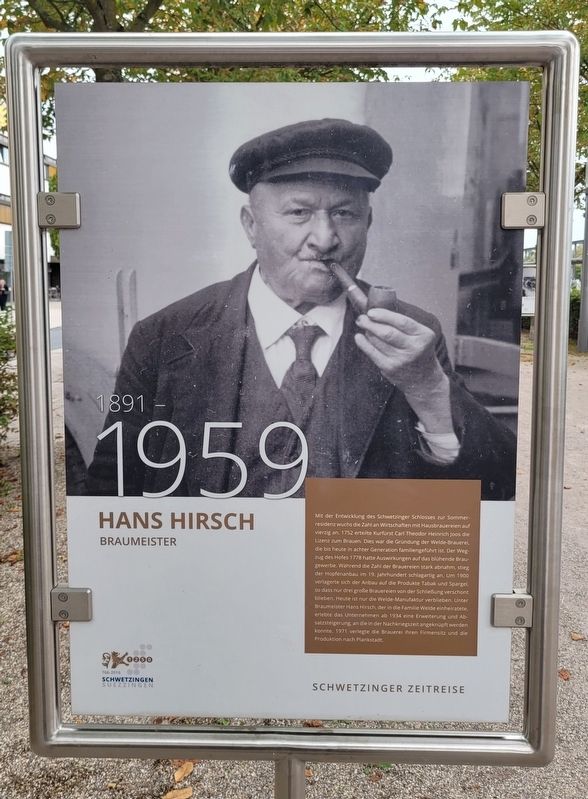
Photographed by James Hulse, September 23, 2024
1. Hans Hirsch Marker

Braumeister
Mit der Entwicklung des Schwetzinger Schlosses zur Sommerresidenz wuchs die Zahl an Wirtschaften mit Hausbrauereien auf vierzig an. 1752 erteilte Kurfürst Carl Theodor Heinrich Joos die Lizenz zum Brauen. Dies war die Gründung der Welde-Brauerei, die bis heute in achter Generation familiengeführt ist. Der Wegzug des Hofes 1778 hatte Auswirkungen auf das blühende Braugewerbe. Während die Zahl der Brauereien stark abnahm, stieg der Hopfenanbau im 19. Jahrhundert schlagartig an. Um 1900 verlagerte sich der Anbau auf die Produkte Tabak und Spargel, so dass nur drei große Brauereien von der Schließung verschont blieben. Heute ist nur die Welde-Manufaktur verblieben. Unter Braumeister Hans Hirsch, der in die Familie Welde einheiratete, erlebte das Unternehmen ab 1934 eine Erweiterung und Absatzsteigerung, an die in der Nachkriegszeit angeknüpft werden konnte. 1971 verlegte die Brauerei ihren Firmensitz und die Produktion nach Plankstadt.
Brewmaster
With the development of Schwetzingen Palace as a summer residence, the number of inns with in-house breweries grew to forty.
this page online
Erected by Schwetzinger Zeitreise.
Topics. This historical marker is listed in this topic list: Industry & Commerce. A significant historical year for this entry is 1752.
Location. 49° 23.022′ N, 8° 34.672′ E. Marker is in Schwetzingen, Baden-Württemberg, in Rhein-Neckar-Kreis. It is in Rheinau. It is on Bahnhofanlage just south of Carl-Theodor-Straße. The marker is located in a small park with

Photographed by James Hulse, September 23, 2024
2. The view of the Hans Hirsch Marker in the park

Regionally, this marker is on the German Upper Rhine. Globally, it is in Europe, the European Union, Atlantic Europe, Central Europe, the Schengen Area, Western Europe, and the Western World. Historically, it finds itself in what was once the Roman Empire, the Holy Roman Empire, and the former West Germany.
Other nearby markers. At least 8 other markers are within walking distance of this marker: Louis Lingg (here, next to this marker); Clementine Bassermann (here, next to this marker); Max Bassermann (here, next to this marker); Karl (Freiherr Von) Drais (a few steps from this marker); Heinrich Tiedemann* (a few steps from this marker); Karl Friedrich Schimper (a few steps from this marker); Johann Michael Zeyher (a few steps from this marker); Leopold I. (within shouting distance of this marker). Touch for a list and map of all markers in Schwetzingen.
More about this marker. There is a non-related marker attached on the other side of the post.
Credits. This page was last revised on October 30, 2024. It was originally submitted on October 28, 2024, by James Hulse of Medina, Texas. This page has been viewed 112 times since then and 9 times this year. Photos: 1, 2. submitted on October 30, 2024, by James Hulse of Medina, Texas.
