Muskogee in Muskogee County, Oklahoma — The American South (West South Central)
The First Baptist Church
Muskogee Oklahoma Historic Preservation Commission
Photographed by Cosmos Mariner, September 11, 2024
1. The First Baptist Church Marker
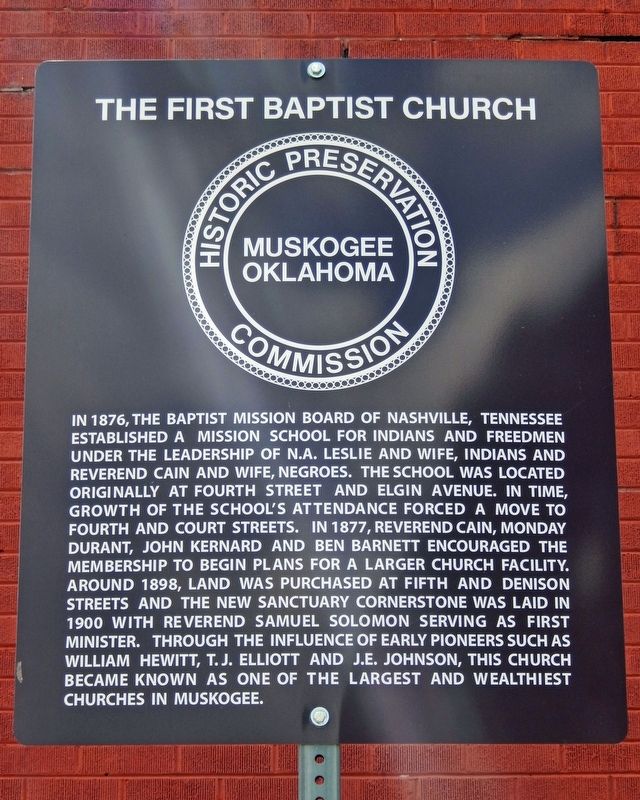
In 1876, the Baptist Mission Board of Nashville, Tennessee established a mission school for Indians and freedmen under the leadership of N.A. Leslie and wife, Indians and Reverend Cain and wife, negroes. The school was located originally at Fourth Street and Elgin Avenue. In time, growth of the school’s attendance forced a move to Fourth and Court Streets. In 1877, Reverend Cain, Monday Durant, John Kernard and Ben Barnett encouraged the membership to begin plans for a larger church facility. Around 1898, land was purchased at Fifth and Denison Streets and the new sanctuary cornerstone was laid in 1900 with Reverend Samuel Solomon serving as first minister. Through the influence of early pioneers such as William Hewitt, T.J. Elliott and J.E. Johnson, this church became known as one of the largest and wealthiest churches in Muskogee.
Erected by Muskogee Oklahoma Historic Preservation Commission.
Topics and series. This historical marker is listed in these topic lists: African Americans • Architecture • Religion & Religious Structures. In addition, it is included in the National Register of Historic Places (NRHP)
this page online
Location. 35° 45.144′ N, 95° 22.362′ W. Marker is in Muskogee, Oklahoma, in Muskogee County. It is at the intersection of Denison Street and North 5th Street, on the left when traveling west on Denison Street. The marker is located along the sidewalk on the north side of the First Missionary Baptist Church. Touch for map. Marker is at or near this postal address: 429 Denison Street, Muskogee OK 74401, United States of America. Touch for directions.

Regionally, this marker is in the Muscogee Nation, specifically in the Cherokee Nation, and in Northeast Oklahoma—Green Country. It is also in the American South, specifically on the prairies, and on the Southern Plains. Globally, it is in North America, the Western Hemisphere, the Western World, and the Anglosphere. Historically, it finds itself in what was once the territory of the Mississippian Culture and also the Louisiana Purchase.
Other nearby markers. At least 8 other markers are within walking distance of this marker: Severs Hotel (about 500 feet away, measured in a direct line); Grace Episcopal Church (about

Photographed by Cosmos Mariner, September 11, 2024
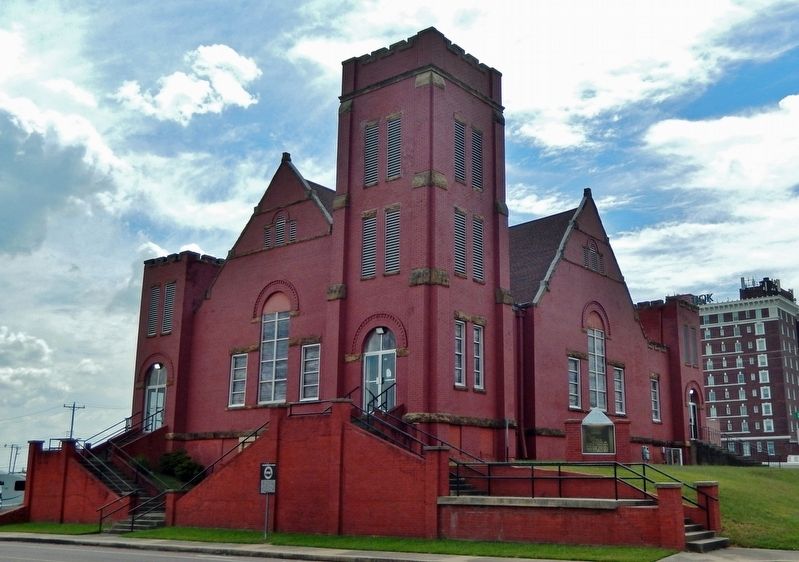
2. First Missionary Baptist Church (north elevation)
The marker is located along the sidewalk, near the northwest [right] corner of the church.
Regarding The First Baptist Church. National Register of Historic Places № 84003164.
From the National Register Nomination submitted 9/25/1984:
The First Baptist Church is a 1½-story, detached, religious building with raised basement. The building is square-shaped with gabled roof. The facade to rear portion has north-south orientation with an east-west oriented cross gable.The First Baptist Church is historically significant because: (1) it is the oldest Black Protestant church in Muskogee having been built in 1903, four years before Oklahoma statehood and (2) it is one of the two oldest buildings of any type which remain intact in the black community of Muskogee.
Membership peaked in the 1920s at approximately 700 members, one of the largest black congregations in Oklahoma. During the same
decade, the church hosted the annual National Baptist Convention, the largest black Baptist organization in the United States. During the depression of the 1930s, the church assumed an active role in providing food for the poor and unemployed by sponsoring a soup kitchen at the church.Photographed by Cosmos Mariner, September 11, 20243. First Missionary Baptist Church (northwest elevation)
Also see . . . First Baptist Church (Wikipedia).
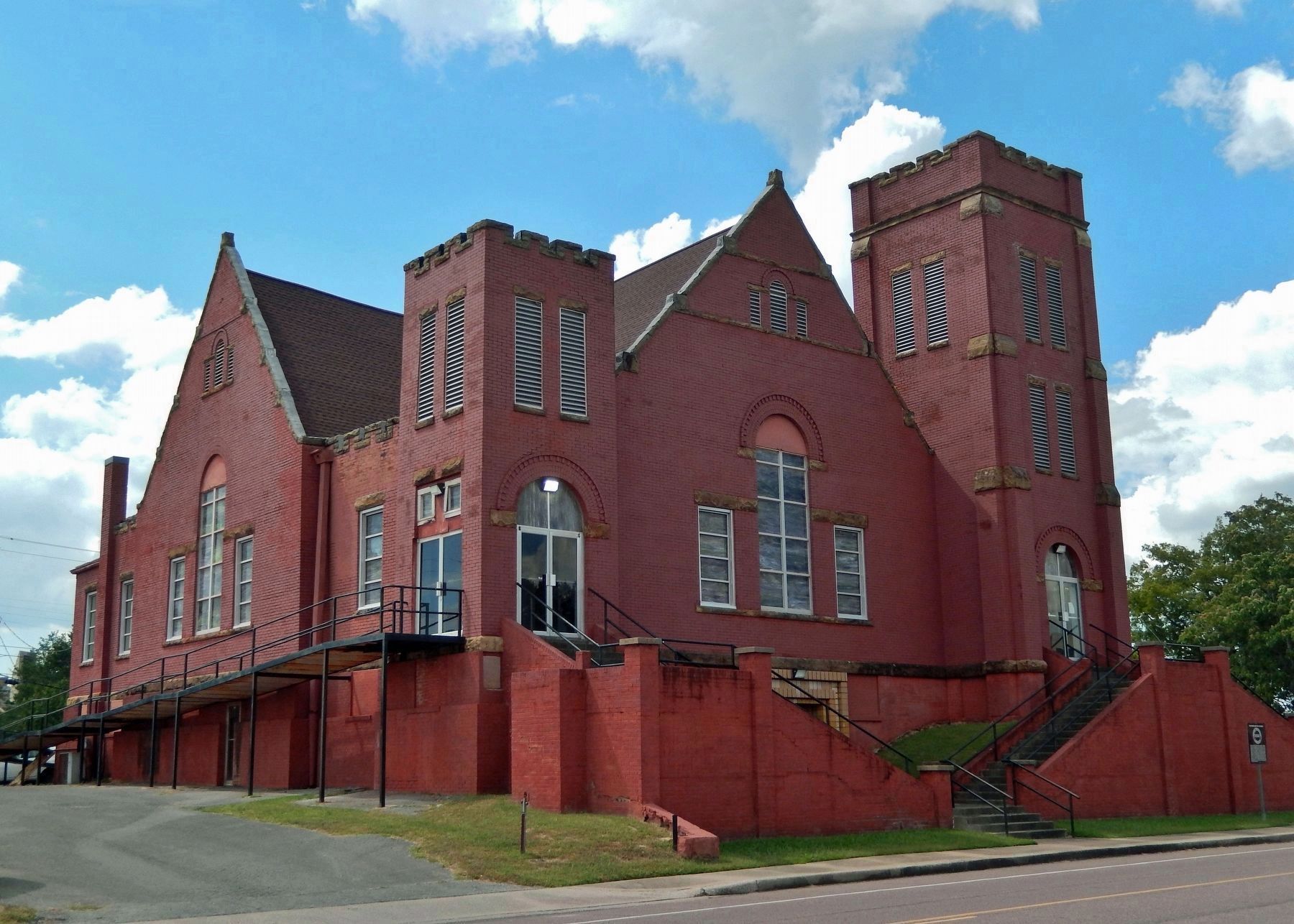
Excerpt: The church was completed in 1903 and was the first church building for the African-American population of Muskogee County. It was built in a Romanesque Revival style. It features two asymmetrical, crenelated towers and a steeply pitched gabled roof. The building is clad in two types of red brick. The two types of brick are separated by a rusticated limestone belt course. The building was listed on the National Register of Historic Places in 1984 for architectural significance and for its importance in local African-American history.(Submitted on October 29, 2024, by Cosmos Mariner of Cape Canaveral, Florida.)
Photographed by Cosmos Mariner, September 11, 2024
4. First Missionary Baptist Church (northeast elevation)
From the National Register Nomination: The facade, or north side, has two crenallated towers, one at either corner. The one on northwest corner is three story and the one on northeast corner is two story. Within each tower on facade side are round arched entryways, both of which contain double metal doors with glass lights. Each of the doors has two-paned transoms. The entryways, located on first floor above raised basement, are reached by stairwells partially enclosed with red brick walls adorned with pilasters. There is also a double door entry to basement in facade. It is located between the two main stairwells. The basement doors are metal with lights in the upper half and are framed with polychromatic brick laid in three rows. The gable end portion of the facade has a long rectangular opening with ten fixed panes. It is topped with a round arch which has miniature dentils. Flanking this center window are two 2/2 double-hung sash windows with rock-faced lintels and continuous sill running below all three windows. Above the main window arrangement in the gable end is a smaller replication of the larger band.
Credits. This page was last revised on July 15, 2025. It was originally submitted on October 28, 2024, by Cosmos Mariner of Cape Canaveral, Florida. This page has been viewed 371 times since then and 55 times this year. Photos: 1, 2, 3, 4. submitted on October 29, 2024, by Cosmos Mariner of Cape Canaveral, Florida.
