Downtown Halifax in Halifax Region, Nova Scotia — The Atlantic Provinces (North America)
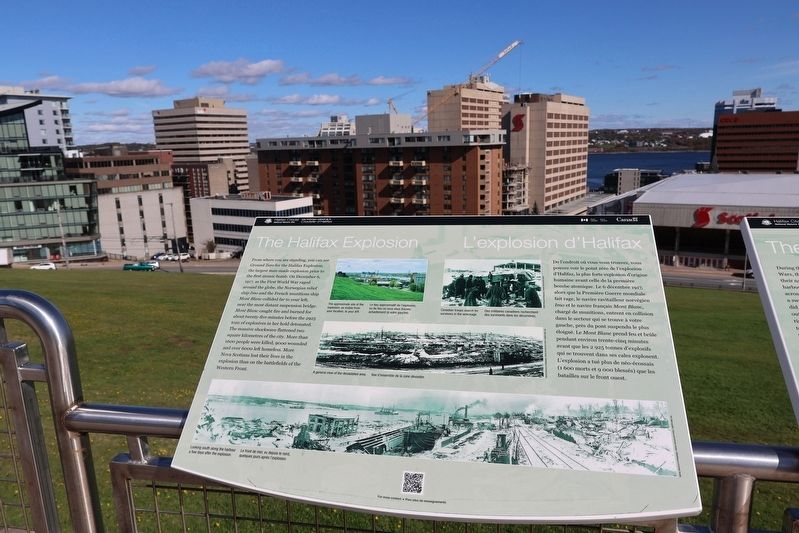
The Halifax Explosion/L'explosion d'Halifax
| — | Halifax Citadel National Park Site/Citadelle d'Halifax | — |
Photographed by Sandra Hughes Tidwell, October 15, 2024
1. The Halifax Explosion/L'explosion d'Halifax Marker
French:
De l'endroit ou` vous vous trovvez, vous pouvez voir le point ze`ro de l'explosion d'Halifax, la plus forte explosion d'origine humaine avant celle de la premie`re bombe atomique. Le 6 de`cembre 1917. alors que la Premie`re Guerre mondiale fait rage, le navire ravitailleur norve`gien Imo et le navire francasi Mont Blanc, charge` de munitions, entrent en collison dans le secteur qui se trouve a` votre gauche,
this page online
Captions:
English: The approximate site of the explosion, as visible from your location to your left.
French: Le Lieu approximatif de l'explosion, vu du lieu ou` vous trouvez actuellement (a` voter gauche).
English: Canadian search for survivors in the wreckage.
French: Des militaires canadiens recherchent des survvivants dans les de`combres.
English: A general view of the Devastated area.
French: Vue d'ensemble de la zone de`vaste`e.
English: Looking south along the harbor a few days after the explosion.
French: Le front de mer, vu depuis le nord, quelques jours apre`s i'explosion.
Topics. This historical marker is listed in these topic lists: Disasters • Forts and Castles • War, World I. A significant historical date for this entry is December 6, 1917.
Location. 44° 38.864′ N, 63° 34.74′ W. Marker is in Halifax,
Photographed by Sandra Hughes Tidwell, October 15, 2024
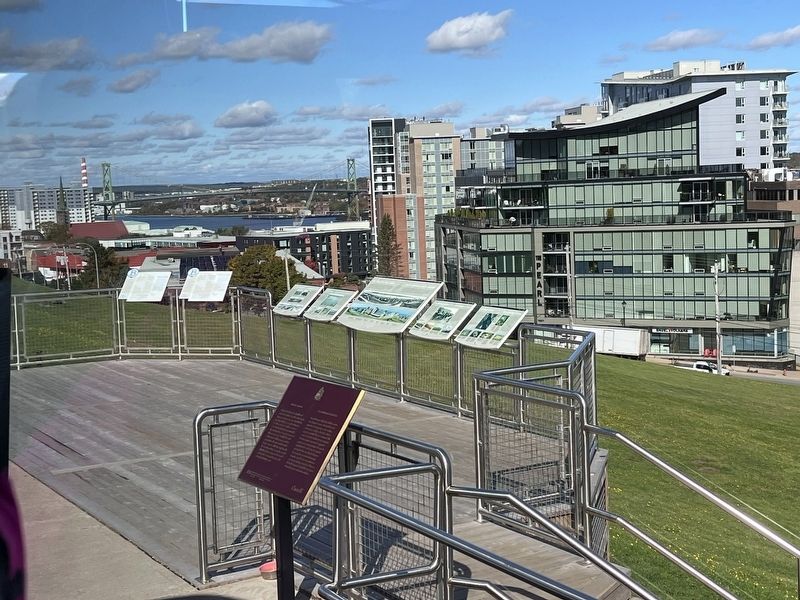
2. The Halifax Explosion/L'explosion d'Halifax Marker

Regionally, this marker is in the Maritimes and in Atlantic Canada. Globally, it is in the North Atlantic Region, North America, the Western Hemisphere, the Western World, and the Anglosphere. Historically, it finds itself in what was once a British colony, the Viceroyalty of New France, and Acadia.
Other nearby markers. At least 8 other markers are within walking distance of this marker: The Jamaican Maroons/Les Marrons de la Jamaique (here, next to this marker); The Saluting Battery / La batterie de salut (a few steps from this marker); The Convoys / Les convois (a few steps from this marker); Fortress Halifax/La forteresse Halifax (a few steps from this marker); The Acadians on George Island / Les Acadiens sur l'Île Georges (a few steps from this marker); Citadel Hill/La Colline de la Citadelle/Kuowaqe'jk (a few steps from this marker); Halifax Citadel / La Citadelle d’Halifax (within shouting distance of this marker); D-Day/Jour J (within shouting distance of this marker). Touch for a list and map of all markers in Halifax.
Also see . . . Cargo Ship Mont-Blanc and the Halifax Explosion: World’s Largest Man-made Accidental Explosio. SS Mont Blanc was a vessel commissioned by the French and was put into operation in the year 1899. The latter was initially launched by a Norwegian whaling conglomerate, the White Star Line in the year 1889 and was used in whale-tracking and hunting for most part of its maritime operations. At the time of the accident, the SS Imo was engaged with the Belgian Commission for Relief in Belgium operations (Submitted on October 29, 2024, by Sandra Hughes Tidwell of Killen, Alabama, USA.)
Credits. This page was last revised on December 6, 2024. It was originally submitted on October 29, 2024, by Sandra Hughes Tidwell of Killen, Alabama, USA. This page has been viewed 230 times since then and 37 times this year. Photos: 1, 2. submitted on October 29, 2024, by Sandra Hughes Tidwell of Killen, Alabama, USA. • Bill Pfingsten was the editor who published this page.
